In the War Room, Rick and Marty Lagina and Craig Tester discuss the results of the dye test conducted at the Money Pit. After pumping up to half a million gallons of seawater mixed with nontoxic red dye into borehole C-1, Gary Drayton spotted red-colored water seeping from the ground at Smith's Cove, water that tested positive for traces of the dye. The team agrees to pursue excavation beneath the 6,000-square-foot crane pad, believing it sits directly over the convergence point where the stone box drains merge into a flood tunnel leading to the Money Pit. Additional government permits and a cofferdam extension will be required. Meanwhile, the sinkhole that formed around borehole H-8 two weeks earlier has made that site too unstable to continue, and the team pivots to a new strategy: reaching the treasure vault through Shaft Six, the searcher tunnel originally dug in 1861.
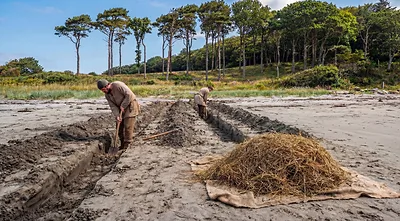
At Smith's Cove, Jack Begley, Gary Drayton, archaeologist Laird Niven, and heavy equipment operator Billy Gerhardt continue investigating the slipway structure first discovered by treasure hunter Gilbert Hedden in 1936. Gary finds another hand-forged iron object resembling a spear point near the base of the slipway, similar to one recovered four weeks earlier that was compared to a Roman pilum. As the full structure is exposed, Laird photographs and records every detail before the team begins carefully dismantling it. Searching the spoils from beneath the slipway, Gary then recovers a massive wrought iron hinge with what appears to be a square hole, found more than six feet deep below the seabed.
Rick gathers Jack, Alex Lagina, Peter Fornetti, and professional diver Tony Sampson in the War Room to review sonar data collected by the Centre for Geographic Sciences from the waters off Oak Island's southern shore. The scans revealed several anomalies, including a triangle-shaped rock formation that appears to point toward the Money Pit and a possible ship's anchor. Alex and Tony dive to investigate, with Peter handling surface communications and Jack standing by as backup. They confirm the triangular formation does point toward the Money Pit, but the suspected anchor proves to be natural rock. Captain Ryan Mosher maneuvers the barge in deteriorating weather conditions throughout the operation.
Rick and Marty also meet with professional surveyor Steve Guptill, who will compile more than a century of searcher maps and survey data into a single geo-referenced overlay. By layering records from different decades and using known shaft locations as reference points, Guptill aims to pinpoint the exact position of Shaft Six and its connecting tunnel to the original Money Pit. Dave Blankenship joins Rick and Marty at the Money Pit to brief the Irving Equipment team, including Vanessa Lucido, on preparing the site for the new excavation.
Marty, Alex, and historian Doug Crowell travel 20 miles north to the Ross Farm Museum in New Ross, Nova Scotia, to consult blacksmithing expert Carmen Legge about the Smith's Cove artifacts. Carmen identifies the previously found iron objects as crib spikes, used to join heavy timbers, and dates them to the mid-1600s. The wrought iron hinge, he concludes, is the oldest piece in the collection, dating easily to the early 1600s and predating the Money Pit's discovery in 1795 by nearly two centuries. He notes the hinge held something substantial, at least two to two-and-a-half inches thick. At the Mug and Anchor Pub in Mahone Bay, Marty shares Carmen's findings with Rick, Gary, and Dave, and the team grows increasingly confident that the slipway and its associated artifacts may be the work of original depositors rather than later searchers.