About This Artifact
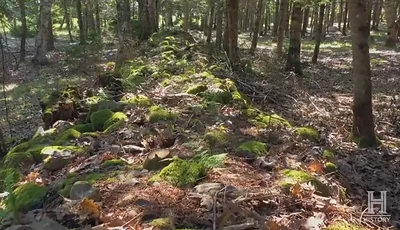
Charcoal and coal recovered from the stone road in the southeastern corner of the Oak Island swamp record burning activity tied to the road's construction and use. Material was found among the cobblestones of the road surface, within a buried firepit identified inside the pathway, and within a charcoal-rich burn layer with stones arranged in a circular pattern.
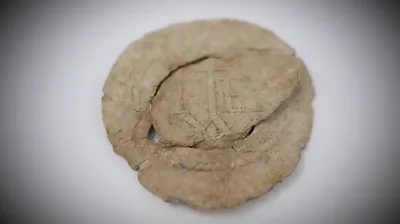
Archaeologist Miriam Amirault recovered a piece of coal from the road surface in Season 8 Episode 15. Dr. Ian Spooner subsequently analysed the sample and reported a sulphur content of 1.12 percent, well below the Nova Scotia average of three to four percent for native coal. Spooner classified the material as low-sulphur subbituminous A coal, a type not commonly found in the province but documented in European coalfields in Spain, eastern Europe, England, Scotland, and Wales. He cautioned that identifying the buyer of the coal would require archival research, since British or French operators could have sourced coal from any of these regions. Pollen and spore analysis was proposed at the time to establish both the precise age and the geographic origin of the sample. No broadcast results have followed.
The charcoal evidence is distinct from the coal. In Season 8 Episode 17 the team uncovered a buried firepit with red oxidation staining and charcoal within the pathway, interpreted by Dr. Aaron Taylor and Dr. Ian Spooner as evidence that workers built fires during the road's construction. In Season 8 Episode 25, Dr. Aaron Taylor and Miriam Amirault identified a charcoal-rich burn layer along the road with stones laid in a circular pattern, accompanied by coal and slag. Taylor described the feature as consistent with a hearth or forge and noted that the slag pointed to metalworking activity on the island well before 1795.
In Season 13 Episodes 4 and 5, the team explicitly linked charcoal recovered along the southeast-corner stone road to charcoal samples from the western swamp's cobble feature, describing the material as possibly Portuguese in origin and more than 500 years old. The southeast-corner samples themselves have not been independently radiocarbon-dated on broadcast, and the Portuguese attribution remains a working interpretation rather than a laboratory determination.
What the charcoal and coal together record is fire activity tied to the stone road. The coal points to a fuel source uncommon in Nova Scotia and present across several European coalfields. The on-site burning features indicate either construction fires, a hearth, or small-scale metalworking at the site.
Historical Context
Miriam Amirault, archaeologist; Dr. Ian Spooner, geologist; Dr. Aaron Taylor, archaeologist; Gary Drayton, metal detection expert; History Channel Seasons 8 and 13
Where It Was Found
Found at Southeast corner of the swamp, within and among the stones of the stone road, in a buried firepit inside the pathway, and within a charcoal-rich burn layer with stones laid in a circular pattern. Location: Oak Island, Nova Scotia, Canada.