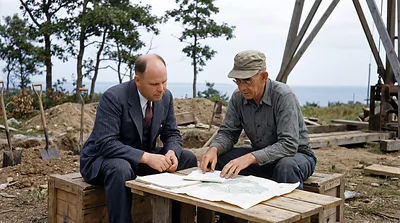
Terry Deveau, former president of the New England Antiquities Research Association, visits the swamp to inspect the massive stone road uncovered along its eastern border. His assessment carries weight: the feature is two to three courses thick, approximately six feet wide, and built to a standard consistent with cart track widths used across Europe for centuries. The construction technology, Deveau concludes, does not match French or British colonial roadbuilding practices seen in Nova Scotia over the last 400 years. In his view, the road speaks to a European building tradition from the 1500s or earlier, brought by people already familiar with stone road construction. Rick connects the observation to the ox shoes previously found along the pathway, envisioning a scenario in which a ship offloaded cargo to ox-drawn carts that carried heavy loads inland toward the Money Pit.
On Lot 25, metal detection expert Gary Drayton and Rick continue their supervised investigation of the Samuel Ball foundation under a heritage permit arranged by archaeologist Laird Niven. Gary recovers a large copper coin with green patina, estimating it dates to the 1730s or 1740s and possibly a British penny. A second target produces an ornate cane topper, riding crop topper, or military swagger stick topper bearing a crown and rose design that Gary considers consistent with 1700s English craftsmanship. Rick observes the emblem could predate Ball by a century and may be French, Portuguese, or English in origin. At the Research Center, Doug Crowell confirms the rose and crown as a symbol of the English monarchy dating to 1485 and Henry VII's victory in the Wars of the Roses, and notes the item appears gilded. In a War Room video conference, historian Sarah MacInnes of the Fortress of Louisbourg National Historic Site reviews photos of recent finds. She confirms the ox shoes match specimens in Louisbourg's archaeological collection, connecting them to the mid-18th-century French military compound where a large treasure went missing in the 1740s. The cane topper does not match any style in the collection, and Laird suggests the piece may be a lipstick cover. Alex Lagina asks whether any other finds have comparable objects at Louisbourg, prompting MacInnes to highlight the ox shoe connection.
At the Money Pit, Charles Barkhouse and geologist Terry Matheson oversee borehole BC-4, positioned to the northwest to continue tracking the tunnel horizon at roughly 87 feet. The core produces a surprise at 78 feet: a hand-hewn wood beam embedded in dense maroon till, showing cut edges and axe ridges with no visible saw marks. The unusual depth suggests a possible correlating shaft rather than a lateral tunnel. From 87 to 94 feet, embedded wood appears at what Terry identifies as the edge of the tunnel, with loose collapsed material squashed outward to the sides. In a separate War Room meeting, Craig Tester briefs Marty on the drilling status, confirming three wells have now hit the tunnel and presenting a carbon-14 date of 1648 to 1694 from the wood. Craig raises the possibility that the original Money Pit may lie further west than previously believed.
Back in the swamp, Rick joins Dr. Ian Spooner, Miriam Amirault, and Dr. Aaron Taylor as they extend the pathway excavation into the uplands, confirming people-placed rocks and stones transported from higher ground. A buried firepit with red staining and charcoal is uncovered within the pathway, evidence that workers built fires during the road's construction. Gary Drayton and Michael John then metal detect the spoils, recovering an irregular iron piece that Gary identifies as a possible handmade cart wheel bearing, pre-industrial in character, as well as a hand-forged rose head spike. Jack Begley confirms the spike closely matches one Michael found earlier in borehole OC-1 spoils from the Money Pit area, where a wooden tunnel dated to 1706, raising the prospect of a direct connection between the swamp pathway and the underground workings. Later that afternoon, Marty joins Aaron alongside Josh Ballard and John Winters of Gerhardt Property Improvement to continue the excavation, and Marty discovers a cut wooden stake lining the edge of the cobblestone feature. Aaron identifies it as a survey stake used to lay out the road before construction, and the team plans to carbon-date it.