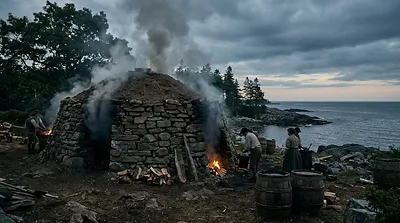
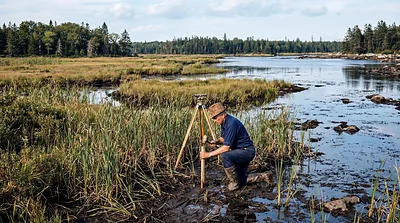
Along the eastern border of the swamp, metal detection expert Gary Drayton joins Rick Lagina and Craig Tester to sweep the stone pathway, pulling a square ox shoe nail from between the cobblestones. The find confirms the road was once used by draft animals hauling heavy loads in the direction of the Money Pit. While Billy Gerhardt excavates further sections of the feature, Dr. Aaron Taylor applies standard archaeological methodology, following the pathway as it continues to extend through the swamp. Archaeologist Miriam Amirault recovers a piece of coal from the road surface, a discovery Rick connects to the charcoal previously found at a suspected British military pine tar kiln on nearby Lot 15. The coal can be tested for its country of origin, offering a potential link between the two features. Later, with Dr. Ian Spooner, Craig, and Gary working the site, Rick spots the top of a wooden keg at the cultural level near the pathway. A second piece from a different barrel is found nearby, distinguished by its different radius. Ian calls the finds very important, and the team bags both pieces for chemical analysis, noting a possible connection to the keg barrel fragment a survivor pulled from the collapsed Money Pit in 1861.
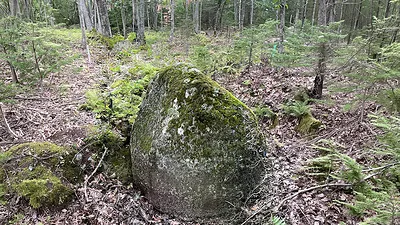
On Lot 10, Marty Lagina and Gary investigate Cone E, one of the five boulders forming Nolan's Cross, the megalithic formation first identified in 1981 by Fred Nolan. Earlier in the season, author and researcher Corjan Mol and researcher Chris Morford had suggested something of value might be located near the site, and the team subsequently uncovered a stone-paved feature resembling the swamp pathway. Gary detects multiple hand-forged ox shoe nails scattered around the base of the boulder, a concentration Marty finds telling. Maintaining a team of oxen represented considerable expense, and the pulling power required to move a boulder of that size suggests organized, well-funded activity. The presence of ox shoe nails at both the swamp pathway and Nolan's Cross raises the possibility that the same builders were responsible for both features.
In the Money Pit area, surveyor Steve Guptill presents a new drilling grid based on Doug Crowell's recently discovered 1898 diagram, which places the original Money Pit west of the Tupper Shaft rather than where the team has been concentrating. Borehole C-5, the first direct shot at the Money Pit this season, sits just five to six feet from C-1, where five years ago, on Charles Barkhouse's recommendation, the team found a large void at 170 feet containing gold-colored objects. Geologist Terry Matheson, Scott Barlow, and Charles Barkhouse oversee drilling. Deteriorated wood appears at 77.5 and 79 feet, followed by stacked timber with a piney smell at 89 feet. Terry identifies what appears to be a support beam. Rick insists on pushing to at least 118 feet, the depth where the Oak Island Association's Shaft Six collapsed in 1861 after tunneling into the Money Pit caused a catastrophic rush of seawater. After a hydraulic hose failure halts work and a north Atlantic storm rolls in, the team presses on, reaching the 118-foot target and encountering in situ material and possible tunnel evidence before moving to the next borehole.
Doug Crowell and Scott Barlow bring the swamp keg pieces to blacksmithing expert Carmen Legge at Northville Farm, some 50 miles north. Carmen identifies the two pieces as serving different purposes, one for dry goods, and dates the workmanship as far back as the 1400s into the mid-1700s, noting the construction is not of Nova Scotian origin. In the War Room, Dr. Ian Spooner presents his analysis of the swamp coal to the full team. The sulfur content registers at just 1.12 percent, well below Nova Scotia's average of three to four percent, classifying it as low sulfur subbituminous A coal, a type not commonly found in the province but present across European coalfields in Spain, eastern Europe, England, Scotland, and Wales. Jack Begley suggests the results could help identify who built the road, though Ian cautions that determining the buyer requires archival research, as British or French interests may have purchased coal from other regions. Pollen and spore analysis will take months but could establish both the coal's age and its precise geographic origin.