The bay stretches twenty-two kilometres long and sixteen and a half wide. Two hundred and eighty-eight square kilometres of sheltered water on the outer Atlantic coast of Nova Scotia. By some counts the bay holds three hundred and sixty-five islands, one for every day of the year. Oak Island sits in the western half, a short distance from the mainland at the head of an unnamed cove. The bay opens directly south onto the open Atlantic. The Nova Scotia Current runs along the coast from the northeast, while in summer the prevailing winds blow from the southwest. A vessel approaching under sail from the open ocean gets pushed into the bay's mouth and then sheltered by its islands. The geography is what made the place worth coming to. The names attached to it across four centuries are the history.
Sebetre and the Mi'kmaw Centuries
1 min
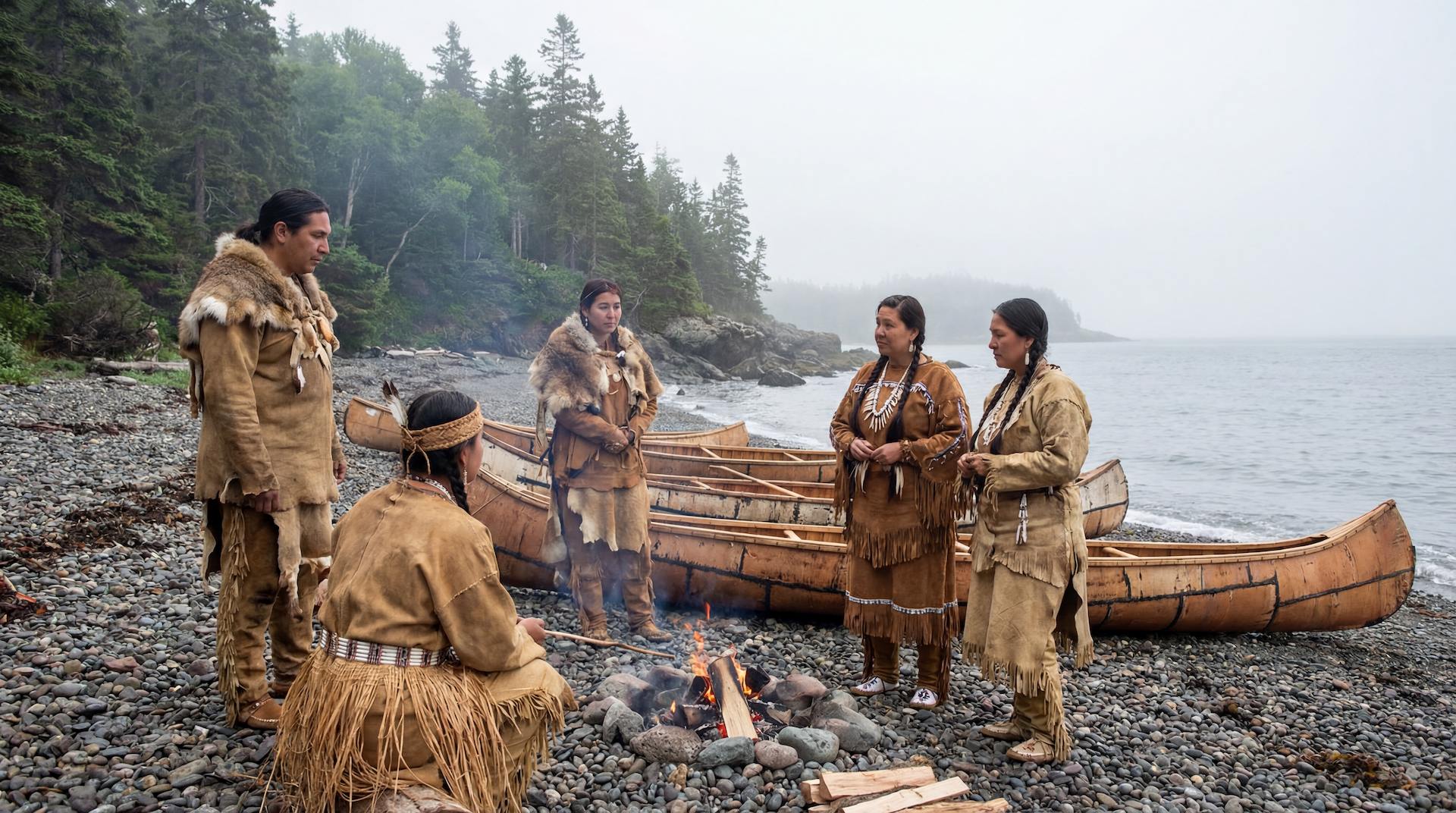
For at least thirteen thousand five hundred years, the bay was part of the territory known as Mi'kma'ki. The Mi'kmaq summered along its sheltered coves and wintered inland up the rivers that drain into it. Indian Point, on the bay's western shore just outside the present town of Mahone Bay, was a primary summer settlement. In the Mi'kmaw language the bay carried the name Sebetre, preserved in a French royal survey conducted between 1700 and 1703 and only recorded there. A second name, Mush-a-Mush, taken from the river that flows into the bay at its western end, survived in British records into the 1750s and remains in place names today.
In September 2021, archaeologists working in the Oak Island swamp recovered pieces of Mi'kmaw pottery. Carbon dating placed the fragments between five hundred and two thousand five hundred years old. Excavation in the swamp was halted, the find reported to Acadia First Nation, and the Mi'kmaw presence on Oak Island became part of the documented record rather than a matter of inference. The bay's first chapter is older than every European arrival put together.
 Mi'kmaq, the First Nation on Oak Island→
The Portuguese on the Charts
1 min
Two manuscript maps drawn by the Portuguese cartographer Bartolomeu Velho in 1560 and 1561 mark a double bay at 44.5 degrees north latitude on the coast of what would become Nova Scotia. The label reads Gulfo de Sam Bernaldo, the Gulf of Saint Bernard. A small island within that bay system is named, with explanation: I. barselonas por serem de Barcelos hos que as descobrirao, the Barcelona Islands because those who discovered them were from Barcelos. The two adjacent bays of close enough size and proximity at that latitude on the Nova Scotia coast are Mahone Bay and St. Margaret's Bay.
The colony Velho is recording was led by an Azorean family. In documents preserved in the Archives of Angra on the island of Terceira and rediscovered in the 1950s by the chief archivist Manuel C. Baptista de Lima, Diogo de Barcelos petitioned the Portuguese crown for the right to renew explorations begun by his father Pedro. Between 1521 and 1531 Diogo armed a ship at his own expense and reached the new lands. After his death his son Manoel and his nephew Marcos continued the voyages. Testimonies given before a notary in January 1568 describe expeditions in 1562 or 1563 and again in 1565 or 1566, with another planned for the spring of 1568. Across these voyages cattle, sheep, goats and pigs were put ashore on the island the Azoreans called Barcellona de Sam Bardão, where the animals bred without supervision. The colony's exact location within the Mahone Bay area is open, since the Velho maps show it on an island within a two-bay system that includes both Mahone Bay and St. Margaret's Bay.
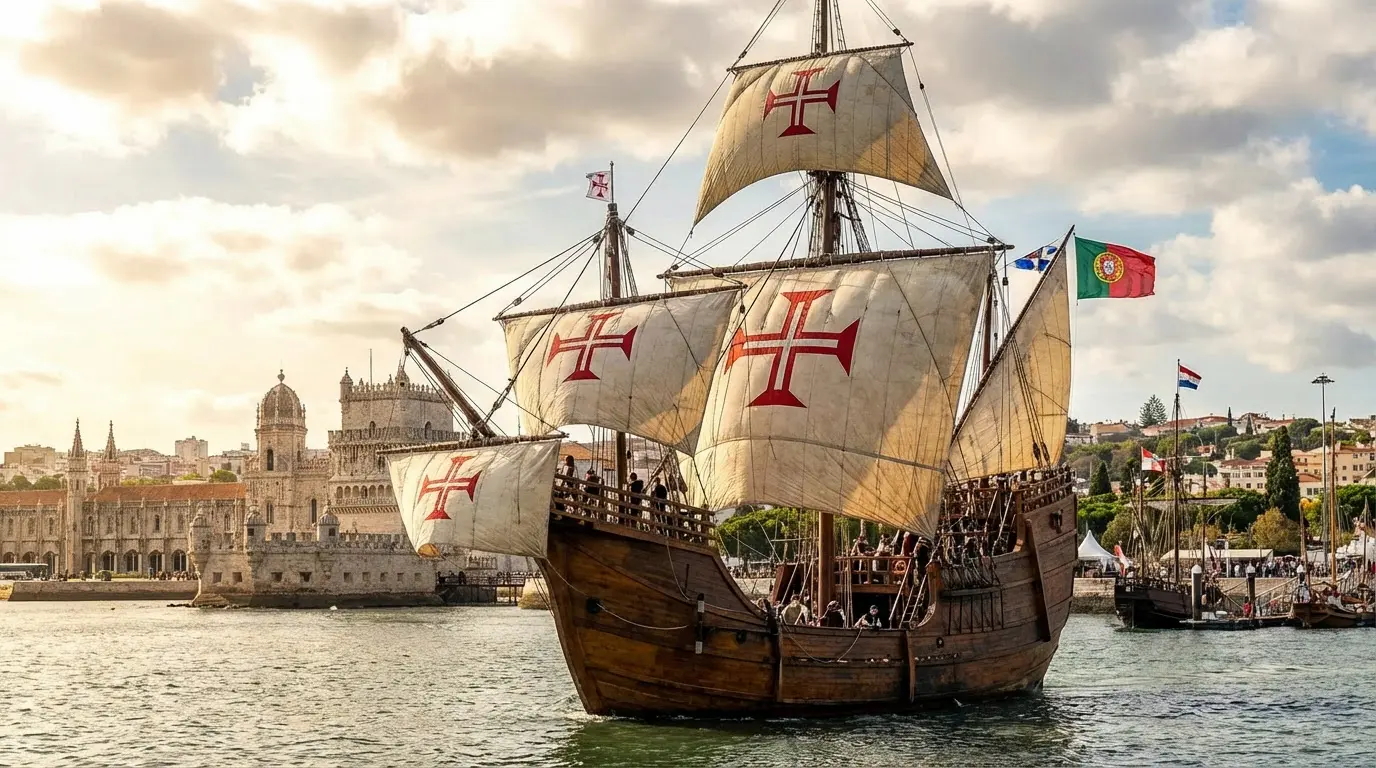 The Portuguese: The Order of Christ→
Les Martyrs
1 min
In 1604 Samuel de Champlain charted the south shore of what the French called Acadie. On his chart the islands of the bay carry the name Les Martyrs, the martyrs. No surviving document explains who was martyred, when, or by whom. The name appears on Champlain's map and on no other.
Mirligueche: The Knight of Malta's Coast
4 min
Sixty-five years of continuous French administrative attention to this bay began with one man's arrival in 1632. Isaac de Razilly came up the coast that September at the head of a fleet of three ships and three hundred men, commissioned by Cardinal Richelieu and the Company of New France to take possession of Acadia under the Treaty of Saint-Germain-en-Laye. The document confirming his appointment names him in full: Isaac de Razilly, Commandeur de l'ordre de St Jean de Jerusalem, a Knight of the Order of Malta. He landed at La Hève on 8 September 1632 and built Fort Sainte Marie-de-Grâce at the river's mouth. La Hève became the principal French harbour on the Nova Scotia coast.
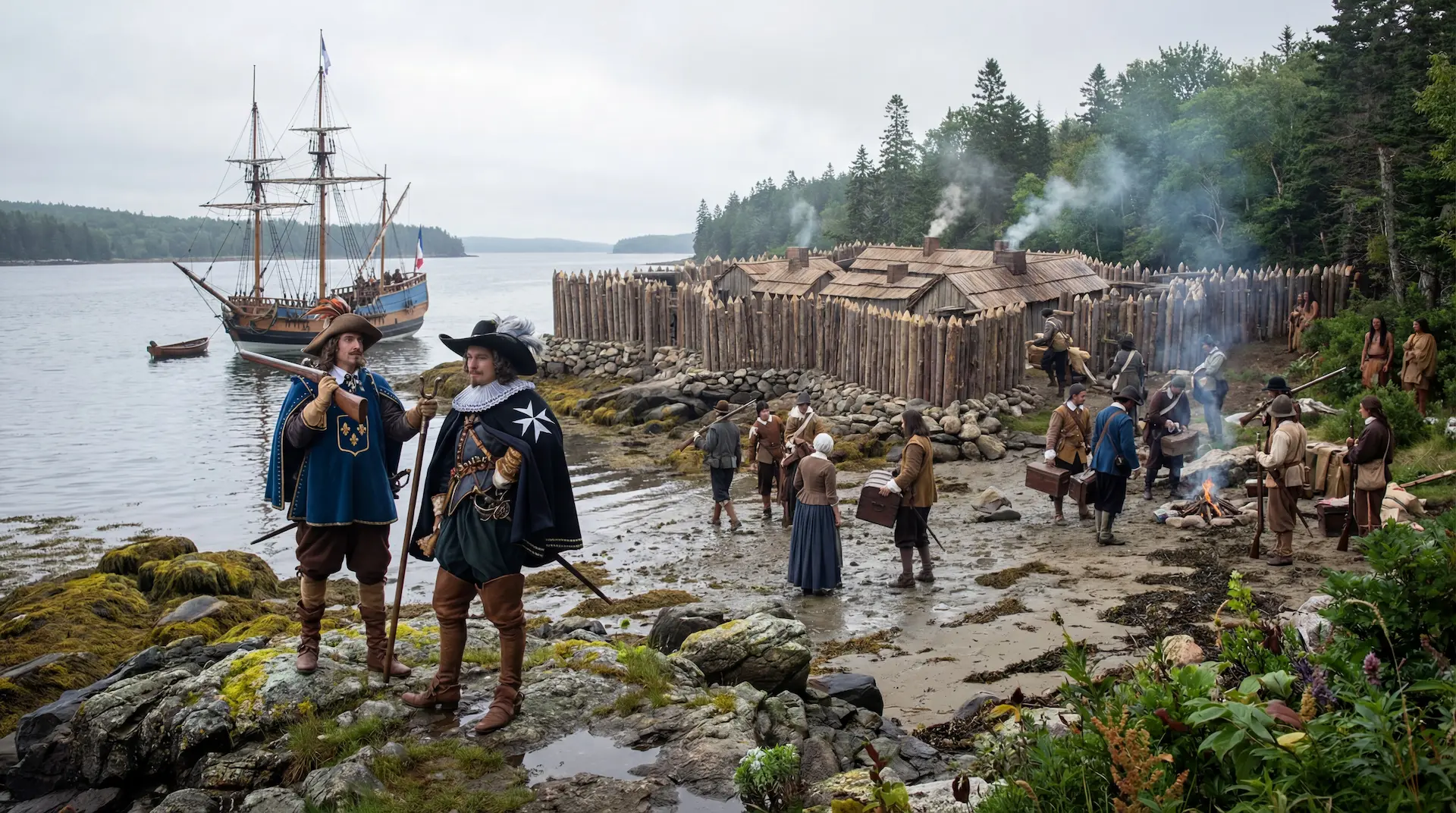 The Knights of Malta→
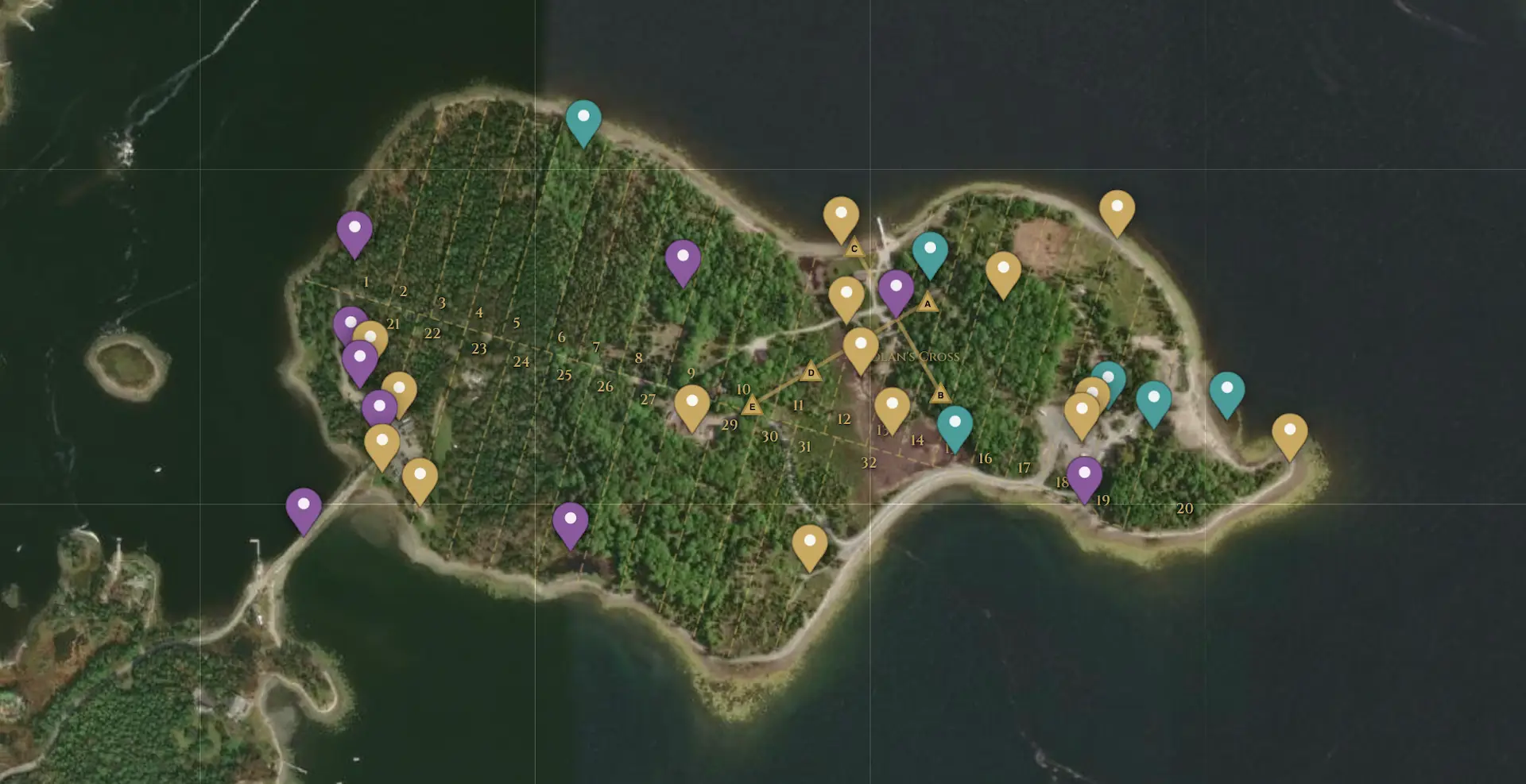
In the bay three leagues east-northeast of La Hève, a connected quarter-league portage away, lay Mirligueche. The name came from the Mi'kmaw word for the whitecaps that broke on its waves. To the French it carried no other label. Razilly's lieutenant Nicolas Denys, the future governor and author of the first sustained French description of Acadia, established a sawmill in the oak forests between La Hève and Mirligueche near present-day Riverport. He cut white oak in the form of planks and beams and exported it to France in Razilly's ships. The operation ran until Razilly's death in late 1635. When royal surveyors returned to the site in 1700, the abandoned mill pilings were still in the ground, rotted and worm-eaten but visible.
A second French presence at Mirligueche from the same period took root and stayed. The Petitpas and Bugaret family was established at the bay by the Company in roughly 1636, a date confirmed by the military engineer Lhermite's retrospective document of 1716, which records the family's continuous residence over the preceding eighty years. They were still there when the British founded Lunenburg in 1753.
A French naval list of fishing harbours compiled before 1685 includes a single line on the bay: La Baye de Mirliguefge qui a 10 L de large et 7 de profondeur. The bay of Mirligueche, ten leagues wide and seven deep. It is the only outer-coast harbour in the list given specific dimensions, the kind of attention paid to places the navy expected to use.
In 1684 Louis XIV ordered a royal survey of the Acadian coast for naval oak. The mission was led by a writer named Lalanne, with the Port Royal-born coastal pilot Abraham Boudrot aboard. Lalanne visited Mirligaiche three times. The only place in his journal where he records active interest in trees is at Mirligaiche. The map he produced of the bay was left deliberately blank, though he described islands on both sides in great quantity. A full timber report from the voyage exists somewhere in the French archives but has not yet been located. Lalanne's coast journal survives at Dalhousie Special Collections in Halifax.
In April 1695 a ministerial letter from Versailles to the Governor of Acadia instructed Captain Pierre Denys de Bonnaventure to leave gifts for the Indigenous communities of Chibouctou (Halifax), Miraraichy (Mirligueche), and beyond. The bay is named alongside Chibouctou as an administrative unit. Bonnaventure that summer made a full Acadian coast transit on the frigate l'Envieux, carrying detailed piloting instructions for La Hève and treating the south shore as patrolled French water.
Three years later, on 19 September 1698, the military engineer Lhermite, Major of Plaisance, embarked for La Hève and Port Rossignol on the Dragon. His coastal pilot was Abraham Boudrot, the same man who had piloted Lalanne to Mirligaiche fourteen years earlier. Lhermite's mission was a military survey in advance of proposed fortification. In the same weeks his report records English vessels. A New England ketch was at Mouscoudabout, at the house of the named Petitpas, the same family established at Mirligueche from 1636. Two Salem fishing vessels, l'Espervier and le Dauphin, were intercepted by Bonnaventure at Chibouctou. New England merchants were using the French Mirligueche network as a contact point.
Around 1699 a French coastal pilot's manuscript described the route from La Hève to Mirligueche in operational detail. The bearing is east-northeast, the distance three leagues. La Hève is named the finest harbour on the eastern coast, with the old fort site capable of sheltering vessels of fifty guns. Red oaks are noted at Mirligueche. The bay is described as good for vessels but with hazards requiring local knowledge.
The fullest French description of the bay survives in a royal survey conducted between 1700 and 1703. The Mi'kmaw name Sebetre is recorded. The portage from La Hève is given at a quarter-league. Two islands at the bay's eastern end are named: Meransecanby at the back of the bay and Causamancaby next to it. Eight settlers are proposed. The trees are described as predominantly oak, suitable for barrel staves. Denys's abandoned sawmill is noted northwest of the bay. One league north of the bay's head, at the Mi'kmaw place called Chichimichiouaty (Gold River), Philippe Mius d'Entremont's son is recorded as living.
By roughly 1702 or 1703, the bay was formally granted. The acting governor, under royal authority, conceded the seigneurial rights of Morlégueche (Mirligueche) to Bonnaventure. The neighbouring tract at Chichimichiouaty went to Villellieu the same year. La Hève, by accident of paperwork, fell inside a separate concession to Falaise. Lhermite was proposed as engineer to build a permanent fort at La Hève. The fort was never built.
This whole French administrative life took place without ever producing a published map. The Velho charts of 1560 had labelled the bay; Champlain in 1604 had labelled the islands. After that, for one hundred and thirty-two years, the French ran administrative correspondence, naval surveys, land grants, and a continuously inhabited family settlement on a bay that appears on no French map under any name.
Cap La Hève and Port Maltois
1 min
In September 1746, one hundred and fourteen years after Razilly built his fort, the largest expeditionary force France had ever sent to North America approached the Nova Scotia coast. The Duc d'Anville's fleet of sixty-four ships and eleven thousand men was tasked with retaking Louisbourg and Acadia. The expedition collapsed at Chibouctou. The fleet's ship journals across those weeks share one navigational reference point: Cap La Hève. At least six separate vessels recorded their position by bearings to Cap La Hève as they made the coast. The promontory Razilly had chosen for his fort in 1632 was still the anchor of French navigation on this shore.
On 8 November 1746 the frigate La Sirène, unable to join the main fleet at Annapolis, retreated to a harbour her captain called Port Maltois, Malta Port. From there she sent Mi'kmaw messengers to Chibouctou and to La Hève for intelligence. Port Maltois is Port Medway, one harbour southwest of Mahone Bay on the same outer coast. A British military map drawn in 1757 by Lieutenant Elias Meyer of the Royal American Regiment is titled "A chart of the coast of Nova Scotia from Port Maltois to Lawrence town" and confirms the identification. No surviving document explains why a Nova Scotia harbour on the same coast where a Knight of Malta built France's principal fort was called Malta Port. The name appears in French naval records of 1746 and a British military map of 1757, and is unexplained in any secondary source.
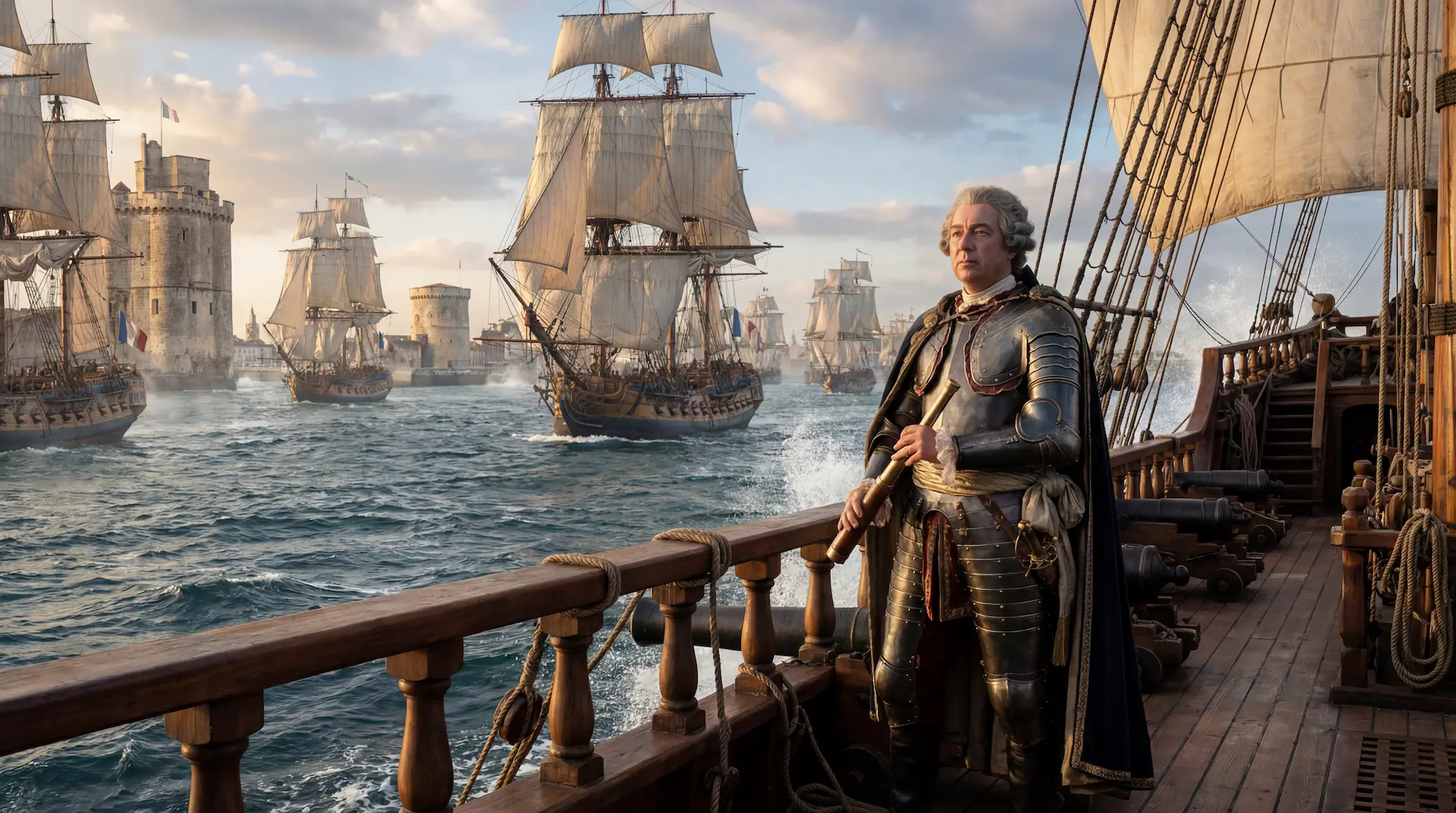 Duc d'Anville's Doomed Fleet→
Captain Durell's Chart, 1736
1 min
The Treaty of Utrecht in 1713 ceded peninsular Nova Scotia to the British. Acadie became Nova Scotia; the French capital at Port Royal became Annapolis Royal. Continuous French administration of Mirligueche outlasted the treaty by twenty years. A 1734 chart drawn by the New England cartographer Cyprian Southack still shows French inhabitants near the bay, naming La Have, Margaret's Bay, and Mallagash Harbour without any label for the inner bay between them.
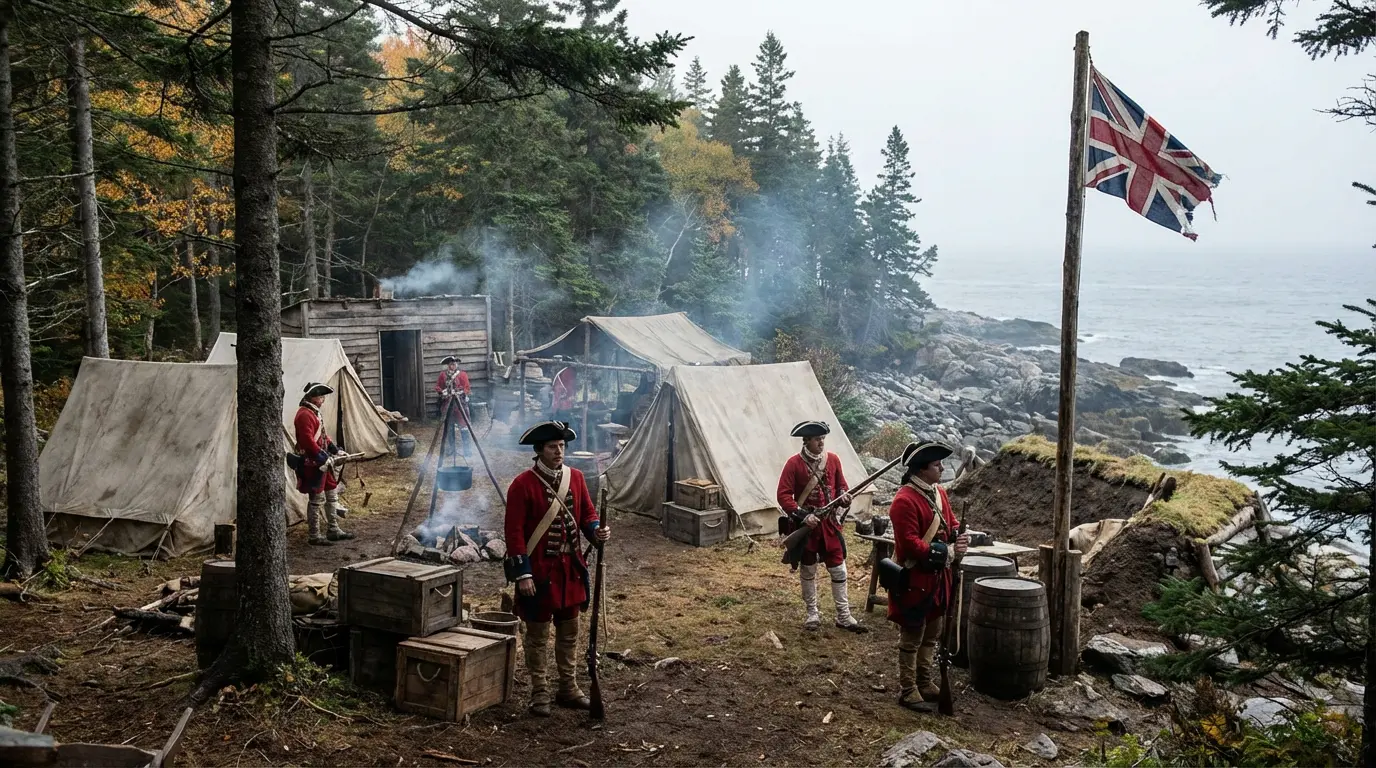 The Secret British Military Bank→
The name Mahone Bay appears for the first time on a chart drawn by Captain Thomas Durell of the Royal Navy in 1736. Durell left no record of where he got the name. The standard derivation, given by Judge Mather DesBrisay in his 1870 History of the County of Lunenburg and reaffirmed by R. V. Harris a century later, links the name to the French word mahonne, a low-lying barge propelled by long oars called sweeps, used by Mediterranean pirates and well known on the French coast. DesBrisay's etymology is the one that has held, though no document records the moment of naming.
In May 1753 Governor Peregrine Thomas Hopson, preparing to relocate his Foreign Protestants from Halifax, applied British names to the coast. Merligueche became Lunenburg, in honour of King George II's German duchy of Brunswick-Lüneburg. Mushamush became Mahone Bay. The Mi'kmaw name persisted in British surveyor records as late as 1756, but the new name went on the maps and stayed.
The Foreign Protestants and Ephraim Cook
1 min
Between 1750 and 1752, British recruiters placed notices in Germany, the Montbéliard region of France, Switzerland, and the Netherlands. The promise was land, food for a year, and a few farm animals. More than two thousand two hundred Foreign Protestants made the crossing to Halifax. The town was overcrowded within months. In May 1753 Governor Hopson assembled them, had them draw cards for the lots of their new settlement, and sent them down the coast under Colonel Charles Lawrence with ninety-two regulars and sixty-six militiamen. They landed at Merligueche, which they renamed Lunenburg.
The town of Mahone Bay itself dates to the following year. In June 1754 Captain Ephraim Cook arrived with a smaller party of English, French, and Swiss settlers and established a community on the inner bay's western shore. Mills were built at the mouths of the two rivers that flow into the bay. Over the following decades the settlement grew its own blacksmiths, merchants, school, churches, and shipyards. The first families on record include John Kedy and his sons, who took the mill seat on the Mushamush River. On the west side of the bay the early names were Zwicker, Ernst, Rooder, Loy, Ham, Mader, Smeltzer, Swinchammer, Moser, Eisenhauer, Lantz, Keizer, Vicnot, and Hyson. In Bayview Cemetery, where the original Anglican and Presbyterian churches once stood above the village, gravestones from the late 1700s remain in German.
The Three Churches
1 min
The architectural picture that draws photographers to the bay was the work of fifty years of denominational competition. In 1833 the Lutheran, Methodist, Baptist, and Presbyterian congregations of Mahone Bay built a Union Meeting House together on Edgewater Street. As congregations grew they built their own. The first dedicated church was St. James Anglican, raised in 1833 above Bayview Cemetery on the outskirts of the village. The Presbyterians followed in 1861 on the same hilltop. In 1869 St. John's Lutheran built on Edgewater Street, the first of the three churches at the modern waterfront location.
By 1885 the Anglicans had outgrown their hilltop building. The rector William Henry Snyder, active in the local Masonic Lodge, originally proposed that the new church be modelled on Solomon's Temple in Jerusalem, a Masonic icon. The proposal ended when Edward Harris, the youngest brother of the Prince Edward Island architect William Critchlow Harris, arrived in the parish as curate. William Harris was already known for English Gothic churches across the Maritimes. He designed the new St. James for Mahone Bay in the style that became the crown of his early period. It was built between 1885 and 1887 next to St. John's Lutheran on Edgewater Street. The 1887 interior colour scheme has been preserved through every repainting since.
The Presbyterians, not to be left on the hilltop alone, had their building lifted onto logs and rolled downhill to Edgewater Street the same year. In 1925 the Mahone Bay Presbyterian and Methodist congregations merged, and the building became Trinity United. The three steeples reflected in the harbour have been the postcard image of Mahone Bay since at least 1900. By 1934 the town had a Tourism Association.
The Young Teazer
2 min
On 26 June 1813, during the War of 1812, the American privateer Young Teazer was cornered outside the entrance to Mahone Bay by two British warships. The vessel had begun life as a Spanish slaver, was sold at Halifax in 1811, converted to a British packet, refitted as a British privateer (the Liverpool Packet), captured by an American vessel, and finally sold at auction as the Young Teazer. Her captain on that day, Lieutenant Frederick Johnson of Maine, had been captured once before by the British and had signed a parole undertaking never to take up arms against the Crown again.
When the British squadron sighted him outside the bay, Johnson ran for the shelter of Great Tancook Island. The British cut him off. Facing capture and a hanging for breach of parole, Johnson set fire to his own ship. He had not accounted for the gunpowder in the hold. The Young Teazer exploded with a force that rattled windows in the town of Mahone Bay. Few aboard survived. The hull was towed into Chester the next day and sold as salvage; its remains became the foundation of the Rope Loft Restaurant on the Chester waterfront. The keelson was framed into a wooden cross that hangs today in St. Stephen's Anglican Church, Chester. The annual Wooden Boat Festival in Mahone Bay reenacts the burning every August.
The town was incorporated as the Town of Mahone Bay in 1919 with a population of around nine hundred. It has not grown much since. The Mahone Bay Museum, at 578 Main Street, holds the local archive and the official history of the town. The view of the three churches reflected in the harbour from Edgewater Street is fifteen minutes' walk from the museum. The Mug & Anchor at 643 Main Street, the English-style pub that has served as the unofficial War Room for the Oak Island team across the seasons, sits another five minutes along the same street. In August the town holds its Pirate Regatta. In September it stages the Scarecrow Festival. In November the Father Christmas celebration. The harbour is good for kayaking. The looping roads around the bay are good for cycling. The bay is about an hour by car from Halifax.
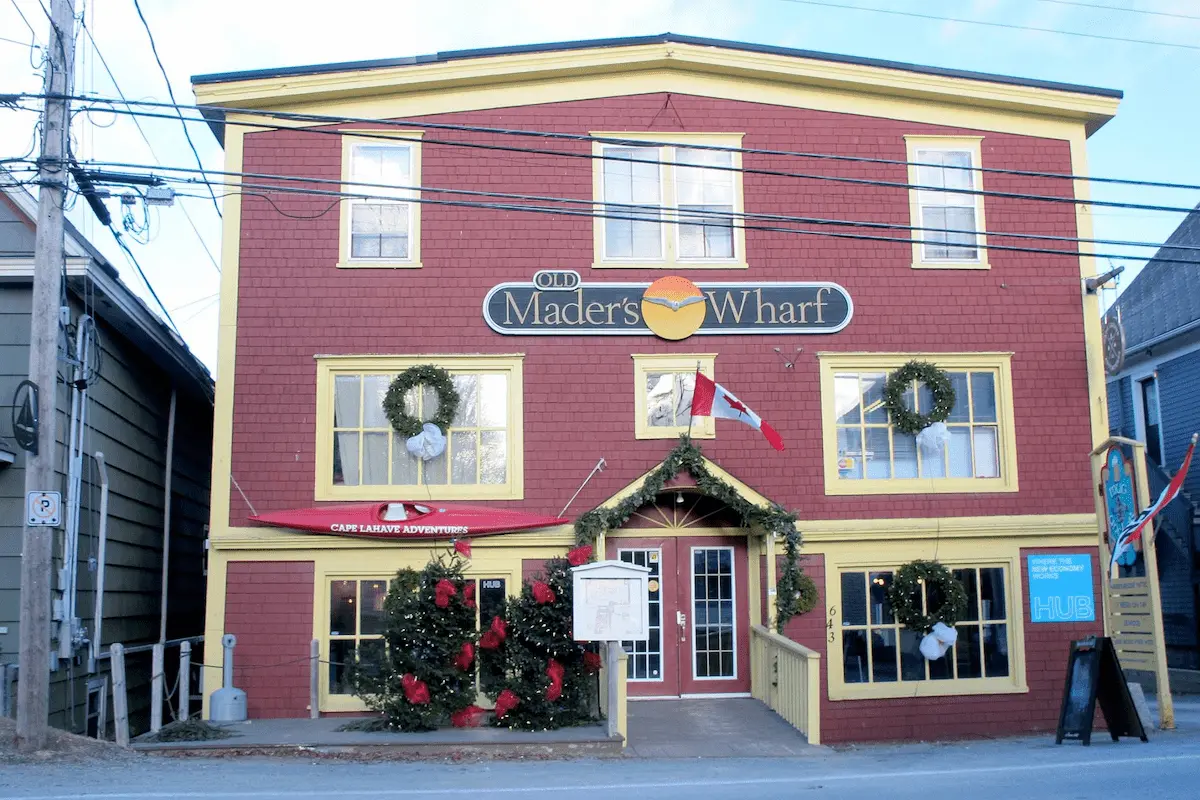 Mug & Anchor Pub→
Oak Island lies on the bay's southern shore, twenty minutes' drive east of the town along the coastal road. Mi'kmaw fishermen worked these waters for thirteen thousand five hundred years before any of the rest of it. Whatever else is true of the place, that part is established.
Sources
2 min
Primary documents
- Richelieu-Razilly convention, 1632, confirming Razilly as Commandeur de l'ordre de St Jean de Jerusalem (COL C11D Vol. 1, fol. 51, microfilm C-11359 p. 65).
- Undated fishing harbour list, pre-1685, giving dimensions of Mirligueche (COL C11D Vol. 1, fol. 9, C-11359 p. 20).
- Archive summary of the Lalanne royal oak survey, 1684 (COL C11D Vol. 3, fol. 534, C-11360 p. 275); full journal at Dalhousie Special Collections, Halifax.
- Ministerial letter, Versailles to Villebon, 16 April 1695 (C-11990 p. 267, Marine B4 Vol. 16).
- Bonnaventure coast transit and La Hève piloting instructions, summer 1695 (C-11990 pp. 251–300, Marine B4 Vol. 16).
- Lhermite embarkation for La Hève with Abraham Boudrot, 19 September 1698 (C-11990 p. 658, Marine B4 Vol. 19).
- English vessels at the Petitpas household and at Chibouctou, September–October 1698 (C-11990 pp. 660–661, Marine B4 Vol. 19).
- French coastal pilot manuscript, La Hève to Mirligueche, c. 1699 (COL C11D Vol. 3, fols 447–449, C-11360 pp. 175–177).
- Royal survey of Mirligueche, 1700–1703, with portage, islands, settlers and oak (COL C11D Vol. 4, fol. 214, C-11360 p. 542).
- Mirligueche granted to Bonnaventure, c. 1702–1703 (COL C11D Vol. 5, fol. 106, C-11360 p. 1031).
- Lhermite's retrospective on the Petitpas family at Mirligueche, January 1716 (Bibliothèque et Archives Canada).
- D'Anville fleet ship journals citing Cap La Hève as primary navigation reference, September 1746 (C-11991 pp. 716–721).
- La Sirène at Port Maltois, 8 November 1746 (C-11991 p. 627, fol. 71).
Cartography
- Bartolomeu Velho, manuscript world maps, 1560 and 1561 (reproduced in Portugaliae Monumenta Cartographica, II, plates 202 and 229).
- Samuel de Champlain, chart of the Nova Scotia coast, 1604.
- Cyprian Southack, chart fragment of the Atlantic coast of Nova Scotia, 1734.
- Captain Thomas Durell, chart of the Nova Scotia seacoast, 1736 (first known use of "Mahone Bay").
- Lieutenant Elias Meyer (Royal American Regiment), A chart of the coast of Nova Scotia from Port Maltois to Lawrence town, 1757 (Huntington Library).
Published sources
- L.-A. Vigneras, "The Voyages of Diogo and Manoel De Barcelos to Canada in the Sixteenth Century," Terrae Incognitae 5 (1973).
- W. F. Ganong, ed. and trans., Nicolas Denys, The Description and Natural History of the Coasts of North America (Acadia), Champlain Society, Toronto, 1908.
- W. F. Ganong, Crucial Maps in the Early Cartography and Place-Nomenclature of the Atlantic Coast of Canada, Royal Society of Canada, 1929–1937; reprinted with commentary by Theodore E. Layng, University of Toronto Press, 1964.
- Mather B. DesBrisay, History of the County of Lunenburg, Halifax, 1870 (second edition 1896).
- R. V. Harris, The Oak Island Mystery, 1958.
- Paul Wroclawski, "Early History of Mahone Bay, Nova Scotia," NEARA Journal 44 (Summer 2010).
- Robert C. Tuck and Graham Tuck, Churches of Nova Scotia.
- Steve Vernon, Haunted Harbours: Ghost Stories from Old Nova Scotia, Nimbus Publishing, 2006.
- Beamish Murdoch, History of Nova Scotia, Halifax, 1865–1867.
- Mahone Bay Museum, "Our Town's History," published research panel at mahonebaymuseum.com.