
About This Artifact
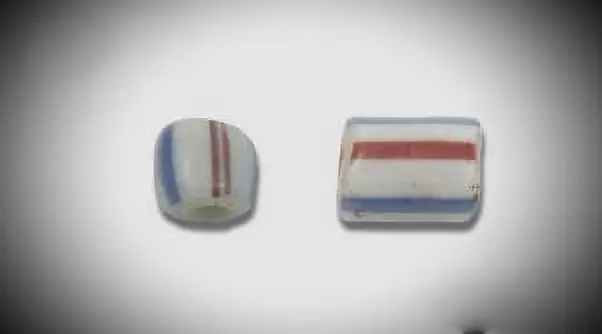
Six Venetian glass beads have been recovered from the Lot 5 round stone foundation across three seasons of excavation. The first was unearthed by Jamie in Season 11 Episode 10 (January 2024), found alongside seventeenth-century salt-glazed stoneware. A second matching bead was recovered two weeks later by Moya MacDonald in Season 11 Episode 12. In Season 11 Episode 13, Halifax glass-bead specialist Phillip Doucette examined both beads and confirmed they were manufactured in Venice using the drawn-bead method, with early colour formulations placing them between 1500 and 1650. He noted that five or six such beads found together typically indicate a string used for trade or barter rather than personal decoration.
In Season 12 Episode 8, a third bead, identified as a seed bead by Laird Niven, was matched by Emma Culligan's XRF analysis to the earlier Venetian beads in both composition and colouring. The copper-based colorant, rather than selenium or gold, placed the date at the early 1700s or earlier. In Season 12 Episode 20, Moya recovered a fourth Venetian trade bead. In Season 12 Episode 21, Fiona Steele uncovered a green glass bead with visible striations, identified by Laird Niven as a wound bead made by winding molten glass around a metal rod, a technique potentially dating to the 1400s and predating the drawn beads. In Season 13 Episode 3, Tansy Rudnicki uncovered a blue glass bead; Emma's XRF showed a compositional average matching the earlier Venetian beads, with Laird identifying it as a seed bead introduced in the second half of the 1600s. A sixth bead was recovered in Season 13 Episode 7 from the round stone foundation.
In Season 13 Episode 12, local historian and author Joan Dawson confirmed at Fort Point in LaHave that the Venetian beads found on Lot 5 are the same type Isaac de Razilly, the Knight of Malta who established the French colony of Acadia in 1632, would have used for fur trading with the Mi'kmaq. De Razilly's headquarters at Fort Point lay fifteen miles south of Oak Island, and journals from his expedition describe an island filled with oaks.
Historical Context
Seasons 11-13. Analysis by Phillip Doucette (Halifax glass bead specialist), Laird Niven (archaeologist), Emma Culligan (XRF). Historical attribution per Joan Dawson at Fort Point, LaHave.
Where It Was Found
Found at Lot 5. Location: Oak Island, Nova Scotia, Canada.


