About This Artifact
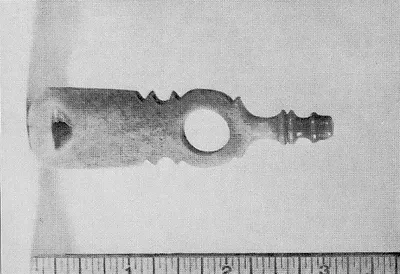
A two-inch-thick oak peg removed by Dan Blankenship from the U-shaped wooden structure at Smith's Cove during the 1969 excavation, and submitted by Kerry Ellard's representative McCabe to Geochron Laboratories in October 1969 for radiocarbon dating. The peg secured a six-inch by seven-inch spruce timber to one of the large spruce logs (twelve to twenty inches in diameter) that formed the main horizontal element of the U-shaped structure. Timbers in the structure were spaced approximately four feet ten inches on center, and the peg was one of multiple oak fasteners used throughout the assembly in place of metal hardware. Geochron sample GX-1692 returned a result of 1090 plus or minus 140 C-14 years before present, calibrating to approximately 860 AD with a range of 720 to 1000 AD. Geochron tentatively identified the sample as wood, probably cedar, while Kerry Ellard's September 1970 letter to Dr. Terasmae described the peg as oak. The species discrepancy has not been resolved in the surviving documentation, and no follow-up species analysis appears in the MacPhie compilation. Harold Kruger of Geochron emphasised in his December 1969 letter to McCabe that radiocarbon dating measures when the tree formed rather than when the wood was worked, and cautioned that the wood fragments came from rather large trees which may have had a substantial age at the time of fabrication. The medieval C-14 result therefore establishes the wood itself as no younger than the eighth to tenth century, but does not by itself date the construction of the U-shaped structure, which Dr. Colin Laroque's later dendrochronological analysis placed in 1769. The peg is one of two radiocarbon-dated samples from Blankenship's 1969-70 Smith's Cove excavation, the other being the inclined ramp beam (Geochron GX-1691, ~1135 AD, range 1025-1245). Both samples produced medieval dates, and Harold Kruger's caveat applies equally to both: the dates reflect the age of the timber as it was growing, not the date at which the structures were assembled. The reconciliation of medieval wood with eighteenth-century felling dates remains an open question for any reading of the Smith's Cove sequence.
Historical Context
Sources: Les MacPhie, "Summary of Documents and Results for Carbon Dating at Oak Island" (compiled July 2006), pp. 13-15, 23. Geochron Laboratories report GX-1692 (19 December 1969). Harold Kruger to McCabe (19 December 1969, p. 13). Kerry Ellard to Dr. J. Terasmae (15 September 1970, p. 23). Dan Blankenship, "Summary of Work Performed at Smith's Cove, August 31 - September 18, 1970" (pp. 16-19, structure description). Smith and Coles letter to Helix Investments (14 October 1969, p. 11).
Where It Was Found
Found at Smith's Cove, removed from U-shaped wooden structure. Location: the cove at the east end of Oak Island where the flood system's box drains were found in 1850.