The Story Told at Chester
2 min
In 1928, a historian named Dunbar Hinrichs was living in the town of Chester on the shore of Mahone Bay. Hinrichs was a William Kidd biographer who would later publish The Fateful Voyage of Captain Kidd in 1955. That year, he received an unusual visitor: a Frenchman who had come to Nova Scotia to investigate a family legend.
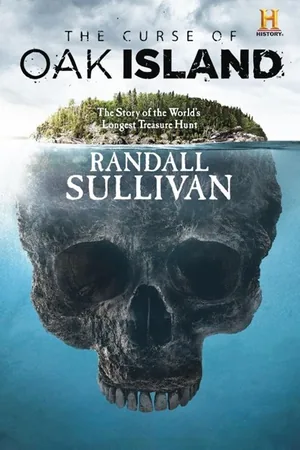
The story, as Randall Sullivan recounts it in The Curse of Oak Island (2018), involved a group of wealthy Huguenots who had escaped France aboard two ships immediately after the Edict of Nantes was revoked in 1685. The ships had sailed together from La Rochelle across the Atlantic to the island of Saint-Domingue, in what is now Haiti, where an engineer accompanying the group supervised the construction of underground vaults protected by flood tunnels. Some families deposited their wealth in these vaults. One ship then sailed to New York. The second continued north to Nova Scotia, making its way to Mahone Bay, where the leaders selected an uninhabited island. The same engineer supervised construction of a second vault system, also protected by flood tunnels, accessible either by a secret tunnel from the surface or by closing a gate installed in the flood tunnel system.
Sullivan spells the historian's name "Henrichs," but the correct spelling appears to be Hinrichs. More importantly, Sullivan presents the 1928 visitor's family legend alongside a separate story as though they are parts of the same narrative. In 1947, an engineer named Albert Lochard claimed to have discovered a system of tunnels and vaults at Kavanach Hill in southern Haiti. David Tobias heard about Lochard independently in the late 1960s and sent Dan Blankenship to Haiti in 1970 to investigate. Blankenship could not locate Kavanach Hill or find anyone who knew about the supposed discovery. He eventually tracked Lochard to New York City, where the engineer was living under an assumed name as a political refugee. Lochard told his story without asking for anything in return, but as Sullivan himself acknowledges, "the main problem with Lochard's story was that he could offer no witnesses to verify it." These are two separate threads, one from 1928 and one from the late 1960s, that Sullivan weaves together without flagging the gap.
Hinrichs told Sullivan he had not taken the Frenchman's tale seriously at first. He reconsidered only after hearing about Lochard's Haiti discovery nineteen years later. But even then, Hinrichs raised what he considered a fatal problem with the theory. Sullivan quotes his conclusion directly: "The Huguenots had not arrived in Nova Scotia in any numbers until after the Acadians were expelled in 1756, by which time the Mahone Bay area was populated by a good many New Englanders and Germans who had moved there on the promise of free land from the British government. It is doubtful that the Huguenots or anyone else could have created the works on Oak Island at that late date without people noticing."
That objection has been repeated in Oak Island literature for decades. It is also contradicted by primary sources that neither Hinrichs nor Sullivan appears to have consulted.
The Huguenot Diaspora
1 min
In 1685, when Louis XIV revoked the Edict of Nantes, fifty thousand Huguenot families fled the country. Sullivan notes that most of those who left France for the New World "were upper class. Many were members of the French nobility and nearly all of the others were part of what historians have called an affluent artisan class." They departed primarily from the Atlantic coast provinces: Aunis, Saintonge, Poitou, and Normandy, according to research published by the Bibliotheque nationale de France. Many left from the port of La Rochelle itself, the Huguenots' former stronghold. The vault story, if taken at face value, describes a group that went first to Haiti, then to Mahone Bay.
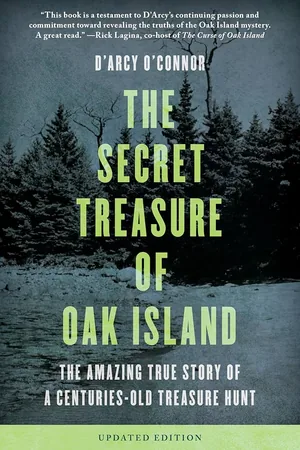
Sullivan is the only major Oak Island author to give the theory sustained attention. Mark Finnan does not mention it in Oak Island Secrets (1995), though he notes that Pierre de Gua, Sieur de Monts, a Huguenot merchant from Saintonge, received a colonization charter from Henri IV in 1604 and helped establish the first French settlements in the region. Sullivan dismisses the vault theory on chronological grounds. That dismissal rests on two assumptions: that no Huguenots of means were present in Mahone Bay before the late 1750s, and that the area was too well-populated by then for secret construction. Both can be tested against the historical record.
The De Villiers at La Rochelle
2 min
Before the Huguenots arrived in Mahone Bay, the other side of France's religious wars had already left its mark there. And the thread that connects them runs through a single family name.
In 1627, during the siege of La Rochelle, Isaac de Razilly was among the Catholic naval commanders blockading the Huguenot port. Razilly was a Knight Commander of the Order of Malta who had lost an eye in the fighting. His mother was Catherine de Villiers, a descendant of the House of Villiers de L'Isle-Adam, one of the oldest Norman military lineages in France. The family traced its roots to Godefroy de Villiers, who appears in the records around 1013, barely a century after the Norse chieftain Rollo accepted Normandy from the French crown. By the twelfth century, the De Villiers were embedded in the command structures of both the Knights Templar and the Knights Hospitaller. Jean de Villiers served as Grand Master of the Hospitallers during the fall of Acre in 1291. Philippe de Villiers de L'Isle-Adam, six generations later, held the same title during the siege of Rhodes in 1522, and it was he who led the order to its new home on Malta. Catherine de Villiers was Philippe's direct descendant.
On the opposite side of the siege, leading an English fleet of over a hundred ships in support of the Huguenot rebels, was George Villiers, the 1st Duke of Buckingham. Buckingham's line descended from the same Norman root. When William the Conqueror crossed the Channel in 1066, a knight named Galdefridus de Vilers sailed with him. His descendants became the De Villiers of Gloucester and the barons of Warrington, embedding the family name in the English aristocracy within a single generation of the Conquest. The French branch stayed on the continent, produced the Templar and Hospitaller commanders, and merged with the House of L'Isle-Adam in the 1290s. The English branch evolved separately for five and a half centuries, until it produced a Duke who sailed back to France to fight for the Huguenots at the very port where his distant cousin was blockading them for the Catholic crown.
 De Villiers: The Treasure Bloodline→
Also fighting alongside Razilly on the Catholic side was Francois de La Rochefoucauld, who was rewarded for his role at the siege with the elevation of his county to a duchy-peerage.
Buckingham's expedition failed. The Huguenots of La Rochelle held out until October 1628, when starvation forced their surrender. Of the city's 30,000 inhabitants, fewer than 6,000 were still alive. What matters for Oak Island is what happened next, and where the survivors went.
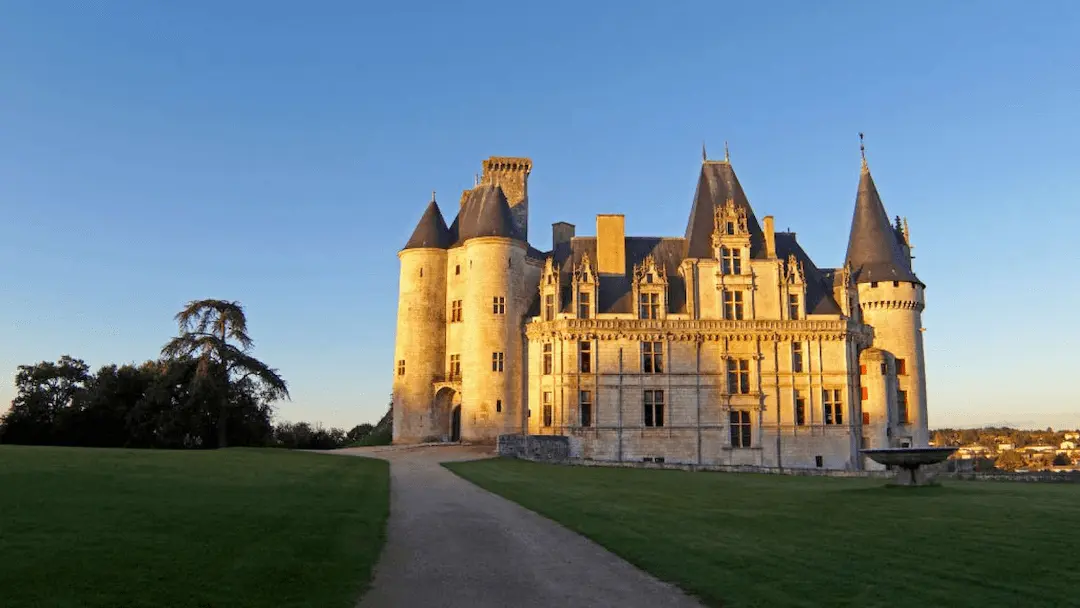 Château de la Rochefoucauld→
The Knights of Malta at the Entrance to Mahone Bay
2 min
Four years after the fall of La Rochelle, the Treaty of Saint-Germain-en-Laye returned Acadia to France. Richelieu chose Razilly to reclaim it. On September 8, 1632, the one-eyed Knight of Malta landed at LaHave on the south shore of Nova Scotia with three hundred men, including his cousin Charles de Menou d'Aulnay and the merchant-explorer Nicolas Denys. LaHave sits at the entrance to Mahone Bay.
Razilly built Fort Sainte-Marie-de-Grace and established what was, for a few years, the capital of New France. His companion Denys, exploring the inner reaches of the bay, gave the first known written description of its islands, including one covered with a forest of mature oak trees. As Finnan noted in Oak Island Secrets, this account by Denys is "the first known description of the area," and the oaks he described would eventually give the island its name.
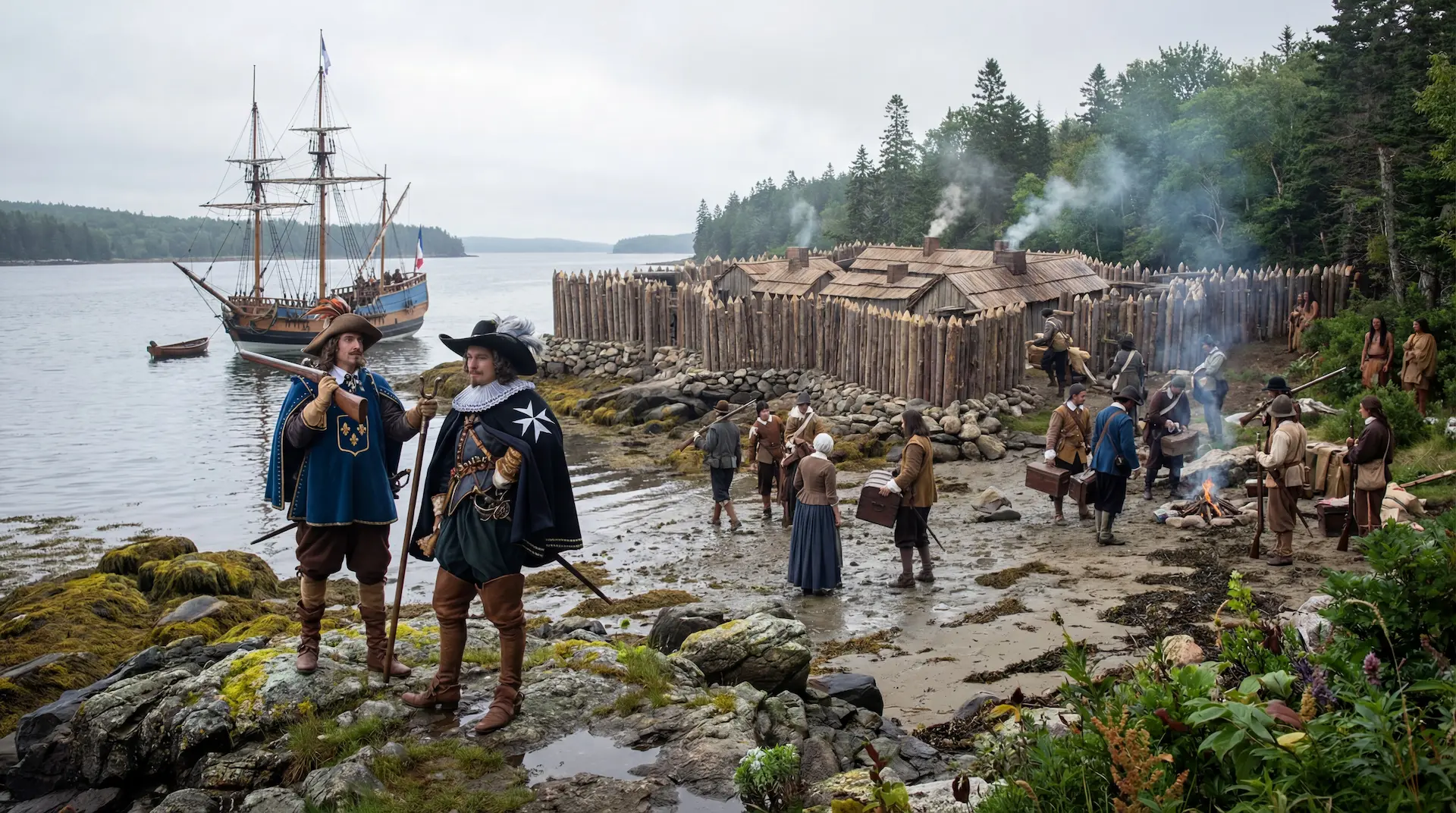 The Knights of Malta→
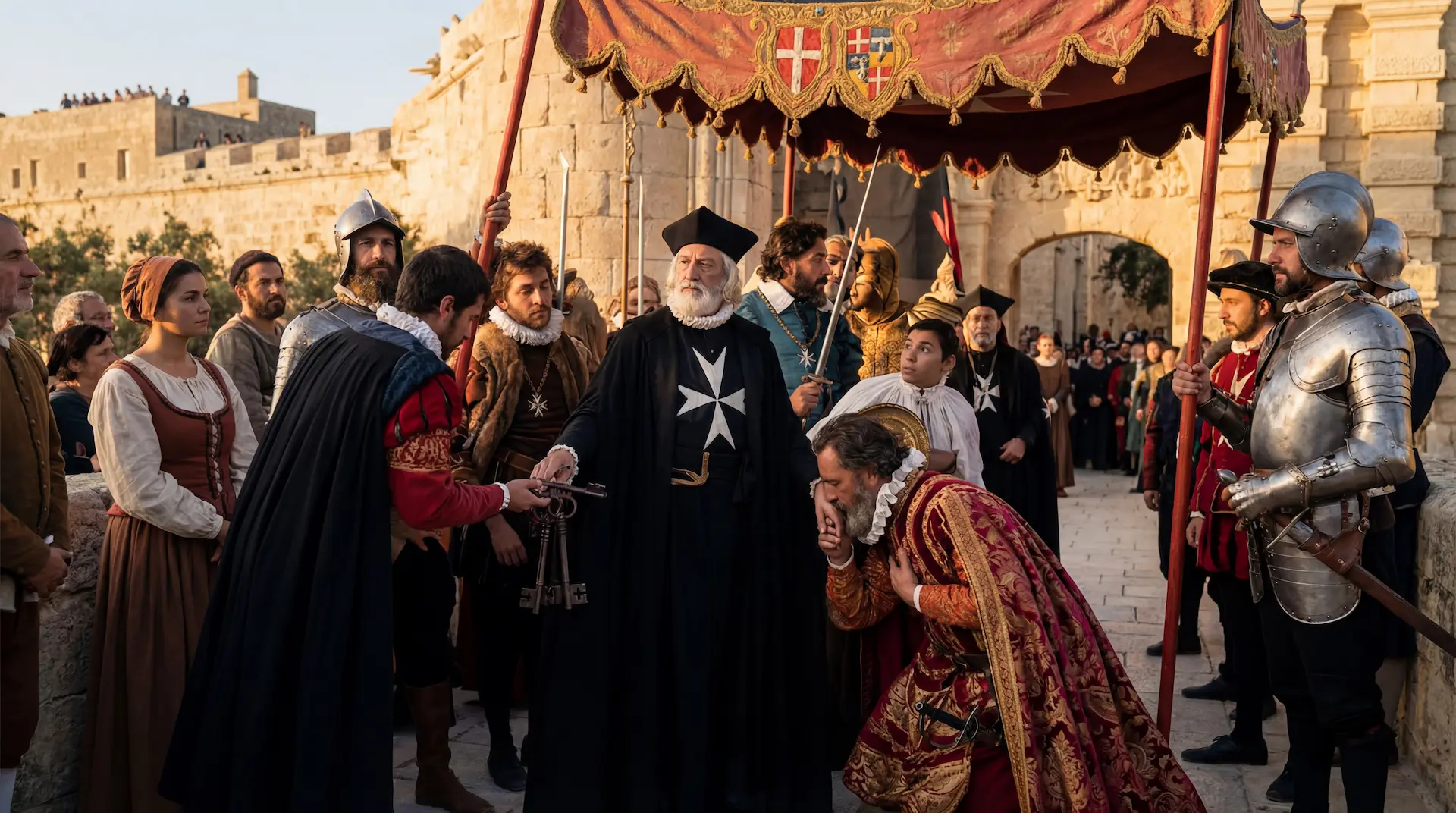
Razilly's ambitions went beyond farming and fur trading. According to records held by the Order of Malta's Canadian Association, he formally offered his Acadian lands to the Grand Master of the Order with the proposal that they be erected into a priory. The Grand Master, Fra Antoine de Paule, rejected the idea. But the proposal is documented: the descendant of Philippe de Villiers de L'Isle-Adam, the man who had led the Knights of Malta to their island headquarters a century earlier, was now asking the same order to establish a permanent institutional presence on the Atlantic coast of Nova Scotia, twenty-five kilometres from Oak Island.
Serving under Razilly at LaHave was another Knight of Malta, Phillipe de Longvilliers de Poincy, who would later go on to the Caribbean and convince the Order to purchase four islands there. As a study on the Hospitaller colonization of the Americas notes, members of the Knights of Malta "had been prominent in New France and the French Antilles" from the very beginning, and "many French naval officers had trained with the Hospitaller navy."
Razilly died at LaHave in December 1635. His cousin d'Aulnay moved most of the settlers to Port Royal. The fort was later destroyed by fire. But the footprint at the entrance to Mahone Bay, established by a descendant of the De Villiers line, predates the Huguenot vault theory's proposed timeline by over fifty years.
A Wealthy Huguenot on Oak Island's Doorstep
3 min
The evidence that directly challenges Sullivan's chronological dismissal comes from a source he does not cite: Winthrop Pickard Bell's The Foreign Protestants and the Settlement of Nova Scotia, published by the University of Toronto Press in 1961.
Louis Payzant was born around 1695 in Caen, Normandy, where he worked as a cloth merchant. His life has been documented in unusual detail for an eighteenth-century colonial settler. The French academic Paul Joubert published a study of him in 1963 in the Bulletin de la Societe des Antiquaires de Normandie under the title "Louis Paisant, religionnaire et fugitif." After the death of his first wife, Payzant petitioned to have his daughter returned from the Catholic school where she had been placed. He and the girl fled Caen for the British island of Jersey in 1739.
On Jersey, Payzant married Marie Anne Noget, herself a Huguenot refugee, in January 1740 at St. Helier. He started a second family. His son John, born October 17, 1749, would later write a memoir in which he described his father as "a wealthy merchant of Caen" who "moved over to Nova Scotia (in 1753) with a great property in order to make a fortune for himself and children." That memoir was edited by Brian C. Cuthbertson and published in 1981 as The Journal of the Reverend John Payzant. The historians MacMechan and DesBrisay, drawing on an account given by another son, Louis Jr., to Silas Tertius Rand for publication in The Provincial in 1852, recorded that Louis owned three ships, sold two, and brought his wife, sons, and all his worldly goods to Halifax.
The family arrived in the summer of 1753 and was directed to the Foreign Protestant settlement at Lunenburg. Within a few years, Louis obtained a grant of an island in Mahone Bay. Bell identifies it as "the one known today as Covey's Island, five miles south of Oak Island." Mather Byles DesBrisay, in his History of the County of Lunenburg (first published in 1870), describes how Payzant built first a brushwood cabin, then a log hut, and was nearing completion of a two-storey dwelling. Boxes and bales of goods were stored for trade. A field of wheat had been sown. By the spring of 1756, this was a functioning trading post operated by a man of considerable means, on an island five miles from Oak Island.
On the evening of May 8, 1756, a raiding party ordered by the Governor General of New France arrived at Rous Island, four miles south of Oak Island, killed an old man and his adult son, and captured the grandson. They forced the boy to guide them to Payzant's Island. Louis was killed on his doorstep. DesBrisay preserves his last words: "My heart is growing cold." The raiders killed a servant woman and her infant child, burned the storehouse, and took Marie Anne, one month pregnant, and her four children captive to Quebec City, a journey of over a thousand kilometres.
Marie Anne gave birth to a fifth child, Lisette, in captivity on December 26, 1756. The family spent four years as prisoners and was released after the Battle of Quebec in 1759. They returned to Nova Scotia in 1760. Linda G. Layton, a direct descendant, published the definitive modern account in 2003: A Passion for Survival: The True Story of Marie Anne and Louis Payzant in 18th Century Nova Scotia, through Nimbus Publishing in Halifax. Her research draws on the Nova Scotia Archives, Jersey parish records, French military documents, and the Payzant family papers (NSARM, MG1, Vol. 747, No. 42).
One detail connects the next generation to the broader Oak Island timeline. Phillip Payzant, the eldest son, who had been nine years old on the night of the attack, appears in Chester land records dated May 30, 1763. He was granted 300 acres of land near Chester, Lunenburg County, the area immediately adjacent to Oak Island. He held this land until around 1772 before selling and moving to Boston, where he fought in the American Revolution.
What the Evidence Supports
2 min
None of this proves that Huguenots built the works on Oak Island. The Hinrichs vault story remains unverified hearsay from a single anonymous visitor in 1928. The Lochard discovery in Haiti could not be confirmed. There is no direct evidence linking the Payzant family to engineering activity on the island.
But the central objection to the theory, the argument that has kept it on the margins of Oak Island research for nearly a century, does not hold. Sullivan wrote that no wealthy Huguenots were present in the area at the right time. The sources he did not consult, Bell, Layton, DesBrisay, and the Payzant family's own captivity narratives, show a wealthy Huguenot merchant from Normandy living on an island five miles from Oak Island by 1756, three years before the Shoreham Grant brought the main wave of New England settlers. He came with ships and capital. He was operating from an island, not the mainland.
Sullivan also assumed the area was too well-populated for secret construction. The British officer John Knox, who was actually there, saw it differently. Writing about 1757, Knox recorded that "In the year 1757 we were said to be Masters of the province of Nova Scotia, or Acadia, which, however, was only an imaginary possession." The troops and inhabitants at Lunenburg, he continued, "could not be reputed in any other light than as prisoners." Bell cites this passage on page 514 of his study. The French governor, upon learning the victims of the 1756 raid were Protestant French, reportedly considered recruiting other settlers at Lunenburg to burn the town entirely. This was not a supervised colonial outpost. It was a violent frontier where British authority barely extended beyond a few blockhouses.
The De Villiers family, one of the oldest Norman military lineages in France, placed itself on both sides of the La Rochelle siege: Catherine's son Razilly blockading the port for the Catholic crown, while Catherine's distant English cousin Buckingham sailed to relieve it for the Huguenots. Within five years of the siege, the Catholic branch had planted itself at the entrance to Mahone Bay and proposed making the territory a priory of the Knights of Malta. A century later, a wealthy Huguenot fleeing the persecution that followed the Huguenots' defeat settled on an island in the same bay. Both sides of that war left documented footprints within twenty-five kilometres of Oak Island. None of the standard Oak Island reference works has drawn the connection.
Whether either side left something buried there is a question the evidence cannot yet answer.