About This Artifact
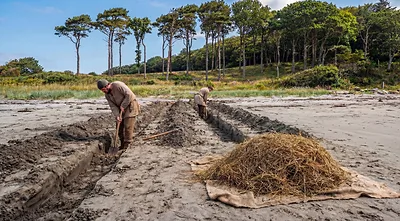
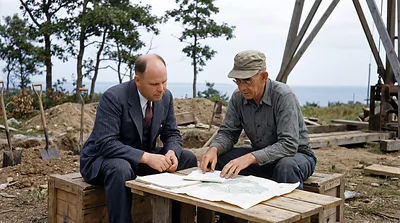
A small wooden box recovered by Dan Blankenship during the Smith's Cove excavation of August through October 1970, found at least two feet below the bottom of the large spruce log of the U-shaped structure, on the inside corner of that feature. Blankenship's contemporaneous notes describe the box as apparently hidden. The box measured eighteen inches wide and twenty-four inches long. Its sides were constructed from four-inch by six-inch oak timbers, the bottom from two-inch oak, and the ends from one-inch spruce. One end of the oak sides was beveled, and an oak dowel was embedded in one side only. A sketch of the box accompanied Blankenship's October 1970 report and survives in the Les MacPhie compilation, and a photograph of it appears in Oak Island and its Lost Treasure. The construction, combining heavy oak with lighter spruce ends and an asymmetric beveled finish with a single dowel, points to a purpose-built object rather than a discarded crate. Graham Harris and Les MacPhie, the geotechnical engineers who wrote Oak Island and its Lost Treasure, offer a specific reading. They describe the find as a small wooden sled, or skip, found about three feet below the log structure, and suggest it could have been used to haul spoil out of the Smith's Cove end of the flood tunnel while it was being dug. Oak sides with one beveled end would suit an object dragged along a tunnel floor, and at eighteen by twenty-four inches it would fit inside the flood tunnel, which is recorded as two and a half feet wide by four feet high. In their broader reconstruction the tunnel was driven partly from a shaft at Smith's Cove, with spoil hauled out by rope and winch. The placement beneath the U-shaped structure indicates the object was deposited before the U-shaped timbers were laid down, or was deliberately placed beneath them at the time of construction. No contents have been recorded in the surviving documentation. No radiocarbon or dendrochronological dating has been performed on the box itself, and its current location is not specified in Blankenship's published reports. Its date depends on its relationship to the surrounding structures. If associated with the U-shaped timbers above it, it would be consistent with the 1769 dendrochronology date returned by Dr. Colin Laroque or with the medieval radiocarbon dates recorded for samples from the same area.
Historical Context
Sources: Les MacPhie, "Summary of Documents and Results for Carbon Dating at Oak Island" (compiled July 2006). Dan Blankenship, "Summary of Work Performed at Smith's Cove, August 31 - September 18, 1970" (pp. 16-19, Item #11). Sketch of Item #11 (p. 20). Blankenship "Resume of operations" (14 October 1970, pp. 24, 26-28). Graham Harris and Les MacPhie, Oak Island and its Lost Treasure, third edition (Formac Publishing, Halifax, 2013), chapter 6 (photo 24).
Where It Was Found
Found at Smith's Cove, beneath U-shaped structure, on the inside corner of Item #2. Location: the cove at the east end of Oak Island where the flood system's box drains were found in 1850.