In the heart of Jerusalem's Christian Quarter, at the end of a narrow lane that passes the Mosque of Omar and opens onto a small stone courtyard, stands the entrance to the Church of the Holy Sepulchre. For almost two thousand years, Christian pilgrims from across Europe and the Middle East have made this their destination: the place where, according to tradition, Jesus of Nazareth was crucified, buried, and raised from the dead. It is, by the reckoning of medieval Christendom, the centre of the world. Crusaders died for it. Kings built their tombs beside it. The military orders that shaped the medieval world were founded to protect those who came to stand before it.
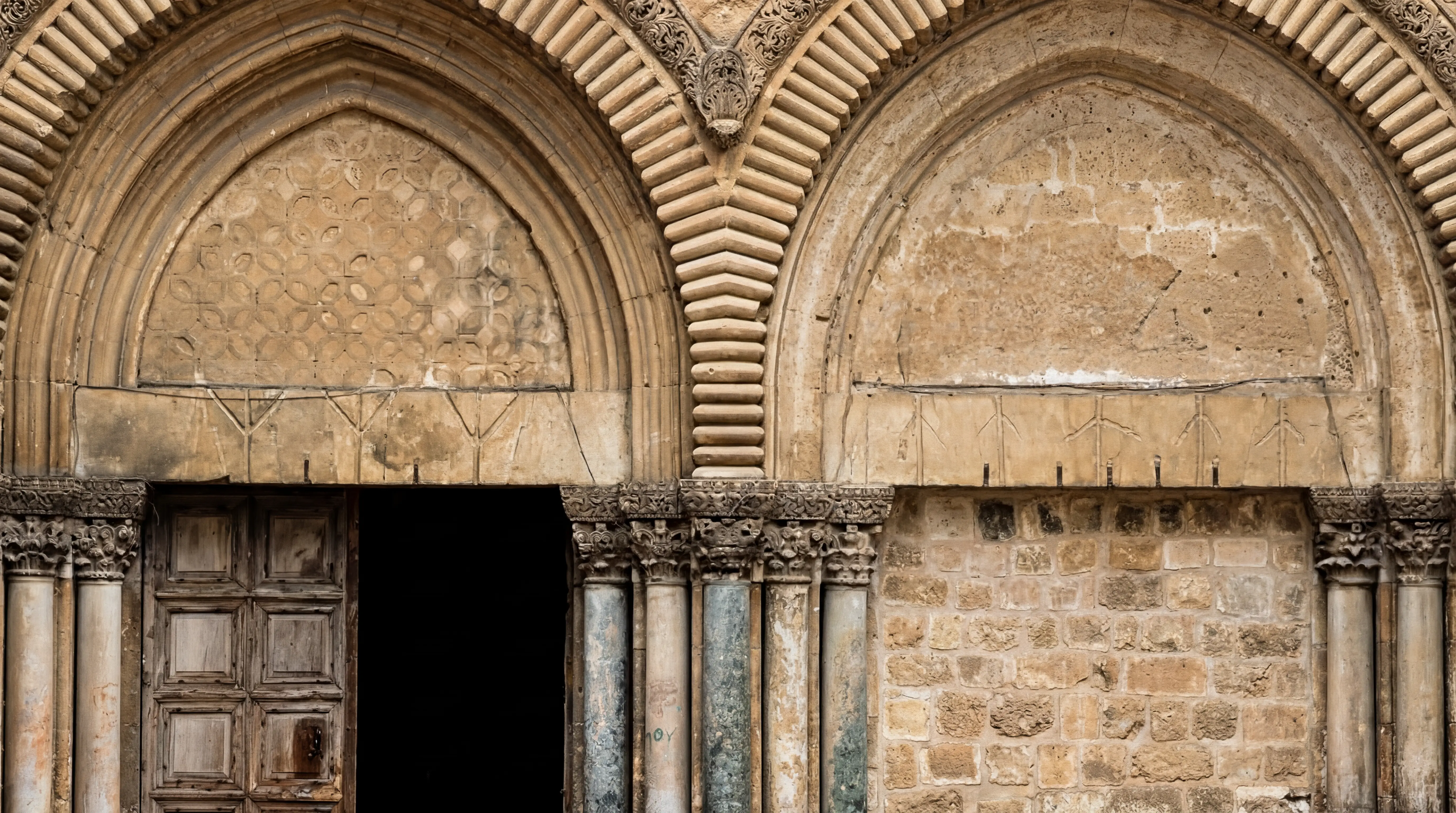
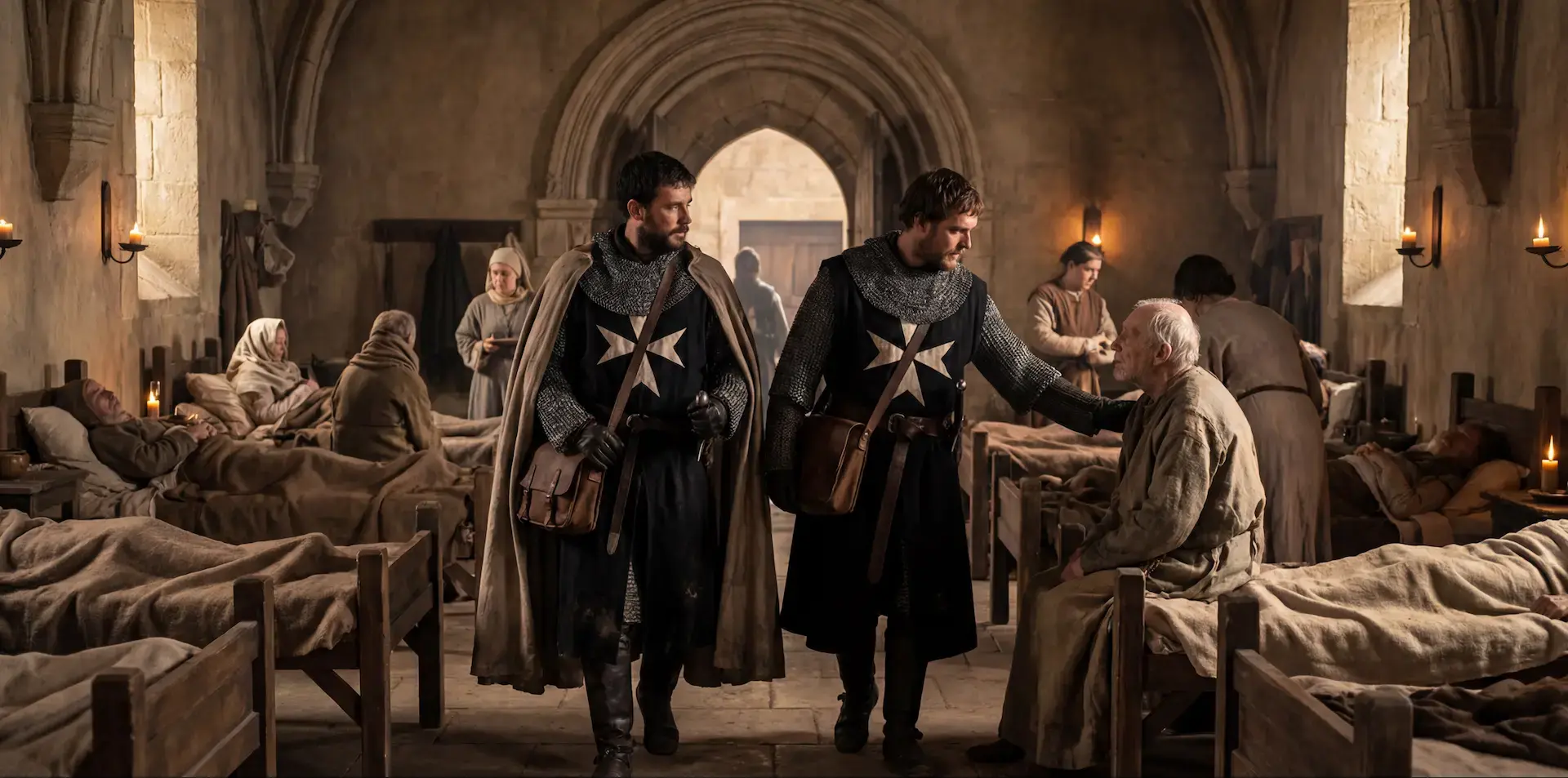
The entrance is two doors set side by side in a Crusader-era facade, topped by ornate carved arches. The left door stands open. The right has been sealed since 1187, when Saladin retook the city and walled it shut. For a century after the Crusaders first took Jerusalem, both doors carried marble lintels, installed for the church's re-consecration in 1149 and carved with scenes from the life of Christ. The ceremony took place fifty years to the day after the Crusaders took Jerusalem, in the presence of the two orders whose entire existence was organized around this building. The Knights Templar, founded in Jerusalem around 1119, had their original quarters on Temple Mount a short walk away. The Knights Hospitaller, founded earlier still to care for sick pilgrims, maintained their headquarters in the Muristan, directly adjacent to the Holy Sepulchre itself. Both orders had been present in Jerusalem for decades before the lintels went up, intimately familiar with the church, its ritual, and its iconography. Those lintels were removed in the 1930s after earthquake damage and are now in the Rockefeller Museum a short walk from Herod's Gate, where they remain to this day.
What their removal exposed has received almost no attention. In the flat stone of the tympanum above each door, carved directly into the limestone that had been hidden behind the marble for eight hundred years, are three-pronged marks. Three above the left portal. Five above the right. One account of the current facade describes them as hooks that once held the lintels in place. But they carry no rebates, no dowel holes, no Lewis cuts. They bear none of the structural characteristics of Crusader-era stone fixings. What they carry is a specific form: three lines radiating from a single point, each group angled outward in a shape that has carried a specific meaning in medieval pilgrimage culture since the time the church itself was built.
The right portal, the sealed one, led directly to Golgotha and the Chapel of Adam. Medieval theology placed Adam's burial at the foot of the cross, directly beneath the site of the crucifixion, and the chapel that marks this spot lies behind the door that has not opened since the 12th century. The four kings who ruled Jerusalem before the 1149 re-consecration, Godfrey of Bouillon, Baldwin I, Baldwin II, and Fulk of Anjou, were buried in the same area, around the chapel. The last of them, Fulk, died in 1143, six years before the lintels went up and the marks passed out of sight. The carvings appear consistent in age with the 1140s construction of the facade itself, placed there in the same decade the fourth king was laid to rest below. Five marks above the sealed door: four rulers and Adam. Three above the open door. The five face downward. The three face up.
What are these symbols? And how did they come to be carved into the most sacred doorway in Christendom?
The Mark That Ends the Journey
2 min
The symbol is called the goose paw, patte d'oie in French, and it is one of the most widely traveled marks in medieval European culture. Three lines from a single point: sometimes drawn with one central line extending upward, longer than the two flanking arms, sometimes as a tripod of equal strokes, often anchored at the base with a short horizontal heel. In either form the image is immediately recognizable once you know to look for it, and once you know what it means, it appears in places that begin to form a pattern.
In medieval Europe, the goose was not merely a farmyard bird. It was a creature associated with vigilance, with wisdom, and with the capacity to navigate across great distances. Adrian Seville, in his study of the Game of the Goose, identifies the goose in medieval symbolic culture as an emblem of favourable spiritual guidance, a creature that could lead the soul as surely as it could orient itself across open water. Juan G. Atienza, in El Camino de Santiago: La ruta sagrada, traces these associations through the pilgrimage culture of northern Spain, where the great network of routes converging on the shrine of Saint James in Galicia had long been called the Way of the Goose. These were qualities that made the animal a natural emblem for any institution whose purpose depended on long-range movement, on keeping routes open, and on bringing things and people safely from one end of the world to the other. The Knights Templar and the Knights Hospitaller, the two orders most closely associated with the Holy Sepulchre, were both thoroughly familiar with the symbol and its meanings. It appears on their properties, in their churches, and carved into the walls of the prisons where their members were held after the suppression of 1307.
Along the Camino routes, spanning thousands of kilometers from the ports of southern France through the Pyrenees and across northern Spain, carved geese, goose feet, and Y-shaped branch symbols appear on church walls, bridge abutments, and hostel doorways. Their function was specific and documented: the goose paw marked the end of a journey. A pilgrim who had walked for months through dust and mountain passes and river crossings, who arrived finally at a sanctuary, would find the three-pronged mark carved at the entrance. It said: you have arrived. The journey is complete.

The Builders Who Carried the Mark
2 min
Across the Basque country and southwestern France, one group became so closely identified with the goose paw that they were required by law to wear it. The Cagots were a persecuted social minority documented in Gascony, Béarn, Navarre, and the Basque provinces from at least the 13th century onward. Their origins remain disputed. They were not a religious minority; most were Christian. They were not ethnically identifiable in any way that contemporaries could articulate. But they were systematically excluded from every dimension of normal civic life: banned from most trades, forced to live at the edges of villages, barred from entering churches through the main door, required to use separate holy water stoups. Benoît Cursente, in Les cagots, histoire d'une ségrégation, documents that in many regions they were legally required to wear a distinctive mark on their clothing in the form of a goose or duck foot, the pied d'oie, a requirement attested from the early 15th century in Toulouse and enforced intermittently across Gascony and Navarre through the mid-17th century. Gérard de Sède, in Le mystère gothique: Des runes aux cathédrales, places the Cagots within the wider tradition of Gothic builder guilds, tracing the goose foot mark through the stonework traditions of southwestern France into the fabric of the great pilgrimage churches themselves.
The paradox is this: the Cagots were also the master builders of the Camino. They were permitted, and in many regions exclusively employed, in carpentry and stonework. The churches, hospices, and bridges of the pilgrimage infrastructure across southwestern France and northern Spain were built by Cagot hands. They were required to mark the buildings they constructed with the same symbol they wore on their clothes, the goose paw, distinguishing their labor from that of recognized guilds. The mark of shame was also the mark of mastery. Across the most sacred pilgrimage routes in the Christian world, the symbol that told a pilgrim the journey was over was carved there by the people most excluded from that journey's reward.
The Templar Network
2 min
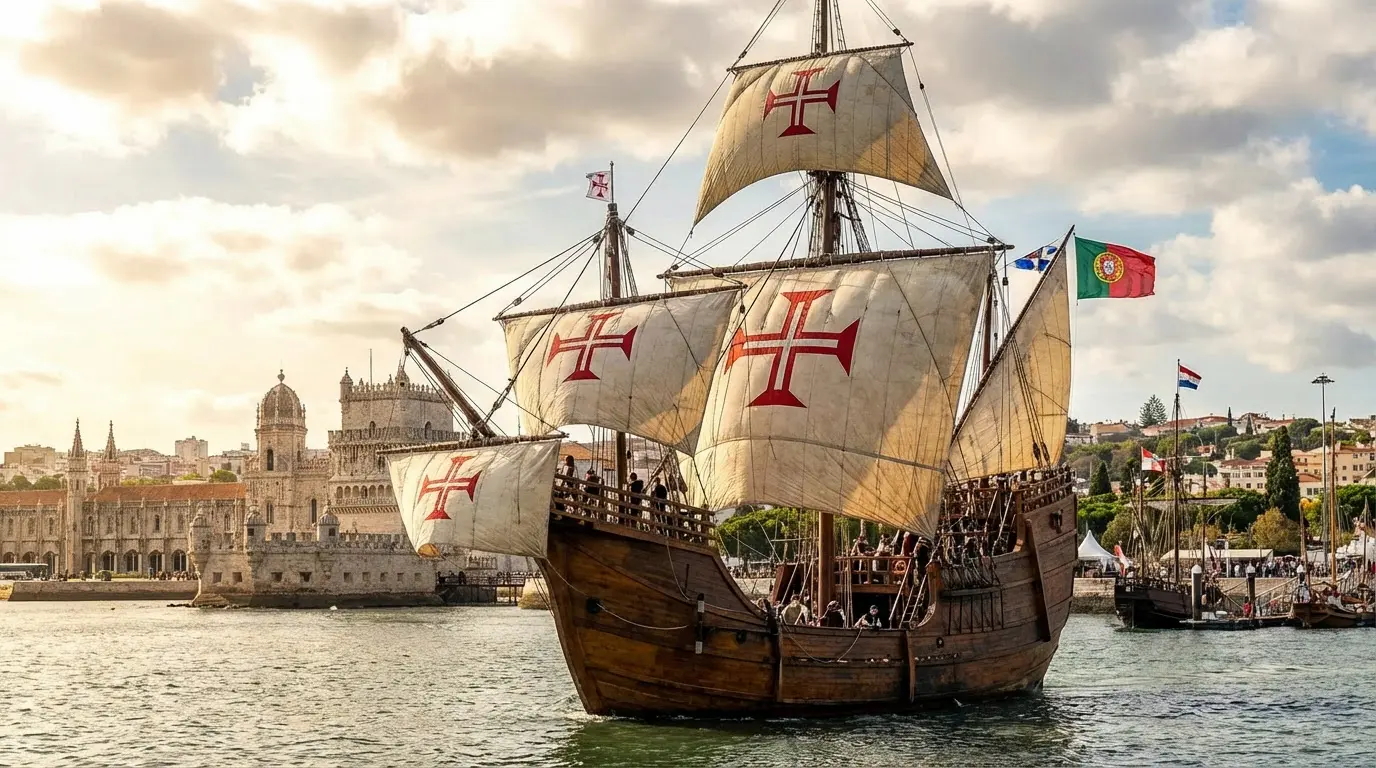
At Tomar in Portugal, the Convento de Cristo served first as the headquarters of the Knights Templar in Portugal and, after the order's suppression in 1307, as the seat of its successor institution, the Order of Christ. The Order of Christ is not a peripheral figure in Atlantic history. It was the institution that funded, organized, and drove Portuguese expansion along the African coast, into the Azores, and across the Atlantic. The ships that sailed under Henry the Navigator, Bartolomeu Dias, and Vasco da Gama carried the red cross of the Order of Christ on their sails. The administrative center of that institution, the Convento de Cristo at Tomar, contains a goose paw carving, documented by researcher Freddy Silva in First Templar Nation, alongside a local legend of three spears, the tripartite form recurring in the same Templar context.
 The Portuguese: The Order of Christ→
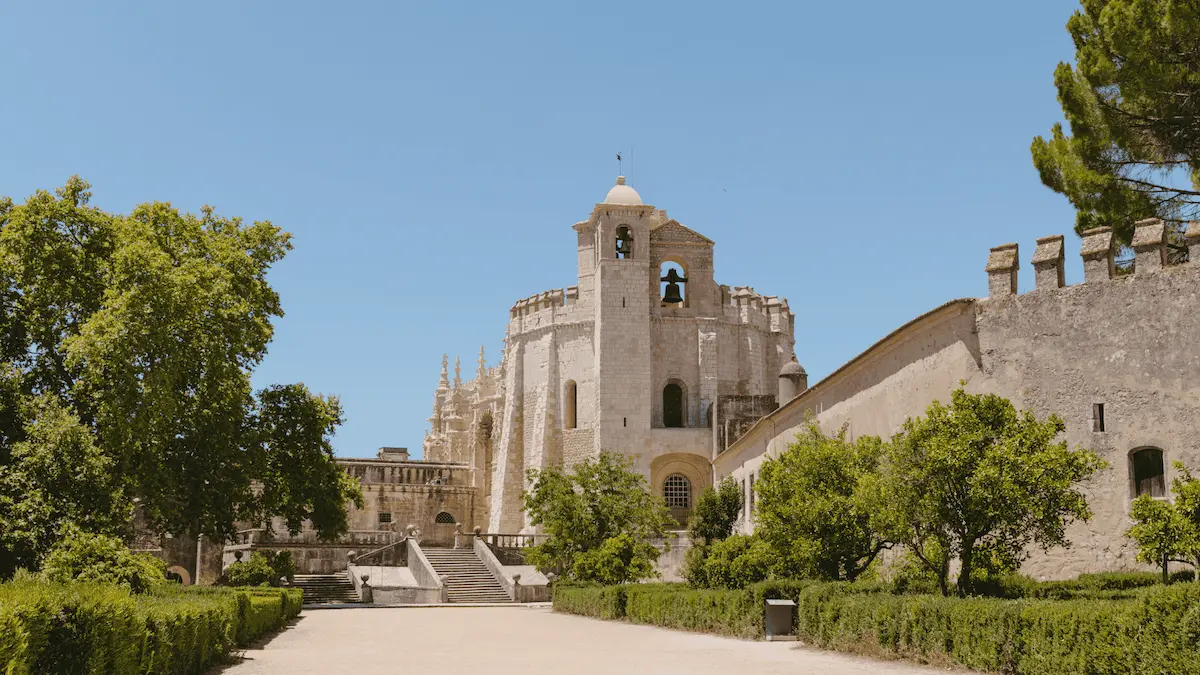 Convento de Cristo→
At Camerano in the Marche region of central Italy, a network of underground caves contains carvings and ritual material associated with Templar activity from the 12th century onward. The complex is one of the most significant underground sites in the Italian peninsula connected to the military orders: multi-level, with altars, crypts, and carved niches extending some twenty meters below the streets of the town. Deep within the complex, a plaster mould taken from a sculpted segment of an old altar carries a goose paw formed not from three abstract lines but from the three nails of the crucifixion, arranged in the tripod configuration. The three nails as a Passion symbol have a documented theological history stretching back to the 13th century, rooted in the Triclavian tradition that held three nails, rather than four, were used in the crucifixion, and associated that number with the Trinity. They appear in medieval ecclesiastical heraldry across Europe. The Society of Jesus, founded in 1540, incorporated them below the cross in its IHS monogram, the most widely recognized institutional use of the symbol in the post-medieval world. But the Jesuits inherited an existing theological symbol. The Camerano carving sits in a pre-Jesuit, Templar-associated context, in a cave complex in use for religious purposes centuries before the Society was founded. Whoever made it understood both the goose paw and the three nails well enough to render one through the other: the navigation symbol built from the instruments of the passion.
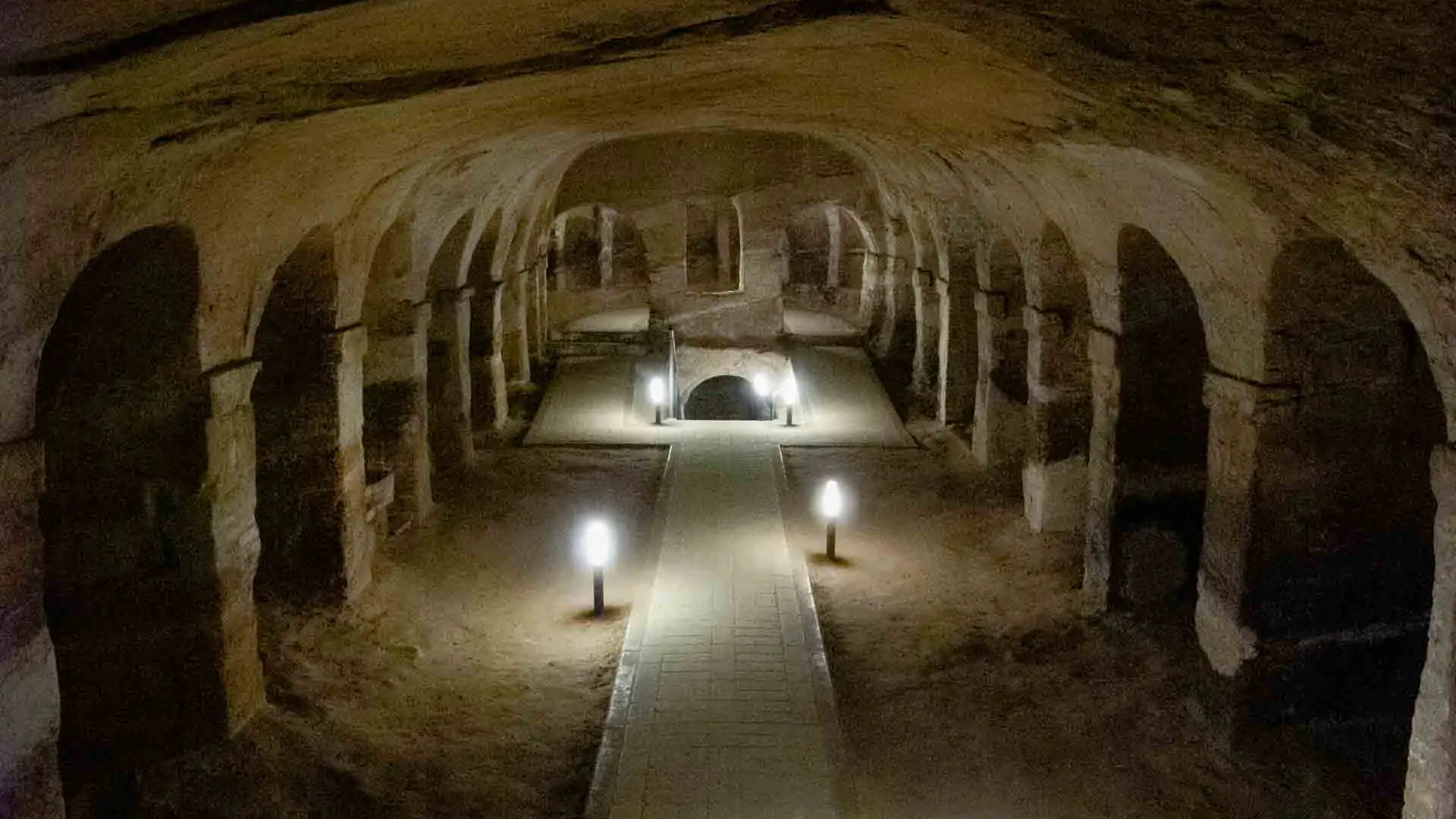 Camerano Caves→
Jerusalem. Tomar. Camerano. The symbol appears at the most sacred Christian site in the world, at the institutional headquarters of the order that drove Atlantic exploration, and in a known Templar underground complex. In each case it appears in a context of specific ritual or logistical significance.
The Atlantic Coast
2 min
In Brooklyn, Nova Scotia, on a large flat rock surface known locally as the wharf stone, a natural formation that served as a quay for the sheltered harbor at Liverpool, someone carved a three-pronged mark into the stone. The wharf stone sits at the water's edge of a natural harbor roughly 55 kilometers from Oak Island. Its function as working harbor infrastructure, a surface where boats landed and cargo moved, is established by local record. The form of the carving is consistent with the goose paw family: three lines meeting at a point, worked directly into a flat rock surface with no accompanying inscription, no date, no context that surviving records explain. No secure dating has been established for the carving, and no published research has previously placed it in the context of the medieval pilgrimage symbol documented across the Templar network from Jerusalem to Portugal.
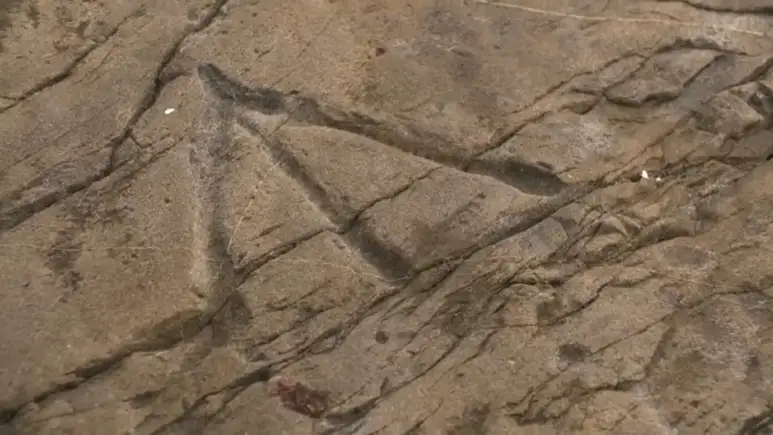 Goose Paw symbol (Brooklyn, NS)→
The tripod form has been compared to the British broad arrow, the three-hatchet-strike mark used under the Broad Arrow Policy from 1721 to reserve mast timber for the Royal Navy. That policy did apply to Nova Scotia. However, three distinct objections rule out that identification. First, the broad arrow in its timber policy context was applied exclusively to standing trees, blazed into bark: it was never applied to rock surfaces. Second, the only documented instances of the broad arrow cut into stone are Ordnance Survey benchmarks, which always carry a horizontal datum line above the arrow, forming a composite symbol entirely different from a plain tripod. The wharf stone carving has no such bar. Third, Ordnance Survey benchmarking was never conducted on the Nova Scotia coastline: it was a British domestic and garrison territories program that did not extend to the province. The broad arrow explanation fails on substrate, on form, and on geography simultaneously.
Context reinforces this. The wharf stone does not carry the tripod mark in isolation. Directly alongside it are a Globus Cruciger, a cut circle, a fish symbol, and a double fish-tail with a cross in a circle. The Globus Cruciger, a cross mounted on an orb, has been a symbol of Christian sovereignty since the late Roman Empire. It appears on medieval coinage, royal regalia, and ecclesiastical carvings across Europe, but never in British military surveying or timber administration. A mark carved in the company of a Globus Cruciger on a working harbor quay is not a survey datum or a timber reservation. It is something else.
Whether the wharf stone at Brooklyn represents the only place on the Nova Scotia coastline where this mark was left is a question that no systematic survey has yet answered.
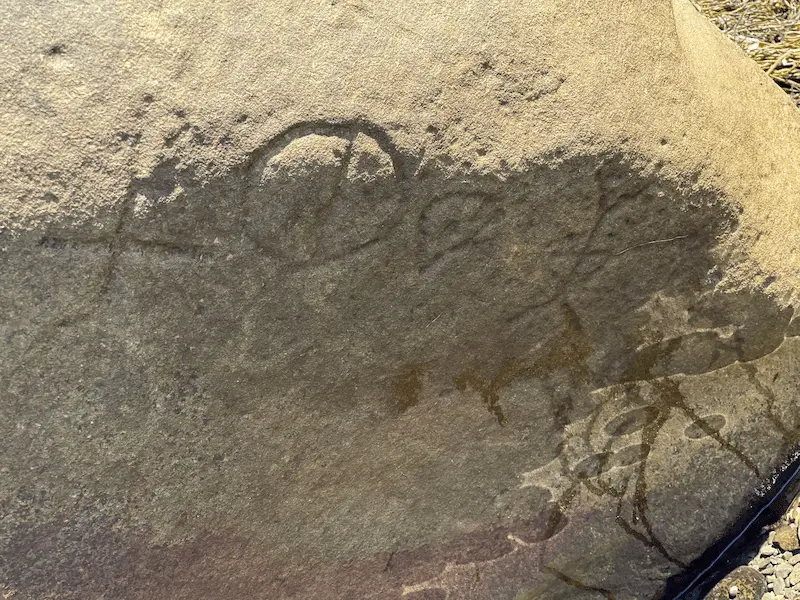 Brooklyn Symbols→
The Azores
3 min
The island of Terceira lies in the central group of the Azores, roughly 1,500 kilometers west of Lisbon in the open Atlantic. It was settled under the direct authority of the Order of Christ, the Portuguese successor institution to the Knights Templar, in the first half of the 15th century. Every aspect of its early colonial infrastructure, its churches, its administrative buildings, its harbor works, was built under that institutional umbrella. Terceira was not a waypoint that happened to fall on the Atlantic route to the New World. It was an Order of Christ possession, organized and populated by an institution that understood the ocean as a corridor and the islands as stations along it.
The oldest carved stone on the island, dated 1454 and now held at the Museu de Angra do Heroísmo, carries an iconographic program that reads as a complete symbolic statement about movement across open water. At the top of the stone, a goose is carved above two goose paws, flanked by two faces representing the winds blowing east and west. The goose, associated in medieval tradition with vigilance and long-distance navigation, is placed here between the cardinal directions of Atlantic travel, oriented between the wind that carries ships out and the wind that brings them home. Below this scene, carved lower on the same stone, is a swirl motif. The swirl drew the attention of the research team in Season 13 of The Curse of Oak Island because of its resemblance to a device on a copper artifact recovered from Lot 8. But the more significant iconography sits above it: a navigator's symbol placed above directional markers, on a stone dated to the first decade of organized Order of Christ settlement on the island.
In the village of Vila de São Sebastião on Terceira stands the Igreja Matriz de São Sebastião, a parish church whose construction began in 1455, one year after the museum stone was carved. It was built under the Order of Christ. On three corners of the chapel interior, carved into the stone, are groups of three-pronged goose paws, their original red pigment still preserved. Three groups of three: nine goose paws in total.
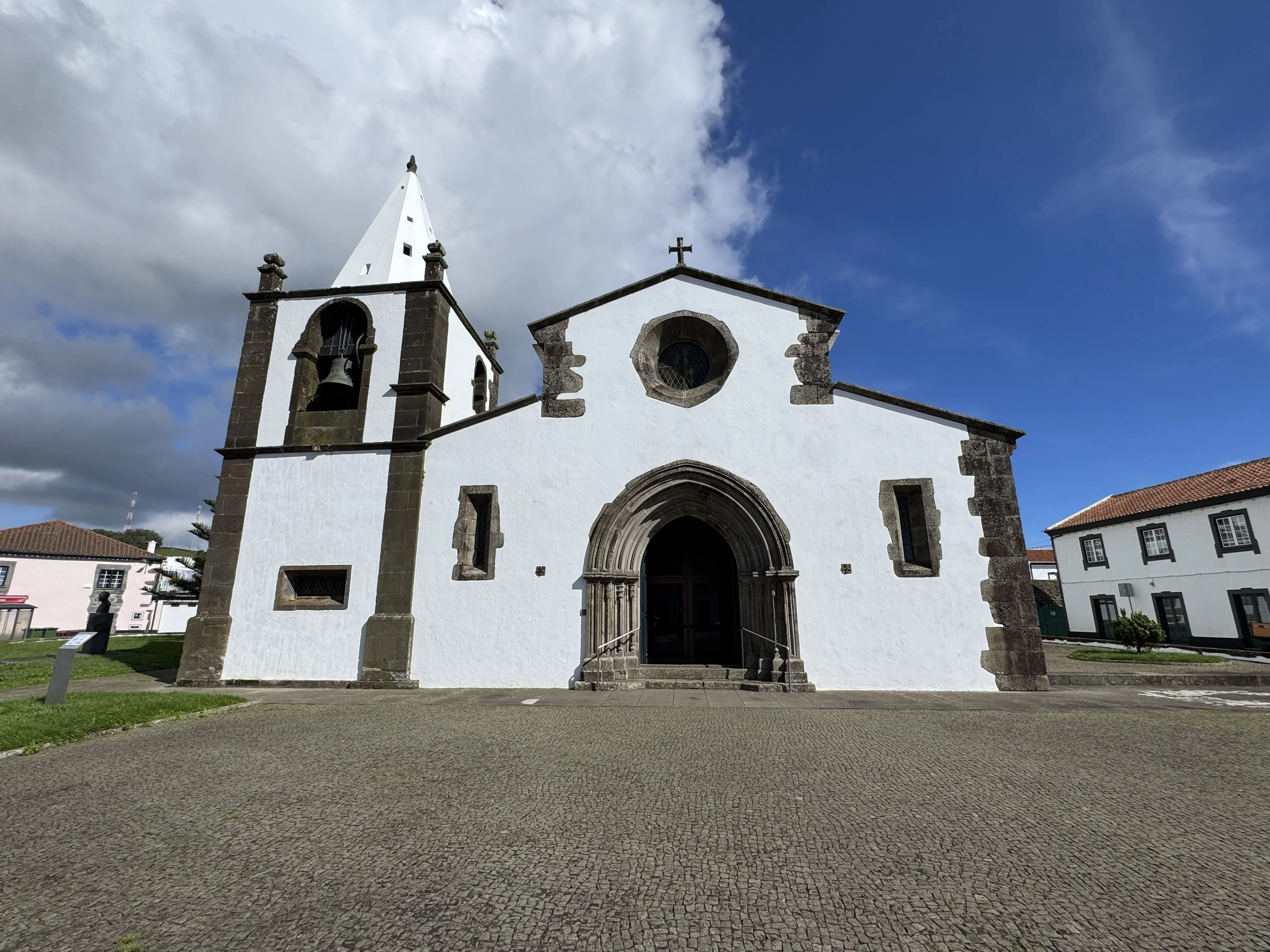 Church of Saint Sebastian→
Nine is not an incidental number in this symbolic tradition. In medieval Christian numerology, nine is the trinity of trinities: three multiplied by itself, the product of the divine number raised to its own power. The Pseudo-Dionysian hierarchy that organized medieval theology arranged the angelic orders into nine choirs. Nine carried a specific theological weight that three, for all its Trinitarian resonance, did not. Where three marked a sacred threshold, nine marked something beyond it.
The left portal of the Church of the Holy Sepulchre carries three goose paws above the door that opens onto the holiest ground in Christendom. The Igreja Matriz de São Sebastião carries nine, in three groups of three, on a church built by the same institution that controlled the sea routes westward. The numerological relationship between those two numbers, and between those two buildings, is an observation. Whether it reflects intention on the part of the carvers, or coincidence in the archaeological record, is a question the evidence as it stands cannot settle. What is established is that the symbol appears at the point of departure for the open Atlantic, in a quantity that medieval theology would have read as the trinity of trinities, placed there by an order that traced its institutional lineage directly to the men who built the portal in Jerusalem.
Sources
1 min
The goose paw in pilgrimage culture and the Camino de Santiago:
- Juan G. Atienza, El Camino de Santiago: La ruta sagrada, Ediciones Robinbook, Barcelona, 1992
- Adrian Seville, The Cultural Legacy of the Royal Game of the Goose: 400 Years of Printed Board Games, Amsterdam University Press, 2019. On the goose as a symbol of spiritual guidance in medieval culture.
The Cagots and the goose foot mark:
- Benoît Cursente, Les cagots, histoire d'une ségrégation, Cairn, 2018. Documents the pied d'oie clothing requirement attested from the early 15th century; the 1581 Bordeaux parliament ruling requiring the insigne discriminatoire du pied de canard; and the Béarnais term pè de guit.
- Gérard de Sède, Le mystère gothique: Des runes aux cathédrales, Robert Laffont, Paris, 1976. The Cagots within the Gothic builder tradition of southwestern France.
The Church of the Holy Sepulchre and its lintels:
- Jerusalem Experience, "The Two Lintels of the Church of the Holy Sepulchre," jerusalemexperience.com. Confirms the lintels were installed in 1149 and removed in the 1930s; confirms the right portal led to Golgotha and the Chapel of Adam.
- Rockefeller Archaeological Museum, Jerusalem. Current location of both Crusader lintels.
Tomar and the Order of Christ:
- Freddy Silva, First Templar Nation. Documents the goose paw carving at the Convento de Cristo, Tomar, and the associated legend of the three spears.
The British broad arrow in colonial Nova Scotia:
- Joseph J. Malone, Pine Trees and Politics, University of Washington Press, 1979. The standard scholarly account of the Broad Arrow Policy and the White Pine Acts of 1691, 1711, 1722, and 1772.
- Graeme Wynn, "Administration in Adversity: The Deputy Surveyors and Control of the King's Woods in Nova Scotia," Acadiensis, University of New Brunswick. Covers enforcement of the broad arrow timber policy specifically in Nova Scotia, with archival references to the Provincial Archives of Nova Scotia.