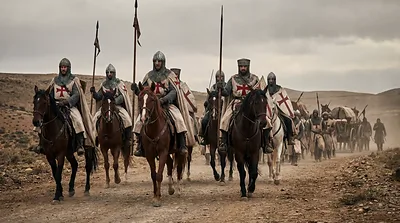
J. Hutton Pulitzer returns to the War Room with his cousin Aubrey Raiford to present the full scope of his theory. He proposes that the treasure buried on Oak Island is the Ark of the Covenant itself, hidden there by Phoenician mariners sometime between 582 and 596 BC. The Phoenicians, an ancient Semitic civilization that dominated Mediterranean trade from approximately 1200 to 550 BC, possessed the seafaring skills to cross the Atlantic. Pulitzer traces what he calls a sacred voyage from the Holy Land through North Africa, up the Iberian Peninsula, along the coasts of Ireland and Scotland, and across to Nova Scotia. At each stop along the route, he identifies archaeological evidence of the same language and the same eight-pointed star symbol. He connects the markings on the inscribed stone found at 90 feet in the Money Pit to tifinagh, an ancient alphabet associated with the Punic language of Carthage. In 1996, three ancient bronze coins identified as Carthaginian were discovered approximately 50 miles from Oak Island, and the eight-pointed star used by the Mi'kmaq people of Nova Scotia matches the Phoenician version. Pulitzer believes the Knights Templar came to Oak Island centuries later not to deposit treasure but to search for the Ark. Rick and Marty find the theory seductive but want more proof before drawing conclusions.
A larger and more powerful drill rig is brought across the Oak Island causeway to replace the quarry drill that stalled at 105 feet the previous week. Rather than drilling blindly, Marty Lagina and Craig Tester adopt a new strategy: locating the Halifax tunnel, one of the many searcher tunnels dug in the 19th century. In 1867, the Halifax Company sank a 110-foot shaft approximately 200 feet south of the Money Pit, hoping to bypass the flood tunnel booby traps. The tunnel flooded with seawater, but if the team can intersect it, the waterlogged shaft should lead them directly to the Money Pit. Using historical maps and charts, the team identifies two possible drill sites.
On the south shore near the swamp, Rick Lagina joins metal detection expert Gary Drayton, Peter Fornetti, and Dan Henskee to search for coins and artifacts that might support Pulitzer's Phoenician theory. After pulling a 1970s pull-tab from the ground, Gary recovers an antique coin. He identifies it as a British copper bearing the profile of King George II with Britannia seated on a shield holding a trident on the reverse, dated 1771, just a few years before the American Revolution. While the coin does not confirm a Phoenician presence, it adds another layer of evidence that human activity on the island predates the 1795 discovery of the Money Pit.
At the Money Pit site, the first drill hole comes up dry with no sign of the waterlogged Halifax tunnel. The team repositions and tries a second location. Meanwhile, the large drill rig begins to sink into the soft, unstable ground, a consequence of more than two centuries of digging, blasting, and backfilling. Safety concerns mount as the team considers the possibility that the rig could be settling over a rotted underground shaft that might collapse entirely. Rick and Craig pack the hole with boulders to stabilize the ground beneath the rig before resuming operations.
Despite the setbacks, the team remains committed to locating the original Money Pit and eventually mounting what Craig calls "the big dig," a complete excavation of the site down to 140 feet. That effort would require blocking or diverting the seawater that floods the shaft, then excavating an enormous hole before it can collapse. The cost would run into the millions. For now, the daily reality of Oak Island continues to test the team's patience and resources, but Rick makes clear that no amount of frustration will drive them away.