On October 16, 2017, Rick Lagina and metal detection expert Gary Drayton are searching the northeast corner of Oak Island at Smith's Cove when Gary uncovers a small lead cross. He estimates its age at somewhere between 1200 and 1600 AD. The discovery carries extraordinary weight because just one week earlier, Rick and two of his nephews had traveled to the 700-year-old Templar prison in Domme, France, where historian Jerry Glover showed them carvings etched into the stone walls by imprisoned knights, some reportedly using their own teeth. Among the carvings was a cross that appears to match the one Gary has just pulled from the sand at Smith's Cove. If the connection holds, the cross could represent physical evidence linking the Knights Templar to Oak Island, some 3,000 miles across the Atlantic.
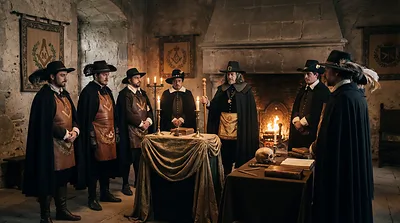
The episode traces the full arc of Templar history. In 1118, French knight Hugues de Payens and eight companions established their headquarters on Temple Mount in Jerusalem, calling themselves the Poor Fellow Knights of Solomon's Temple. Many researchers believe the nine original members spent a decade secretly excavating beneath the Mount, possibly recovering the Ark of the Covenant. The Order grew to more than 5,000 knights and developed what historians recognize as the world's first banking system, including the invention of the letter of credit. Pope Innocent III granted them tax exemption and border access across Europe, making them both fabulously wealthy and politically dangerous. When King Philip IV of France found himself deeply in debt to the Order, he moved to destroy it. On Friday, October 13, 1307, Philip arrested Grand Master Jacques de Molay, who was tortured for seven years before being burned at the stake on March 18, 1314. As the flames rose, de Molay reportedly cursed both the king and the Pope, and both died within a year. Over the following 14 years, Philip's three sons and grandson all died under mysterious circumstances, ending the Capetian Dynasty.
Of approximately 4,000 Templars, only about 500 were ever arrested, leaving 3,500 unaccounted for. A fleet of 18 ships based at La Rochelle on the Atlantic coast vanished before Philip's troops could seize them. Many researchers believe the fleet sailed to Scotland, where the excommunicated King Robert the Bruce offered sanctuary. There, the fugitive knights found protection under the powerful Sinclair family. According to letters discovered in the 16th century, Prince Henry Sinclair hired Venetian sailors Antonio and Nicolo Zeno to guide an expedition of 12 ships from Orkney in 1398, sailing west through Iceland toward Nova Scotia. Backing up the Zeno narrative are oral histories of the Mi'kmaq people, whose legendary figure Glooscap shares striking parallels with Sinclair, arriving by ship from the east bearing gifts and advanced knowledge. The Mi'kmaq ceremonial flag is the reverse of the Templar battle flag, with the star and crescent in mirrored positions.
Physical evidence of possible pre-Columbian European activity in Nova Scotia extends beyond Oak Island. At New Ross, just 20 miles north, property owners Alessandra Nadudvari and Tim Loncarich showed Rick and the team what appears to be an ancient foundation and a carved stone bearing a faint Templar cross. Near the Bay of Fundy, 130 miles southwest, amateur archaeologist Terry Deveau presented the Overton Stone, carved with Mi'kmaq symbols and what appears to be another Templar cross. On Oak Island itself, coconut fiber found at Smith's Cove in 2013 was dated to between 1260 and 1400 AD, placing it squarely within the Templar era. The episode also explores the transition from Templars to Freemasons through Rosslyn Chapel, built in 1446 by Henry Sinclair's grandson William, and the Legend of Enoch, which describes nine underground chambers beneath Solomon's Temple, a structure that researcher Alan Butler argues the Money Pit was deliberately built to replicate.