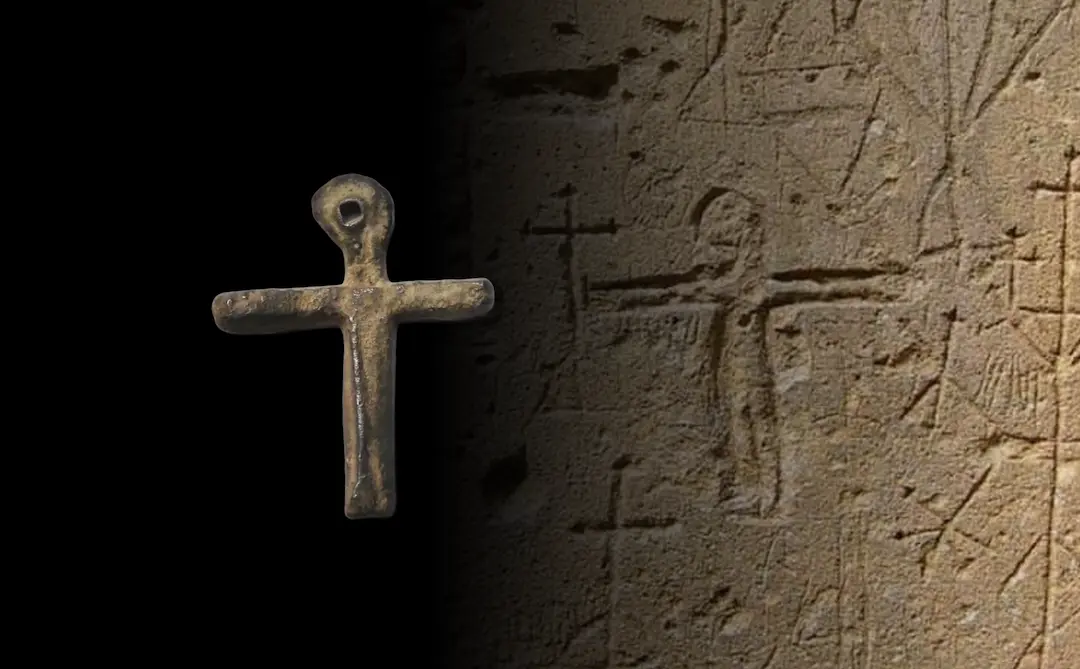
One carving in particular drew international attention in 2017. A crucifix carved into the prison wall bears a striking resemblance to the lead cross discovered by Gary Drayton at Smith's Cove on Oak Island during Season 5 of The Curse of Oak Island. Rick Lagina, who had visited Domme with Alex Lagina and Peter Fornetti during a research trip…
In 1307, seventy Knights Templar were imprisoned in the towers of Domme. The carvings they left behind include a crucifix that matches the lead cross found on Oak Island.
About This Site
Domme is a fortified medieval town in the Dordogne department of southwestern France, perched on a limestone cliff 150 metres above the Dordogne River. It was founded in 1281 by King Philip III of France, known as Philip the Bold, as a royal bastide: a strategic military stronghold designed to assert French control over the region during conflicts with the English Duchy of Aquitaine.
The town's most imposing feature is the Porte des Tours, a massive gateway flanked by two round stone towers that served as both the entrance to the bastide and, from 1307 onward, a prison. The fortifications and ramparts were completed by 1310. Domme was only 26 years old when its towers were put to their darkest use.
On Friday, October 13, 1307, King Philip IV of France ordered the simultaneous arrest of every Knight Templar in his kingdom. The charges were heresy, blasphemy, and idolatry. Historians widely agree that the accusations were politically motivated: Philip was heavily in debt to the order and sought to seize its wealth. Confessions were extracted under torture.
Seventy Templar knights were imprisoned in the towers of the Porte des Tours. According to Canon Tonnelier, who conducted the first systematic study of the site in 1970, these prisoners were held at Domme from 1307 until approximately 1318. The names of all seventy were later published by Andre Goineaud-Berard in the Bulletin de la Societe Historique et Archeologique du Perigord.
During their years of captivity, the imprisoned Templars carved hundreds of images into the hard stone walls of their prison. According to tradition, the prisoners had no tools and used their own fingernails and teeth to score the carvings into the rock. Some researchers, including Templar expert Jerry Glover, have expressed doubt about this explanation, noting that the complexity and depth of the carvings would be difficult to achieve with such crude instruments. Others have suggested that short knives may have been provided to the higher-ranking knights as a courtesy, a practice not uncommon in medieval noble imprisonment. However the carvings were made, the effort required was extraordinary. Seven distinct tableaux survive, depicting crucifixion scenes, crosses, religious figures, and geometric symbols. The carvings include what have been interpreted as Templar crosses, images of Christ on the cross flanked by the two Marys, crowned figures of the Virgin, and complex arrangements of triangles, circles, octagons and squares.
Canon Tonnelier proposed that these geometric shapes formed a symbolic code. An octagon represented the Grail. A triangle surmounted by a cross represented Golgotha, where Christ was crucified. A square represented the Temple of Solomon, the order's headquarters in Jerusalem. A circle represented imprisonment. Whether these interpretations are correct remains debated, but the religious intensity of the carvings is not in question. Whatever the symbols mean, they were carved by people of deep faith who knew they were unlikely to leave those walls alive.
The graffiti remain visible today. The Porte des Tours is open to visitors, and guided tours are available in French with English translations provided on request. In 1970, further examination of the walls revealed additional inscriptions invisible to the naked eye, suggesting that the full extent of the prisoners' testimony has yet to be uncovered.
Domme is now one of the "Plus Beaux Villages de France." But behind the honey-coloured stone and the panoramic views of the Dordogne valley, the towers of the Porte des Tours preserve the last recorded testament of men who were arrested for their faith, tortured for their confessions, and left to carve their truth into the walls of their prison.
Connection to Oak Island
One carving in particular drew international attention in 2017. A crucifix carved into the prison wall bears a striking resemblance to the lead cross discovered by Gary Drayton at Smith's Cove on Oak Island during Season 5 of The Curse of Oak Island. Rick Lagina, who had visited Domme with Alex Lagina and Peter Fornetti during a research trip shown in the preceding episode, immediately noted the similarity.
Templar expert Jerry Glover subsequently confirmed that the Smith's Cove cross is congruent with the Domme crucifix, and also with a design carved onto a pillar in the nave of a 13th-century church in Whitchurch, Buckinghamshire, England. That church stands half a mile from Creslow Manor, a former Knights Templar preceptory that was later turned over to the Knights Hospitaller after the order's suppression.
Lead isotope analysis by geochemist Tobias Skowronek of the German Mining Museum dated the Smith's Cove cross to between 900 and 1300 AD and traced its metal to medieval mines in southern France, thousands of miles from Nova Scotia. The resemblance between a physical artifact found on Oak Island and a carving made by imprisoned Templars in the Dordogne remains one of the most direct visual links between the island and the medieval order.
Gallery