On Oak Island, Rick Lagina restarts the effort to drain the triangle-shaped swamp. Environmental regulations require that water be diverted several hundred yards to the western side of the island rather than pumped into the nearby ocean. Jack Begley helps set up a larger pumping system with additional stations, designed to overcome the natural springs that refilled the swamp the previous year. Meanwhile, Craig Tester, his son Drake, and Jack join Dan Blankenship at a mysterious clearing known as the bald spot, a patch of land where trees inexplicably refuse to grow, adjacent to the boulderless beach, the only stretch of Oak Island shoreline where all rocks appear to have been cleared away. Dan uses dowsing rods to locate what he believes are two intersecting tunnels beneath the surface. An excavator digs to its maximum depth of 12 feet but finds no cribbing or wood, though the team acknowledges the tunnel could lie deeper than the machine can reach.
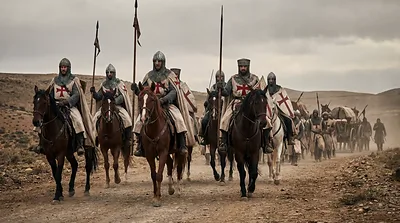
In Scotland, Rick, Marty, Alex Lagina, Dave Blankenship, and Charles Barkhouse join researchers Kathleen McGowan and English author Alan Butler at Saltcoats, a natural harbor on the Scottish coast. Butler explains that after King Philip IV of France ordered the arrest of the Knights Templar on Friday, October 13, 1307, eighteen ships believed to be carrying precious Templar cargo left the port of La Rochelle and sailed for Scotland. Scotland was a safe haven because King Robert the Bruce had been excommunicated by the Pope, placing the entire country beyond Rome's reach. Butler and McGowan believe the Templar treasure, including the Ark of the Covenant and the Holy Grail, was brought into this protected harbor and then moved to nearby Kilwinning Abbey.
At Kilwinning Abbey, the team learns about the Tironensian order, a group of builder monks founded in Tiron, France, in 1109 who constructed more than 100 abbeys and priories across France, England, Ireland, Wales, and Scotland. The Tironensians were not only expert builders above ground but also skilled at constructing underground tunnel systems, including one believed to connect Rosslyn Chapel to a nearby castle. McGowan and Butler argue that the Knights Templar formed a secret alliance with the Tironensians and later the Freemasons to transport and conceal sacred objects, ultimately hiding them on Oak Island. The engineering sophistication required to build the Money Pit's flood tunnel system and underground vault would be consistent with Tironensian expertise.
The group visits Rosslyn Chapel, designed by William Sinclair and built by Freemasons around 1456. The chapel's carvings include what many identify as corn or maize, a grain native to North America that could not have been known in Scotland before the discovery of the New World. This supports the theory that William Sinclair's grandfather, Prince Henry Sinclair, sailed to Nova Scotia in 1398, nearly a century before Columbus. Historical accounts suggest the Mi'kmaq people of Nova Scotia encountered Henry Sinclair and regarded him as a god named Glooscap who taught them new methods of fishing and navigation. The ceremonial flag of the Mi'kmaq is virtually identical to the Templar battle flag of Henry Sinclair.
Alan Butler presents a final theory connecting Rosslyn Chapel directly to Oak Island. The distance between Rosslyn Chapel and Rosslyn Castle is 366 megalithic yards, equivalent to 996 feet. Butler believes the Templars used this same measurement system on Oak Island, constructing a new Jerusalem based on the Enochian model, with a hidden chamber located 366 megalithic yards from the Money Pit at a fixed compass point due west, a location that falls squarely in the swamp. Marty, who has repeatedly expressed his desire to abandon swamp operations, grudgingly accepts that yet another theory points to the same location. Rick commits without hesitation, and the team prepares to return to Oak Island more convinced than ever that the answers lie in both the Money Pit and the swamp.