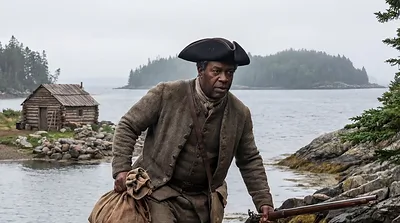
Samuel Ball, the Unlikely Oak Island Owner
Samuel Ball escaped slavery during the American Revolution, settled on Oak Island in 1787, and ac...

Recorded 2022, 142 to 160 ft
A cavern south-east of the Money Pit, found when Borehole L-15 broke into a void at about 150 ft in 2022 and scanned by sonar at about 30 ft long and 12 ft wide. The team named it Aladdin's Cave in Season 11; L-14 reached it at 160 ft, a hole 10 ft north-west of L-16 broke into it at 142 ft and KL-15 at 147 ft, water tests reported traces of precious metals, and cameras and an ROV were sent in. On the show's grid plan it spans rows L to O and columns 13.5 to 17.5, with KL-14.5, L-16, N-15 and N-16.5 inside it and L-13.5 on its western edge. The outline is the team's interpretation of drilling and sonar results, not a surveyed structure.
An area defined by drilling results and named on the show; not a surveyed structure.
142 to 160 ft, as reported by the source.
Borehole L-15 went down in Season 10, 15 feet south of a hole that had just missed a tunnel being tracked toward the Garden Shaft. At 146 feet the bottom fell out and the drill dropped roughly ten feet. Sonar a week later measured the void at about 27 feet east to west by 12 feet north to south. Craig Tester, the engineer and partner in the Lagina search, noted that it sat in the limestone just above bedrock, near the depth of the vault Frederick Blair and William Chappell drilled into in 1897. Dan Blankenship, the Florida contractor who searched the island from 1965 until his death, said any voids in that limestone were probably manmade.
The name arrived in Season 11, when a muon survey reported a low-density anomaly overlapping what the show now called Aladdin's Cave, 30 feet by 12 on sonar. Water testing by Fred Michel, who with Ian Spooner runs the team's water program, reported gold inside it. Borehole L14, aimed at 160 feet, hit open space at 148. Blaine Carr, an underwater imaging specialist, ran a camera and three-dimensional sonar down L14 and concluded there was potential for a manmade ingress into a natural cavern. KL14.5 broke in at 142.5 feet with the void running to 153 feet, where the camera showed what looked like a bolt head and flowing water. A second sonar scan from a new hole picked up two straight lines that did not look natural and a sand-like slope that could be covering objects; a camera showed a wall edge and a dark area read as a possible tunnel entrance. KL15 entered at 147 feet but met infill, read as a partial collapse. By the end of Season 11 the compiled picture was a cavity 25 feet east to west, 15 feet north to south and about 10 feet high, and Spooner said it was collecting gold, silver and wood values.
In Season 12 Marty Lagina, who leads the search with his brother Rick Lagina, proposed the cave as the next caisson target. The caisson, AC1, brought up hand-hewn timbers at 96 feet and a hand-forged spike the team's laboratory dated to the mid-1700s or earlier, and at 115 feet the pressures on the rig spiked and fell, read as breaking into the cave. After flocculant was added to clear the water, Ken Deboer, a remotely operated vehicle specialist, lowered his unit into the shaft; the camera returned a black image, the sonar read nothing, and the team moved on. The episode record through Season 13 shows no return; the deep work of 2025 and 2026 went elsewhere.
Joy Steele and Gordon Fader, a marine geologist who spent his career mapping the seabed off Nova Scotia, give the other reading. The bedrock under the east end of the island is Windsor-age limestone, gypsum and anhydrite; water dissolves those rocks, forming cavities and channels, and when a roof gives way the till above falls in as a sinkhole. Reviewing cavities Graham Harris and Les MacPhie reported at 190 to 200 feet in the 1960s drilling, Fader preferred cavity to chamber, since such openings are likely natural in limestone and gypsum, and noted that wood at those depths can survive from forests that grew there before and between glaciations. Crooker records that in 1966 Robert Dunfield's drill passed through limestone at 140 to 142 feet and fell through a 40-foot void to bedrock, a cavern first met in 1955.
The record supports a real cavity of roughly 25 to 30 feet by 12 to 15 feet at about 150 feet, entered by five boreholes and apparently one caisson, its water reported to carry gold and silver. Against a natural origin are the sonar's straight lines, the bolt-like object on camera and the depth match with the 1897 vault; for it are the limestone and gypsum around the cavity and the documented voids nearby. No one has seen the floor, and nothing has been recovered from inside.




As an Amazon Associate I earn from qualifying purchases.
Samuel Ball escaped slavery during the American Revolution, settled on Oak Island in 1787, and ac...

The widow and son of the admiral who died off Nova Scotia in 1746 dined with Benjamin Franklin. O...

Oak Island evidence as of 2026: the carbon dates, the coins, the human remains, the Lot 8 boulder...