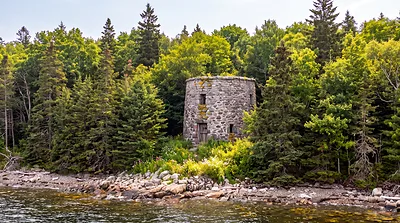
All work on the Garden Shaft comes to a halt after the Nova Scotia government determines the project requires mining permits rather than the rehabilitation authorization Dumas Contracting originally received. Craig Tester explains that Dumas must apply for new permits and has fielded more than 50 questions from various agencies. Dumas has left the site, but Rick Lagina tells Marty Lagina by video conference that the ongoing drill program is unaffected. Three weeks earlier Dumas had begun rehabbing the shaft, found in 2017 and originally believed to be an 80-foot-deep searcher shaft from the 19th century. Wood from the shaft was recently dated to around 1730, and water from the shaft tested positive for gold.
In the Money Pit, the team drills Borehole IJ-15.25 in an effort to track the tunnel heading toward the Garden Shaft, dated to as early as the 17th century. At 108 feet the core contains no wood, and Terry Deveau declares they have missed the tunnel. Steve Guptill determines the next location: Borehole L-15, positioned 15 feet south. A core from 109 feet contains wood, and Terry identifies bedded material at what should be the tunnel's base. He and Charles Barkhouse believe they have nicked the edge, but the angle makes it impossible to determine the tunnel's direction. Drilling continues to 145 feet. The next day, Mike brings over a core from 146 feet and reports the bottom fell out during drilling; the drill dropped roughly 10 feet as if nothing was there. Terry and Steve agree this is a cavity the team did not know about. The following morning Rick and Marty meet the team and lower a camera into L-15. At 151 feet and 8 inches the camera stops. As Scott Barlow rotates the feed, the team notices unusual fractures in the rock and Marty spots what appears to be a pedestal. Marty suggests running 3D sonar to map the void.
On Lot 8, Gary Drayton and Jack Begley arrive at the first flag and unearth part of a claw hammer that resembles one found the previous year on Lot 15, which Dr. Christa Brosseau said could date to the 1500s.
At the Research Center, Marty, Alex Lagina, and Craig meet Jeremy Church and Burton Cosgrove of Panther Geoscience, who will perform a geophysical scan of all 32 lots on Oak Island. Using an EM31-8 prototype based on technology that has been around for several decades, the device measures conductivity to a depth of 30 feet, allowing the team to locate metallic objects and features such as old foundations. Alex and Marty suggest starting in the swamp, where the scan could provide more information about the ship-shaped anomaly and supply data needed for a permit to drain the area. Craig and Alex then join Tony Sampson, Jeremy, and Burton at the swamp, where Tony guides the boat while Jeremy and Burton run the scan. Almost immediately the equipment picks up a target, and after marking it they continue scanning and get another hit. The completed 3D map will take several weeks to process.
In the War Room, the team meets by video conference with Dr. Edwin Barnhart for his final report on the artifact found the previous week on Lot 8. After reviewing Emma Culligan's metallurgy report and researching the symbols, Barnhart confirms the metal is an alloy of copper, zinc, and a very small amount of lead. He states that nothing in the Americas was ever alloyed in this way, making the piece definitively European. Most brass came from Europe and was more common in the 1500s. Barnhart adds that the area around Oak Island was a "crossroads of the world," with the Portuguese present before Plymouth Rock was visited, and the Vikings crossing the Atlantic around 1000 A.D. and plating objects with brass. Rick mentions several very old artifacts already found on the island, including the Chinese cash coin and a piece of ship's railing dated to the 7th century. Robert Young found a coin on Lot 5 in 1996 that he believed was Norse.