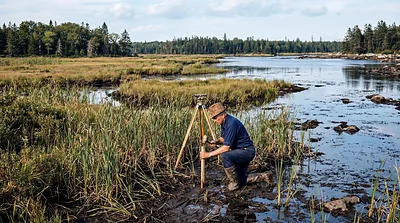
In the War Room, geophysicist Jeremy Church presents results from the geophysical scan of the island performed the previous week with his partner Burton Cosgrove and the help of Tony Sampson. The swamp survey shows numerous red zones indicating high conductivity that could signal metal objects. Rick Lagina wonders whether one of the targets could be the mystery box that island caretaker Jack Adams found in the 1930s. In 1969 Fred Nolan drained the swamp after hearing the story of the box; he never found it but did recover parts of a sailing vessel and survey stakes dating as much as 300 years before the discovery of the Money Pit, leading him to speculate the swamp was artificially created to hide a ship and its cargo. Jeremy also identifies high conductivity near the Eye of the Swamp, where the team previously found boulders in a circular pattern around a possible shaft that Dr. Ian Spooner estimated at roughly 350 years old. Tom Nolan tells the team his father believed a wall system existed between the beach and the swamp on the north side. The team agrees to scan the area and gather as much data as possible before applying for permits.
In the Money Pit, the team performs sonar on Borehole L-15, where a void was found at approximately 150 feet the previous week. After lowering the sonar to that depth, Steve Guptill begins capturing images and then drops the device six more inches, revealing a significant opening running north and south. He will download and process the data for the team. On the Lot 10 beach, Tom, Peter Fornetti, and subsurface detecting expert Stephan Grund conduct a ground-penetrating radar scan using the OKM Gepard 3D device, which can detect structures as deep as 130 feet. The data reveals several anomalies in the middle of the scanned area, in the zone where Fred believed a log wall structure played a role in the creation of the swamp.
Rick and Marty Lagina announce to the team that they have purchased Lot 5, previously owned by Robert Young. Young, Fred Nolan's research partner, purchased the property from Nolan more than 20 years earlier and found many artifacts on it, including buttons and ancient coins. On the newly acquired lot, Rick, Gary Drayton, and archaeologist Laird Niven begin metal detecting. Gary gets a hit near the lot line and Rick unearths a wrought-iron fastener that Laird describes as chisel-like. Gary immediately gets another hit beside the first, producing a second chisel that he believes was lost at the same time. The next day Rick and Gary return and recover a survey marker followed by an old cut coin found deeper in the lot. Gary identifies it as a hammered coin, a style that was being replaced by machined coins in the 15th century.
At the Interpretive Center, Laird examines the coin and confirms it has been cut. Emma Culligan scans it with the XRF and reports the piece is mainly copper with some tin, iron, and arsenic. Rick asks whether this qualifies as arsenical bronze, and Emma confirms it does, adding that arsenical bronze began to disappear in the 1500s and was gone by the 1700s. Laird and Gary agree the coin is unlikely to be English or Spanish. Rick calls Marty with the news.
Craig Tester presents the sonar data from Borehole L-15 in the War Room. Steve shows the team the results: the void measures approximately 27 feet east to west and 12 feet north to south. Craig notes the void sits in the limestone bed just above the bedrock, which does not make sense as a natural feature. Marty asks Dan whether he ever saw voids in the limestone during his time on the island, and Dan replies that any voids there are probably manmade. Craig points out the void is at essentially the same depth as the vault found by Frederick Blair and William Chappell in 1897. To avoid damaging any treasure that may be inside, the team will need to develop a plan before further investigation. In the meantime, drilling will continue closer to the Garden Shaft.