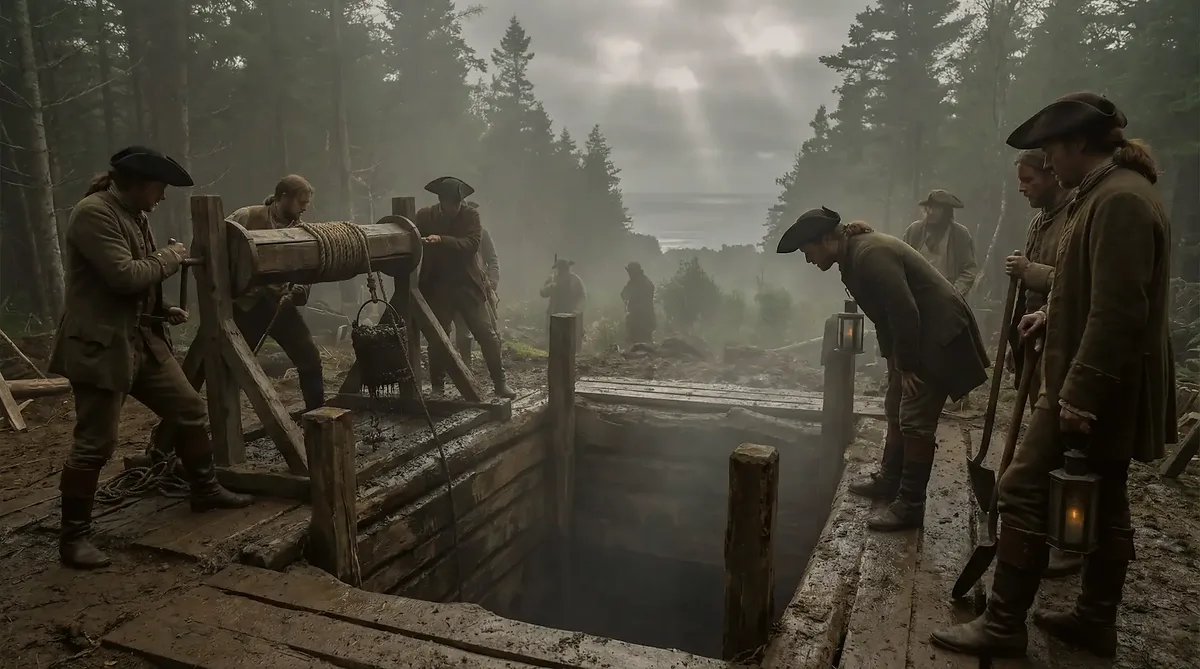
In 1795, Daniel McGinnis, John Smith, and Anthony Vaughan dug with hand tools and stopped at 30 feet. In 1849, the Truro Company lowered a pot auger into the Money Pit and brought up fragments of oak, coconut fiber, and what they described as "metal in pieces." In 2025, a 135-ton telescoping drill rig operated by Soletanche Bachy Canada and ROC Equipment ground through anhydrite bedrock at 212 feet and kept going. The Oak Island treasure hunt has always been defined as much by its machinery as by its mystery, with each generation of equipment pushing deeper into ground that has defeated every previous attempt.
Metal Detection
1 min
Metal detection expert Gary Drayton joined the Oak Island team in Season 2 and has appeared in nearly every episode since, making him the most consistent field presence in the search. His primary instrument is the Minelab CTX 3030, a professional-grade detector equipped with interchangeable coils ranging from a 6-inch unit for tight spaces to a 17-inch oval coil for deeper penetration. Drayton pairs the CTX 3030 with a Minelab PRO-FIND 25 pinpointer for precise target isolation once a signal has been identified. The CTX 3030's built-in GPS allows every find to be logged with exact coordinates, creating a searchable map of artifact distribution across the island.
For fine gold detection in excavated soil, the team uses a Minelab SDC 2300, a compact pulse-induction detector designed for heavily mineralized ground. Spoils removed from Money Pit boreholes are spread on tarps and scanned with the SDC 2300 to catch small metallic fragments that larger detectors might miss. The island's beaches are covered in iron pyrite, but the pulse-induction technology is unaffected by this mineral interference.
In Season 8, the team introduced the OKM eXp 6000 Professional Plus, a 3D ground scanner capable of creating subsurface imaging maps that distinguish between different metal types and geological features. Supplied through KellyCo Metal Detectors, the eXp 6000 has been deployed in seven episodes across Seasons 8 through 12, primarily to survey areas where conventional detectors lack the depth to reach targets of interest. Earlier in the search, the team used a Deepmax X6 unit, a deep-seeking detection system acquired from KellyCo that produced strong nonferrous readings in the swamp during Seasons 1 and 2. The Deepmax X6 was fitted with a large frame coil mounted to a sled for systematic grid scanning across the frozen swamp surface in winter conditions.
Drilling
1 min
Core drilling is the primary method for probing the Money Pit at depths beyond the reach of excavation equipment. Choice Drilling, a Nova Scotia-based company, has provided sonic drilling rigs to the team since Season 6. The sonic rig uses high-frequency vibrations to pulverize subsurface obstacles and extract intact core samples from depths of up to 500 feet. Choice Drilling foreman Brennan has operated the rig across nine episodes, working alongside geologist Terry Matheson to position boreholes based on seismic data and historical shaft maps. The cores are examined on-site as they are extracted, with each section catalogued for depth, material composition, and any artifacts present.
In Season 7, Choice Drilling assembled a 20-ton floating barge composed of four ten-by-twenty-foot sections to support a five-ton sonic drill rig in the swamp, where solid ground does not exist. RMI Marine Limited assisted with the barge construction. From this platform, the team drilled into the "ship anomaly" identified by earlier remote sensing, extracting cores from multiple locations at depths of up to 57 feet below the swamp surface.
Logan Drilling appeared in Season 3, with drillers Harold Fraser and Jason Pike operating a coring rig on the western side of the island, where compacted slate bedrock meant that any void encountered would almost certainly be man-made rather than natural. Well driller Jordan Rogers has also appeared across multiple seasons, operating conventional drilling rigs for exploratory boreholes in locations suggested by researchers and historical maps.
The Oscillator and Caisson System
2 min
The casing oscillator, supplied by ROC Equipment of Salt Lake City, is the largest and most distinctive piece of machinery on Oak Island. The oscillator twists toothed steel caissons into the earth, creating shafts wide enough for systematic excavation of underground material. In Season 4, ROC used a smaller oscillator weighing approximately 64,000 pounds. By Season 7, a custom-built unit weighing 110,000 pounds had replaced it, capable of driving eight-foot-wide caissons to depths exceeding 200 feet.
ROC Equipment CEO Lou Lucido initially ignored phone calls from the Oak Island production team, finding the idea of chasing buried treasure outside his company's normal operations. After conducting research into previous drilling attempts on the island, Lucido committed ROC to the project, drawn by a challenge that aligned with the company's expertise in straight-shaft drilling. Previous attempts on Oak Island had routinely produced shafts that deviated as much as 40 feet from plumb at depth, a problem ROC's oscillator technology was specifically designed to solve.
Vanessa Lucido, CEO of ROC Equipment, has been a regular presence on Oak Island since Season 6, appearing in 26 episodes to oversee caisson operations and advise the team on drilling strategy. Material excavated from inside the caissons is removed by a hammer grab, a long cylinder with metal jaws at its base that is lowered by crane and closed around soil, rock, and debris. The hammer grab has featured in 38 episodes, and the process of examining each load of spoils as it surfaces has produced many of the search's most significant artifact recoveries.
In Seasons 12 and 13, ROC partnered with Soletanche Bachy Canada, a geotechnical engineering firm, to deploy a telescoping caisson method. Adam Embleton of Soletanche Bachy outlined the approach: an 8.5-foot-diameter caisson for the first 130 feet, narrowing to seven feet for the remaining depth to reach 230 feet. The operation replaced the hammer grab with a giant auger bit mounted on a 135-ton rotary drill rig, capable of grinding through the dense gypsum and anhydrite that had slowed previous seasons. Once the auger reached the solution channel, a dig bucket with rock teeth replaced it to safely extract spoils without damaging potential artifacts.
Heavy Machinery and Site Operations
1 min
Irving Equipment Limited, based in St. John, New Brunswick, has supplied cranes and heavy lifting capacity to Oak Island since Season 4, appearing in 44 episodes. The company's largest crane on the island has a lifting capacity of 500,000 pounds, used to position and drive the caissons during oscillator operations. Irving project manager Mike Jardine has coordinated logistics across multiple seasons, including the construction of the 525-foot steel cofferdam at Smith's Cove in Season 6, where Irving crews drove 117 interlocking steel sheet pilings some 25 feet into the seabed to create a dry excavation area.
Heavy equipment operator Billy Gerhardt is the most frequently seen operator on the island, appearing in 103 episodes from Season 5 onward. Gerhardt operates excavators and backhoes for everything from road construction and swamp drainage to trench excavation and artifact recovery. The team has used Volvo EC200E and ECR145E medium crawler excavators, supplied by equipment dealer Strongco, for excavation and cleanup work. The ECR145E, a zero-tail-swing model, proved particularly useful in tight spaces around active dig sites.
Brycon Construction assisted with early infrastructure work in Seasons 4 and 6, including cofferdam preparation and access road construction. Kent Homes, an affiliate of Irving Equipment, donated a prefabricated building in Season 6 to serve as a dedicated research center on the island.
The wash plant, a 50-ton industrial unit acquired in Season 6 from Rhodes Corner Quarry near Bridgewater, Nova Scotia, processes excavated material through a hopper, conveyor belt, grizzly bars, and dual shaker decks with spray nozzles. The system sorts and cleans material by size, allowing the team to identify artifacts that would be invisible in raw spoils. Billy Gerhardt demonstrated the machine before purchase, and it has been in continuous use since, processing material from caisson operations, swamp excavation, and surface digs across 18 episodes.
Remote Sensing and Geophysics
2 min
Eagle Canada, a geophysical survey company based in Calgary, Alberta, conducted seismic imaging of the Money Pit area beginning in Season 6. Geophysicist Jeremy Church led the survey, which used controlled energy pulses to map underground density variations and identify anomalies. The data revealed a 13-by-13-foot feature at the center of the Money Pit area at a depth of 160 feet, dubbed the "Teardrop," along with numerous smaller disturbances consistent with the dozens of searcher tunnels dug over the previous two centuries. Church's seismic data informed drilling decisions across 23 episodes and multiple seasons.
Ground-penetrating radar has been deployed in 13 episodes, beginning in Season 2 when Canadian Seabed Research brought a MALA rough terrain antenna system to the swamp. GPR sends electromagnetic pulses through the earth to detect structures, objects, and voids at depths of up to 30 feet. Unlike metal detectors, GPR can identify stone structures and wooden objects. The technology was later used to survey Samuel Ball's former property on Lot 6, where it detected underground wall features and anomalies near the foundations of Ball's home.
LIDAR scanning, which fires laser pulses and measures the reflected light to create three-dimensional surface models, was introduced in Season 6 and used to map terrain features across the island that are invisible at ground level. The technology revealed subtle depressions, alignments, and ground disturbances that directed subsequent excavation.
In Season 9, Ideon Technologies of Vancouver brought muon tomography to Oak Island, a technique that detects naturally occurring subatomic particles called muons as they pass through underground material. Density variations in rock and soil alter the muon trajectories, allowing the system to map voids and structures at great depth. The same technology detected an unknown chamber inside the Great Pyramid of Giza in 2017. Gary Agnew, Doug Schouten, Kim Lawrence, and Max Howarth of Ideon placed 14 sensors in five boreholes at depths between 80 and 250 feet. The sensors remained in place for nearly two years before Howarth and Schouten delivered results in Season 11, identifying density anomalies that guided the team's subsequent drilling targets.
Laboratory Analysis
1 min
X-ray fluorescence analysis, performed with a handheld XRF gun, has become a standard field tool since Season 8, appearing in 40 episodes. The device fires X-rays at an artifact and reads the elemental composition of the returned fluorescence, identifying metals such as gold, silver, copper, lead, and iron within seconds. On Oak Island, XRF analysis has been used to confirm the composition of coins, buttons, fragments of worked metal, and soil samples without destroying or altering the artifact.
More detailed laboratory work is conducted off-island. Carbon-14 dating has been applied to wood, fiber, and organic material recovered from boreholes and excavations throughout the search. Dendrochronology, the analysis of tree ring patterns, has supplemented radiocarbon results where wood samples are large enough. Mass spectrometry and spectrographic analysis have been used to date metal artifacts and identify alloy compositions, including the brass fragments from deep boreholes that were shown to contain high levels of impurities consistent with early smelting techniques.
Marine and Dive Operations
1 min
The steel cofferdam at Smith's Cove, constructed by Irving Equipment in Season 6, is one of the largest single structures ever built on Oak Island. The 525-foot wall of interlocking sheet pilings created a dry enclosure around the cove, allowing the team to excavate the area where the original box drains and flood tunnel entrances are believed to exist. Earlier seasons used a water-filled bladder system as a smaller-scale cofferdam, but the steel version provided far greater stability and permitted deeper excavation.
Divetech Limited conducted remotely operated vehicle operations in deep boreholes, lowering camera-equipped ROVs into flooded shafts to conduct sonar scans and visual inspections at depths inaccessible to divers. In Season 3, safety diver John Tapper assessed the challenges of a 235-foot descent into Borehole 10-X, recommending trimix breathing systems to manage nitrogen narcosis below 100 feet. Professional diver Harvey, working with diving partner Michael, ultimately reached approximately 204 feet inside 10-X before encountering an impassable drill bar in zero-visibility conditions.
Canadian Seabed Research deployed side-scan sonar off Oak Island's south shore, discovering triangular rock formations on the seabed that appeared to align with the stone triangle first identified by Frederick Blair on the island's south shore in 1897. Marine archaeologist Rod Peterson conducted follow-up dives to examine the formations at roughly 20 feet of depth.
Historical Equipment
2 min
The tools used in the first century of the Oak Island search were crude by comparison but no less ambitious. The Truro Company's pot auger, deployed in 1849, was the instrument that produced the first physical evidence from deep inside the Money Pit: fragments of oak, spruce, coconut fiber, and what the operators described as "metal in pieces" at depths exceeding 100 feet. The auger also brought up a small piece of sheepskin parchment bearing the letters "vi" or "wi" in India ink, one of the most frequently cited finds in the island's history.
The Onslow Company, which conducted the first organized excavation in 1803 or 1804, used manual labor and horse-drawn equipment. By the mid-19th century, searchers had introduced pump engines to combat the flooding that defeated every attempt to reach the bottom of the Money Pit; the first recorded death on the island occurred in 1861 when a pump engine boiler burst during an Oak Island Association operation.
In the 1960s and 1970s, Dan Blankenship and the Triton Alliance brought industrial drilling to the island for the first time. Parker Kennedy of Halifax, described by Blankenship as "the best damn driller I've ever had on the island," operated a churn drill that bored a 27-inch hole through bedrock to 235 feet at Borehole 10-X. A quarter-inch-thick steel casing was driven down to 180 feet, with the remaining 55 feet left with natural anhydrite walls. The Becker drill, used during the same era, brought up fragments of china, cement, wood, charcoal, brass with high impurity levels, and oak buds from blue clay at 170 feet, material that geologists said could only have been placed there by human activity.
An unusual footnote in the equipment history involves Statesman Mining of Aspen, Colorado, a company partly owned by the actor John Wayne. In 1970, Triton leased Statesman's hybrid drill and clamshell digger to rebore 10-X. The machine brought up thin metal fragments from 45 feet but could not handle the boulders below that depth, reaching only 85 feet before being sent back to Colorado. Negotiations for Wayne to narrate a documentary about Oak Island fell through, though the episode left behind a persistent legend about his connection to the treasure hunt.
The Limits of Technology
1 min
For all the advances in drilling, detection, and remote sensing, the geology of Oak Island continues to impose constraints that no piece of equipment has fully overcome. The Money Pit area is, as ROC Equipment's Vanessa Lucido described it, "like Swiss cheese," riddled with more than 40 shafts, tunnels, and boreholes dug over 230 years of searching. Each one eventually flooded, leaving the soil unstable and the subsurface honeycombed with voids. In Season 6, a sinkhole opened beneath the oscillator during drilling of borehole H-8, forcing the team to halt operations while engineers assessed whether the entire Money Pit area might collapse. The sinkhole grew to 11 feet across overnight.
Seawater infiltration, the same problem that defeated the Onslow Company in 1804, remains active. The flood tunnel system, whether originally constructed as a booby trap or a natural feature of the island's limestone geology, continues to fill shafts and boreholes with saltwater at rates that overwhelm pumping capacity. The anhydrite and gypsum bedrock below 150 feet is dense enough to stop drill bits and slow even the 135-ton auger rig brought in by Soletanche Bachy. The solution channel, a natural dissolution feature in the limestone, creates unpredictable voids and shifting ground conditions that make precise targeting at depth an ongoing challenge.
The equipment on Oak Island has evolved from shovels and ropes to industrial machinery costing millions of dollars per season. What has not changed is the fundamental difficulty of extracting material from a waterlogged, geologically complex site that has been disturbed by over two centuries of previous attempts. Each new technology has extended the reach of the search, but the island has yielded its secrets slowly, one core sample, one hammer grab load, and one metal detector signal at a time.