About This Structure
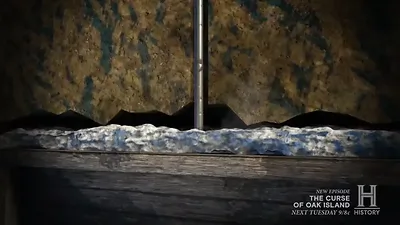
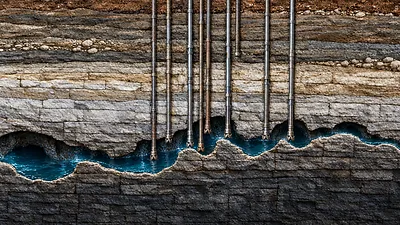
In 1897, drillers working for the Oak Island Treasure Company struck a layer of cement-like material at approximately one hundred and fifty-three feet below the surface of the Money Pit. William Chappell, who operated the drill, left handwritten notes (preserved in the Blair archives) describing the sequence: at 153 feet the drill encountered what he believed was wood, then the auger bored five inches before dropping two inches and striking something hard. Below that, the drill worked through roughly eighteen inches of material in small pieces before hitting a hard, solid surface it could not penetrate.
The team concluded they had drilled through the roof, contents, and floor of a sealed chamber. Additional boreholes established that the structure extended at least seven feet vertically, with walls approximately seven inches thick. Two samples of the cement-like material were sent to A. Boake Roberts and Company in London, a firm specialising in chemical analysis. Without being told the source, the company reported: "From the appearance and nature of the samples, we are of the opinion that it is a cement which has been worked by man." A small piece of parchment bearing ink markings was recovered from the same depth during this drilling, and Chappell later told treasure hunter Bob Restall (as recorded by author Lee Lamb) that he had also seen traces of gold on the drill bit at the time but kept it secret.
In Season 8, Dr. Christa Brosseau of Saint Mary's University analysed a concrete-like coating on a rosehead spike recovered from borehole OC-1 spoils and identified it as low-calcium fly ash cement, distinct from both natural calcium cement and modern Portland cement. Marty Lagina observed that fly ash mortar coating wood and clay could create a waterproof vault capable of lasting thousands of years, a finding consistent with the 1897 accounts of a concrete-encased wooden chamber at 153 feet.
Historical Context
Oak Island Treasure Company
Where It Was Found
Found at Money Pit, 153 ft depth. Location: the original 1795 excavation shaft on Oak Island, Nova Scotia.