About This Material
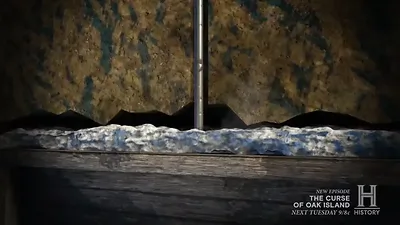
During the Truro Company's pod-auger drilling in 1849, the drill passed through two distinct layers of loose metal at approximately the ninety-eight to one-hundred-and-four-foot level. Each layer was roughly twenty to twenty-two inches thick, separated by eight inches of oak. McCully's first-person account, published in the Nova Scotian on September 30, 1861, described the material as "twenty inches of a material, which by its action upon, and the sound conveyed along the auger, resembled boring through small pieces of metal, coin, if you will, through which the auger passed by its own weight, in one turn."
The Truro Company was unable to recover any of the material. Their only valve sludger, a tube designed to capture core samples through a one-way valve, had broken in the first borehole and was lost at approximately 110 feet. The replacement had a ball-and-pin mechanism instead of a proper valve. As McCully explained, this inferior tool could retrieve soil, clay, wood, and fibre fragments, but the retaining pin physically prevented small objects such as coins from passing into the collection tube. The drill passed through two full layers of loose metal without bringing a single piece to the surface. McCully and his team concluded from the boring sequence that two oak chests or containers, stacked one above the other, sat on the spruce platform and held a quantity of metallic objects.
Historical Context
Truro Company auger borings
Where It Was Found
Found at Money Pit, ~98-104 ft depth. Location: the original 1795 excavation shaft on Oak Island, Nova Scotia.