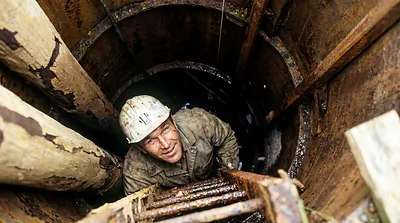
The first of several five-foot-wide, 30,000-pound steel caissons begins grinding into the earth above the Valley 3 target, the site where Rick Lagina and Craig Tester believe the Chappell Vault lies roughly 143 feet underground. In 1897, treasure hunters William Chappell and Frederick Blair located what they described as a seven-foot-tall wooden box covered in concrete at that depth, and their coring bit pulled up bits of gold along with a small piece of paper bearing the letters "V.I." The oscillator drives the caisson using a method strikingly similar to the one Dan Blankenship employed 45 years ago when he sank 10-X using old railway tank cars welded end to end. Progress averages roughly five to six feet per day, with an eight-ton hammer grab extracting the earth from inside the shaft. Each load of spoils is trucked roughly 1,000 yards to Lot 25, where Jack Begley and Charles Barkhouse spread and examine the material for artifacts. Among the finds are multiple pieces of wood with dowel holes, a shell casing, and a dense, perfectly round metallic object that initially reads as silver on Jack's Minelab CTX 3030 detector. The wood and dowels likely come from previous searcher tunnels or the Dunfield spoils, but the metal object defies immediate identification and is bagged for further analysis.
Rick and Marty meet investigative journalist Randall Sullivan at the Atlantica resort near the island. Sullivan published a detailed article about Oak Island in Rolling Stone magazine in January 2004 and has returned to Nova Scotia after 13 years to research a book. Over dinner, Sullivan describes how he initially dismissed the pirate theory until learning about the sophisticated tunnel systems pirates built on Tortuga, which rival the complexity of what has been found on Oak Island. He observes that the Oak Island story engages people because it is not merely a search for treasure but a search for meaning. Rick and Marty invite Sullivan to tour the island, and he is visibly struck by the transformation of the Money Pit area since his last visit, when it was still patches of grass and scattered wrecked equipment from earlier failed expeditions.
As drilling continues past 100 feet, the hammer grab begins encountering material consistent with what previous searchers described at the Chappell Vault depth. Wood comes up from the shaft, and the oscillator meets resistance suggesting a solid structure below. Rick is convinced they have reached the target that Chappell and Blair cored through in 1897. The discovery triggers an intense debate between the brothers: Marty argues for aggressive excavation, pointing out that the vault has already been breached by inch-and-a-quarter drill cores and that the expensive equipment and crew are costing money whether running or not. Rick calls for an immediate stop, insisting that whatever lies below may be historically and archaeologically significant and that a brute-force approach risks destroying it.
Craig Tester outlines a compromise, suggesting they push on the obstruction first to test its resistance before deciding whether to continue cutting or switch to a less invasive method. Ultimately the team suspends operations for the night to regroup and plan their next move. For the first time in the modern search, the question is no longer whether something is buried in the Money Pit but how to recover it without making a catastrophic mistake.