Drilling in the Money Pit area resumes as the team retrieves more core samples from the depth where they believe they have contacted the Chappell vault. The split-spoon coring barrel descends an additional 18 inches with almost no resistance, suggesting the bit has entered a hollow structure. Dan Blankenship examines the material at the drill site: clay, a hard cement-like substance, approximately five inches of horizontally grained wood, and what appears to be a vertical post with a machined edge. Dan notes that no searcher shaft is known to have reached this depth in this location and that vertical timbers at 142 feet are inconsistent with backfilled debris. He raises the possibility that the drill has struck the side of the Chappell vault, the wooden structure reportedly seven feet tall with seven-inch-thick oak walls that William Chappell encountered at 153 feet in 1897.
Swedish researcher and amateur cryptographer Daniel Ronnstam arrives from Sweden to present his theory about the inscribed stone slab found at 90 feet in the Money Pit in 1804. Building on work by Dr. Ross Wilhelm, a former US military cryptographer who in 1971 used a 16th-century cryptography manual to identify a second hidden message in the stone's symbols, Ronnstam claims to have corrected an error Wilhelm made by applying the English rather than Spanish alphabet. His translation reads: "At eighty guide corn long narrow sea inlet drain," followed by a lost letter he identifies as F for Francis Bacon. Ronnstam argues the inscription is a dual cipher containing both the known message about buried treasure and a second set of instructions for defeating the flood tunnels by pouring corn into shafts at strategic points, where it would swell and block the flow of seawater.
The theory depends on the accuracy of the symbols attributed to the 90-foot stone, which has been missing for nearly a century. Alex Lagina notes that no photographs or rubbings were ever made, and all existing versions are copies from books or drawings done from memory. Historical records show the stone was displayed in the window of a bookbinding firm on Upper Water Street in Halifax in 1865, used to raise capital for treasure operations. It vanished around 1919. Charles Barkhouse, himself a Freemason, contacts fellow Mason Cal Hancock to help secure access to the Grand Lodge archives in Halifax, hoping to find records relating to JB McCully, the Mason who reportedly removed the stone from the Money Pit.
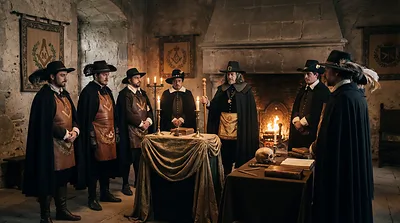
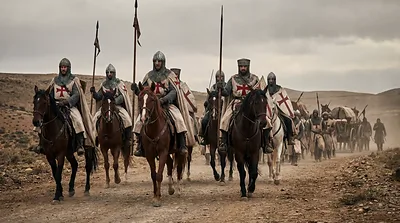
At the Grand Lodge, Alex, Charles, and Ronnstam meet with officials who agree to assist the search. The archives contain records unavailable to the public, and lodge members acknowledge the deep connections between Freemasonry and Oak Island, including the involvement of Masons such as Gilbert Hedden and President Franklin Roosevelt. The Mi'kmaq Grand Council flag is noted to be a perfect reverse mirror image of the Knights Templar battle flag. No definitive lead on the stone's location emerges, but the lodge commits to searching their records further.
Back on the island, the team plans to recreate Frederick Blair's 1898 dye test, in which non-toxic colored powder is poured down a shaft and spotters watch the coastline for dye seeping out, revealing the flood tunnel entry points. A debate arises over which shaft to use. Craig and others argue that pumping water into the area near the Chappell vault risks collapsing the structure they hope to excavate. The team agrees to use Borehole 10-X instead, located 180 feet from the Money Pit. Rick also reports that researcher Kathleen McGowan has invited the team to visit sites in the south of France where she claims proof of the Knights Templar connection to Oak Island can be found.