About This Artifact
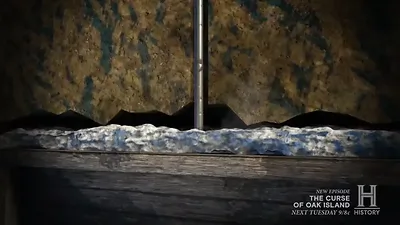
Three small links of gold chain were brought to the surface on the pod-auger bit during the Truro Company's 1849 drilling of the Money Pit. McCully's account states: "We also brought three small links which had apparently been forced from an epaulette. They were gold." An epaulette is an ornamental shoulder piece used on military uniforms and ceremonial coats. In another version of McCully's statement the auger "failed to bring up anything in the nature of treasure, except three links of an ancient watch chain." Finn (1994) likewise describes them as "resembling the links of an ancient watch chain." Fanthorpe counted "three or four links" and suggested they could have come from a necklace, bracelet, or the decorated robes of a religious leader.
A different description comes from James McNutt, who worked on the island for the Oak Island Association in the 1860s. Writing in 1867, McNutt refers to the recovery of three pieces of copper wire rather than chain links, and adds that the auger also brought up grass of the same kind found at sixty feet and a substance resembling putty. Graham Harris and Les MacPhie, the geotechnical engineers who wrote Oak Island and its Lost Treasure, suggest on this basis that the "three links of watch chain" may be an exaggeration. The two accounts cannot now be tested against the object, and they leave open whether the pieces were gold links, copper wire, or something that could be described either way.
The chain links, as McCully described them, are the only material identified as gold to be recovered from the Money Pit during the nineteenth century. Their extraction was incidental; McCully made clear that the replacement auger's ball-and-pin mechanism could not retrieve coins or larger metallic objects, meaning the links were small enough to bypass the retaining pin where everything else in the metal layers could not. The links have not survived in any verified collection, and no scientific analysis of their composition or age has been possible. The Truro Company's drilling took place with shareholders observing, and the links were presented publicly at the time. A letter in the Roosevelt Presidential Library later confirmed that Franklin Roosevelt's grandfather, Warren Delano, had invested in the Truro Company, the same operation that recovered them. The 1909 prospectus of Henry Bowdoin's Old Gold Salvage and Wrecking Company, quoted by William S. Crooker, stated that a treasure had been verified by gold shavings and part of a watch chain brought up with borings from crude implements. This appears to conflate the 1849 chain links with William Chappell's later admission that he saw traces of yellow metal on the drill bit in 1897, and is a promotional restatement rather than an independent record.
Historical Context
Truro Company; authenticity debated. J.B. McCully, letter in the Liverpool Transcript, 16 October 1862. James McNutt, account of 1867, as cited in Graham Harris and Les MacPhie, Oak Island and its Lost Treasure, third edition (Formac Publishing, Halifax, 2013), chapter 2.
Where It Was Found
Found at Money Pit, below 98 ft. Location: the original 1795 excavation shaft on Oak Island, Nova Scotia.