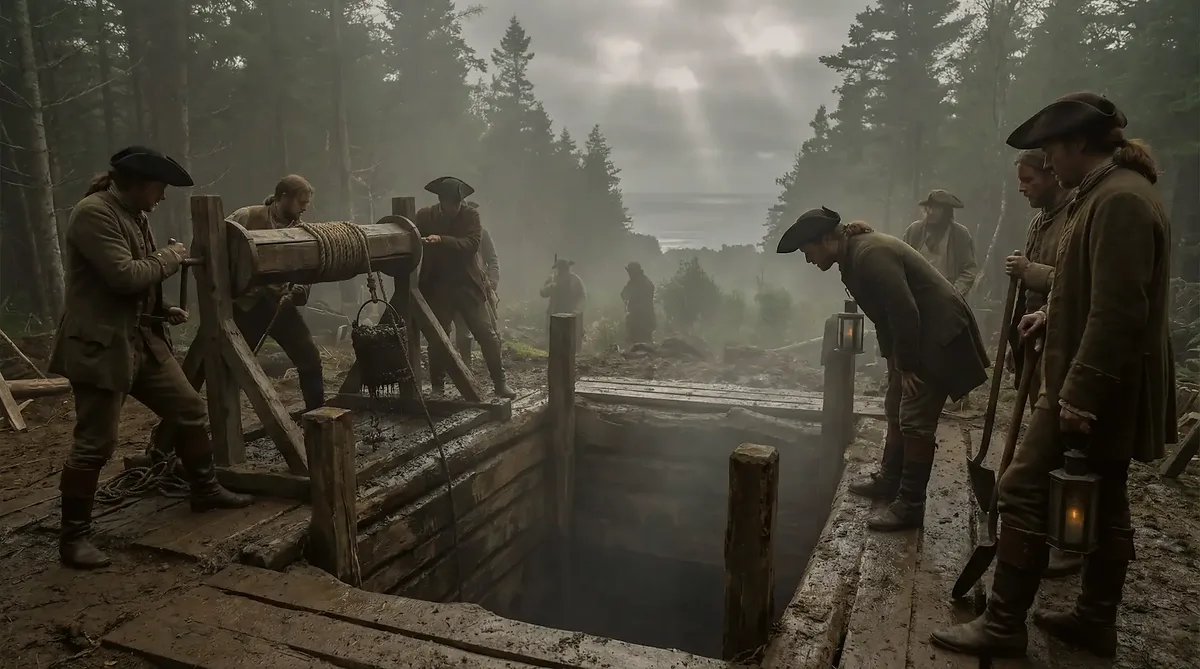
The Menorah is the only treasure proposed for the Oak Island Money Pit whose existence is confirmed by named eyewitnesses across more than a thousand years of documented history. The Ark of the Covenant vanished in 586 BC and was never reliably seen again. The Holy Grail exists primarily as literature. But the golden Menorah of Solomon's Temple was physically observed and recorded at every stage of its journey: in the Temple by Josephus, on the shoulders of Roman soldiers by the sculptors of the Arch of Titus, in the Temple of Peace by visiting rabbis who left their names in the Talmud, in Carthage by Byzantine chroniclers, and in Constantinople by the historian Procopius. After the sixth century, the record falls silent. The next occupants of the Temple Mount, where the Menorah was last reported, were the Knights Templar. Nine artifacts on Oak Island have been independently dated to the exact period of their power.
The Object
2 min
The Menorah described in the Bible in the Book of Exodus was a seven-branched lampstand hammered from a single block of pure gold. According to Exodus 25:31-40, God gave the design directly to Moses on Mount Sinai, specifying every detail of its construction. The lampstand weighed one talent of pure gold, roughly 30 kilograms. The Talmud (Menachot 28b) records its height as 18 handbreadths, approximately 1.6 metres or five feet. Its central shaft rose from a base and supported six curving branches, three on each side, each terminating at the same height as the central stem. The branches and shaft were decorated with 22 cups shaped like almond blossoms, each with a calyx and petals, 11 ornamental knobs, and nine flowers, all beaten from the same piece of metal. Seven oil lamps sat atop the seven arms, burning pure olive oil. The Menorah stood on three legs, according to the Talmud, and was positioned on the south side of the Holy Place in the Tabernacle, illuminating the space before the veil that separated the sanctuary from the Holy of Holies.
The first-century historian Flavius Josephus, who had seen the Menorah with his own eyes, described it as "affixed to a pedestal" with a "central shaft, from which there extended slender branches, arranged trident fashion, a wrought lamp being attached to the extremity of each branch." In a separate passage (Antiquities 3.144-146), he added that the seven lamps recalled the number of the planets and that the candelabrum was positioned crosswise, with the lamps facing south-east.
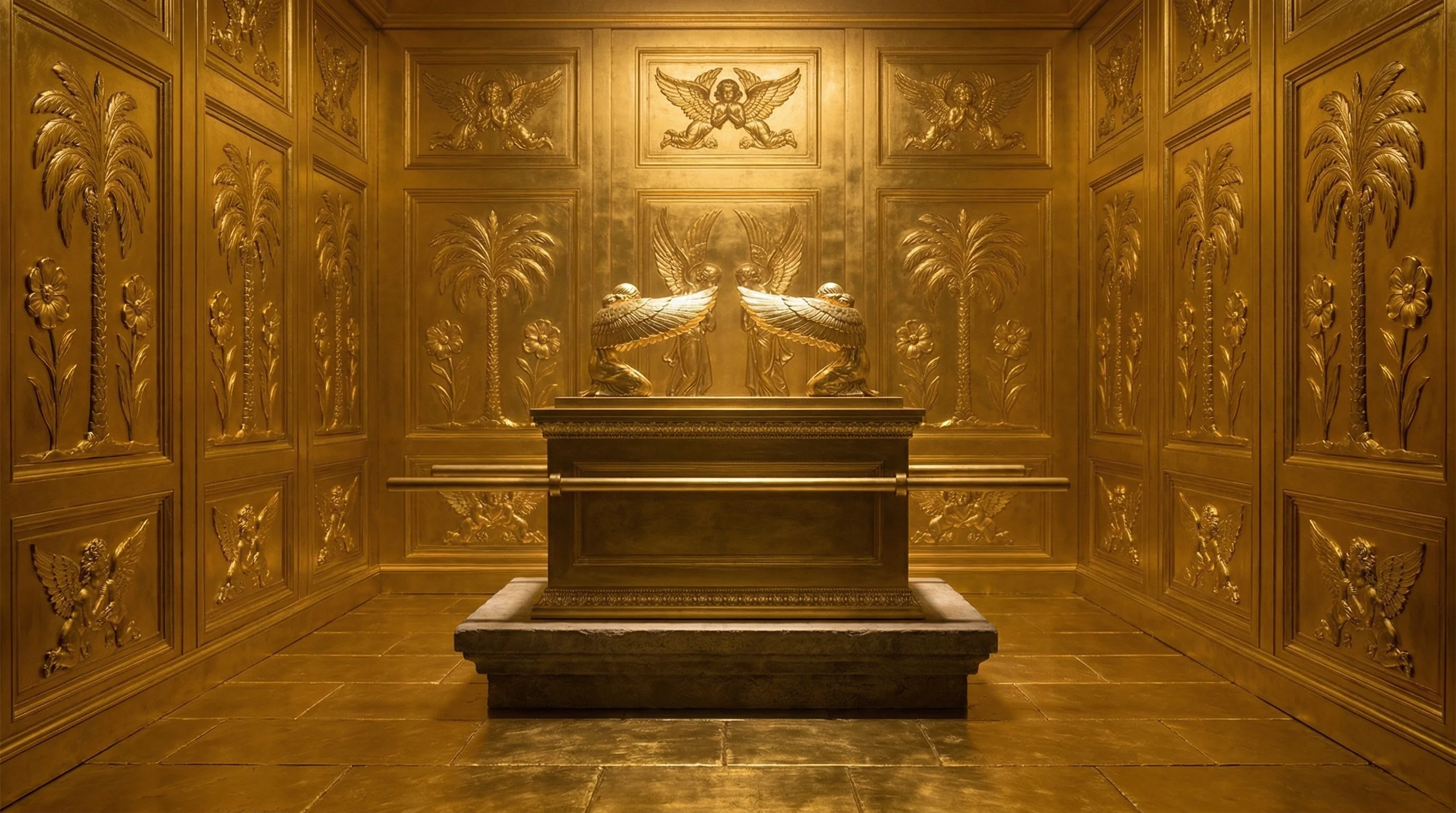
Moses' Menorah, the original lampstand made to God's design, stood on the south side of the Holy Place in Solomon's Temple. According to 1 Kings 7:49, Solomon commissioned ten additional golden lampstands, five on the right and five on the left, flanking the original. Jewish commentators placed these on either side of Moses' Menorah rather than on opposite walls. Each of the ten carried seven lamps, making seventy flames in total alongside the original seven. After the Babylonian destruction of the First Temple in 586 BC, the ten Solomonic lampstands disappear from the record. The Second Temple, rebuilt after the exile, held only a single Menorah. The Ark of the Covenant did not return; it was already lost. But the Menorah survived, and texts confirm its presence in the Second Temple alongside the table of showbread.
 The Ark of the Covenant→
The True Form
2 min
The shape of the Menorah's branches has been debated for centuries, and the debate is not academic. It reaches into the heart of what the Templars may have known, and what they may have seen.
The most recognised image of the Menorah is the one carved into the Arch of Titus in the Roman Forum, erected around 81 AD, which shows curved, semicircular arms rising from a large hexagonal or octagonal base decorated with figures. Rachel Hachlili, in her definitive archaeological study The Menorah, the Ancient Seven-Armed Candelabrum (Brill, 2001), analysed the Arch of Titus relief in detail and noted that the base depicted on the arch is unusual and possibly a Roman addition or embellishment, as no earlier Jewish depiction of the Menorah shows such a base. The earliest known depictions of the Menorah, on the coins of the Hasmonean king Mattathias Antigonus (40-37 BC) and in a graffito on the wall of a Jerusalem house from the Second Temple period, show a simpler form with a flaring or triangular base.
Steven Fine, professor of Jewish history at Yeshiva University and the leading modern authority on the Arch of Titus, was physically on the scaffolding of the arch in June 2012 as part of the Arch of Titus Digital Restoration Project. His team discovered traces of original yellow ochre paint on the carved Menorah, confirming the Romans had painted it to represent gold. Fine published his findings in The Menorah: From the Bible to Modern Israel (Harvard University Press, 2016). The polychromy discovery was the closest any modern scholar has come to the original depiction of the object.
But the Arch of Titus shows curved arms. The twelfth-century rabbi and philosopher Maimonides drew the Menorah with straight, diagonal arms in his illustration for the Mishneh Torah and stated this was the correct form. In 1965, Rabbi Yosef Qafiḥ, a leader of the Yemenite Jewish community in Jerusalem and a member of the Supreme Rabbinical Court, argued that Maimonides' drawing was intentional and authoritative. In 1982, Rabbi Menachem Mendel Schneerson, the Lubavitcher Rebbe, adopted this position and launched a campaign to replace the curved-arm Menorah in public displays. Israel's Chief Rabbi Isaac Halevy Herzog had already objected to the use of the Arch of Titus Menorah on the State of Israel's national emblem, arguing that the depicted base was a Roman fabrication and the original stood on three legs as the Talmud records.
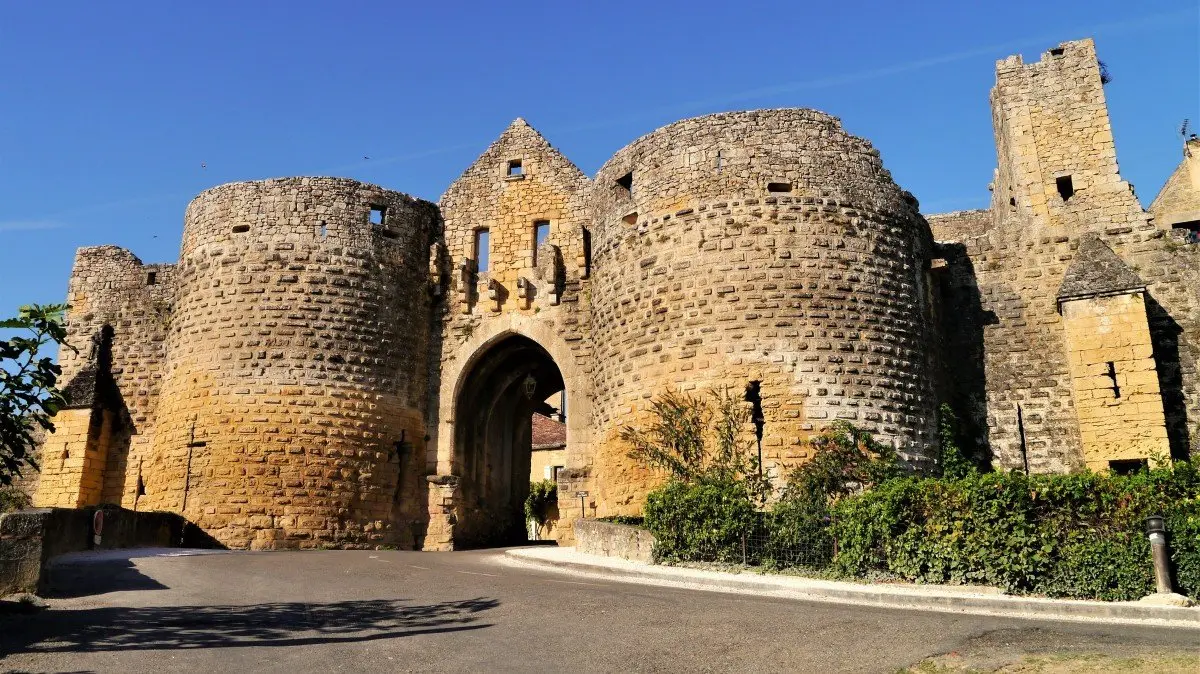
This matters for Oak Island because the Knights Templar appear to have known which form was correct. Inside the guardhouse at the castle of Domme in southern France, where some seventy Templars were imprisoned after the mass arrests of October 1307, the prisoners scratched symbols into the stone walls. Among the carvings is a clearly defined Menorah with straight, diagonal arms. At the Templar commandery of Montsaunès in Haute-Garonne, completed in 1180, a straight-armed Menorah is depicted on the chapel wall. Both depictions match the Maimonides tradition, not the Arch of Titus. The carvings raise an unavoidable problem. Imprisoned Templars in 1307 depicted a form of the Menorah that Maimonides described but that the most famous Roman depiction contradicts. The source of that knowledge has never been explained.
 Domme Templar Prison→
Jerusalem to Rome
2 min
In 63 BC, the Roman general Pompey besieged Jerusalem and entered the Holy of Holies. Josephus records that Pompey saw "the golden table, the holy candlestick, and the pouring vessels, and a great quantity of spices" but touched nothing and ordered the Temple cleansed the following day. The Menorah remained in place. A few years later, Marcus Licinius Crassus stripped the Temple of its raw gold but apparently left the sacred vessels. Herod the Great then refurbished the entire Temple in a reconstruction said to have lasted 46 years.
In 70 AD, Roman legions under General Titus besieged Jerusalem for the final time. The city fell, the Temple burned, and its treasures were carried to Rome. Josephus describes the triumphal procession: "The spoils in general were borne in promiscuous heaps; but conspicuous above all stood those captured in the Temple at Jerusalem. These consisted of a golden table, many talents in weight, and a menorah, likewise made of gold." The Arch of Titus, erected on the Via Sacra around 81 AD, depicts soldiers bearing the Menorah and the table of showbread on their shoulders. Hachlili's analysis confirms that the relief represents the actual vessels from the Temple, carried as spoils through the streets of Rome.
The sacred objects were deposited in the Temple of Peace, built by Emperor Vespasian. Josephus describes it as shaped "in so glorious a manner, as was beyond all human expectation." The Temple functioned as a museum of war spoils, and visitors came from across the ancient world. Among them were rabbis who left their names. Rabbi Shimon bar Yochai, travelling from Judea in the second century, saw the Temple curtain, the parokhet that had once separated the Holy of Holies, with drops of blood from the Yom Kippur sacrifice still visible on it. His companion Rabbi Elazar bar Yosei confirmed the sighting. Rabbi Simeon reported: "When I went to Rome there I saw the menorah." These are not anonymous traditions. They are named individuals, recorded in the Talmud, who stood in the presence of the Menorah centuries after it left Jerusalem.
Carthage, Constantinople, Jerusalem
1 min
The Temple of Peace burned in 192 AD. The Menorah appears to have been rescued and moved to another location in Rome. In 455, the Vandals under King Gaiseric sacked the city. The Byzantine chronicler Theophanes records that Gaiseric loaded his ships with "the solid gold and bejewelled treasures of the Church and the Jewish vessels which Vespasian's son Titus had brought to Rome after the capture of Jerusalem." The Menorah crossed the Mediterranean to Carthage.
In 533, the Byzantine emperor Justinian defeated the Vandals and recovered the treasure. The historian Procopius, who accompanied the campaign, describes the spoils arriving in Constantinople: "the treasures of the Jews, which Titus, the son of Vespasian, together with certain others, had brought to Rome after the capture of Jerusalem." Then Procopius records something remarkable. A Jew in the emperor's cortege recognised the Temple treasures and warned Justinian that a curse followed the objects. Every power that had possessed them had fallen. Rome had fallen. Carthage had fallen. Constantinople would fall next unless the treasures were returned to Jerusalem. Justinian, frightened, ordered the Temple treasures sent to the holy city. He then began construction of the Nea Church (Nea Ekklesia of the Theotokos), a massive new basilica in Jerusalem, which some historians have interpreted as a sanctuary for the returned objects.
If Procopius is accurate, the Menorah was back in Jerusalem by the mid-sixth century. And there the documented trail ends.
Where the Trail Goes Cold
2 min
After the sixth century, no source records the location of the Menorah with certainty. A persistent tradition holds that it never left Rome and remains in the Vatican cellars. Steven Fine addresses this directly in his 2016 study. The idea has surfaced repeatedly, including in formal diplomatic exchanges. In 1996, Sephardi Chief Rabbi Eliahu Bakshi-Doron raised the question during a meeting with Pope John Paul II. The Vatican denied possessing any Temple objects. Fine's research finds no evidence to support the claim, but the rumour endures because no full inventory of the Vatican's subterranean holdings has ever been made public. The related tradition of the Lateran Church's claim to Temple treasures, documented in Eivor Andersen Oftestad's 2019 study of the Descriptio Lateranensis Ecclesiae, showed that the papal cathedral displayed objects identified as the Ark of the Covenant, the rods of Moses and Aaron, and the seven-branch candelabra from the twelfth century until 1745, when Pope Benedict XIV ordered their removal.
The Lateran claim to the Menorah is not a footnote to the Ark tradition. It is independently documented. William Durandus of Metz, in his thirteenth-century liturgical encyclopedia Rationale Divinorum Officiorum, listed "the golden candlestick and its seven branches" among the Temple objects that Constantine placed in the Lateran alongside the Ark.
A rabbinical tradition maintains that the Menorah was hidden beneath the Temple Mount before the Roman destruction, in chambers prepared as far back as Solomon's time. The Apocalypse of Baruch (2 Baruch 6:1-10) describes an angel commanding the earth to receive and guard the Temple treasures "until the last times, so that strangers may not get possession of them."
The Menorah remains central to Jewish identity. It appears on the national emblem of the State of Israel, adopted in 1949, modelled on the Arch of Titus relief. The debate over its correct form, between the curved arms of the Roman carving and the straight arms of the Maimonides tradition, has continued into the twenty-first century. In Israel, the question of what happened to the Menorah is not a matter of historical curiosity. It is a national preoccupation.
The Templars and the Temple Mount
1 min
The Knights Templar were headquartered on the Temple Mount in Jerusalem from 1119 until the city fell to Saladin in 1187, then in Acre until that city fell to the Mamluks in 1291. Their full title, the Poor Fellow-Soldiers of Christ and of the Temple of Solomon, declared the connection. They occupied the Al-Aqsa Mosque and the subterranean chambers beneath it known as Solomon's Stables. King Baldwin II of Jerusalem gave the entire complex to the order, vacating his own palace to do so.
Whether the Templars excavated beneath the Temple Mount, and what they found if they did, remains one of the unanswered questions of medieval history. What is documented is that the Templars depicted the Menorah in its straight-armed form at Domme and Montsaunès, matching the tradition of Maimonides rather than the Arch of Titus. If the Menorah had been returned to Jerusalem by Justinian in the sixth century and hidden beneath the Temple Mount in accordance with the rabbinical tradition, the Templars inherited the last known location of the most sacred object in Jewish history. They occupied that location for 172 years.
When Philip IV of France ordered the arrest of the Templars on Friday, 13 October 1307, the order's leadership had advance warning. Templar Preceptor Jean de Châlons testified before the Papal Inquisition at Poitiers in June 1308 that Brother Gérard de Villiers, Master of France, had fled with fifty horses and put to sea with eighteen galleys. Hugues de Châlons fled with them, carrying the entire treasure of Hugues de Pairaud, the Visitor of the Temple. The historian E.-G. Léonard noted in his 1930 study of the Templar cartulary that Hugues de Châlons was probably identical with Hugh de Villiers, who held the same Templar office at the same commandery, De Pairaud was family by marriage. It makes the escape a coordinated family operation. The treasure left Paris. The fleet sailed. Neither was seen again.
Oak Island
1 min
Nine artifacts and structures on Oak Island have been independently dated to between 1100 and 1300 AD, the exact period of Templar power. The lead cross found at Smith's Cove in 2017 was traced through lead isotope analysis by Tobias Skowronek of the German Mining Museum to pre-fifteenth-century ore deposits in the Montagne Noire of southern France, within the Templar heartland. Coconut fibre from the Money Pit returns radiocarbon dates between 1036 and 1374 AD across three independent samples tested by two laboratories. Human bone fragments recovered from the Money Pit at a depth of 160 to 170 feet included remains of two individuals, one of European descent and one of Middle Eastern origin.
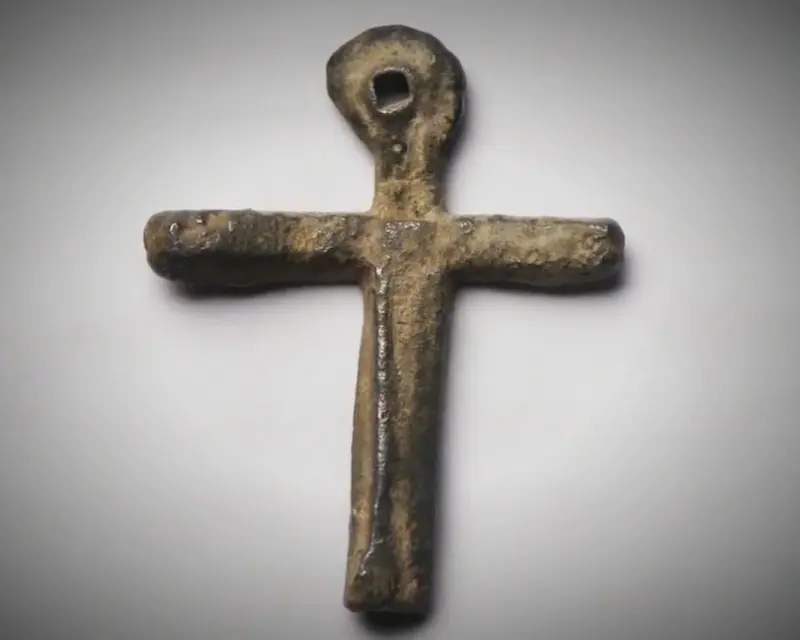 Lead cross→
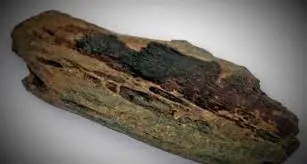 Human bone fragments (2 individuals)→
The engineering of the Money Pit is itself an argument. Layered oak platforms, a flood tunnel system fed by the sea, drainage material imported from the tropics: whoever built this shaft invested resources on a scale consistent with a military or state-level operation, not a pirate cache or a colonial vault.
 Oak Island Flood Tunnels and Box Drains: The Water Trap→
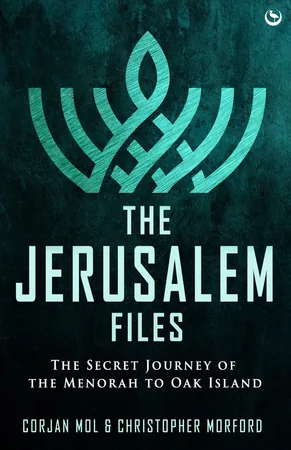
At the Palace of Versailles, the gardens laid out under Louis XIV contain a giant Menorah formed by the arrangement of pathways, fountains, and groves. The central axis of this formation, extended in both directions, points to the Temple Mount in Jerusalem in one direction and to Oak Island in the other. This alignment, and the encoded references to the Menorah discovered on Samuel de Champlain's 1612 map of Acadia, are among the original findings presented in The Jerusalem Files by Corjan Mol and Christopher Morford (Watkins / Penguin Random House, 2024). The book traces a documented path from ancient Jerusalem through medieval Europe to Oak Island, naming individuals at every link in the chain. The full case for the Menorah's journey to Nova Scotia is presented there.
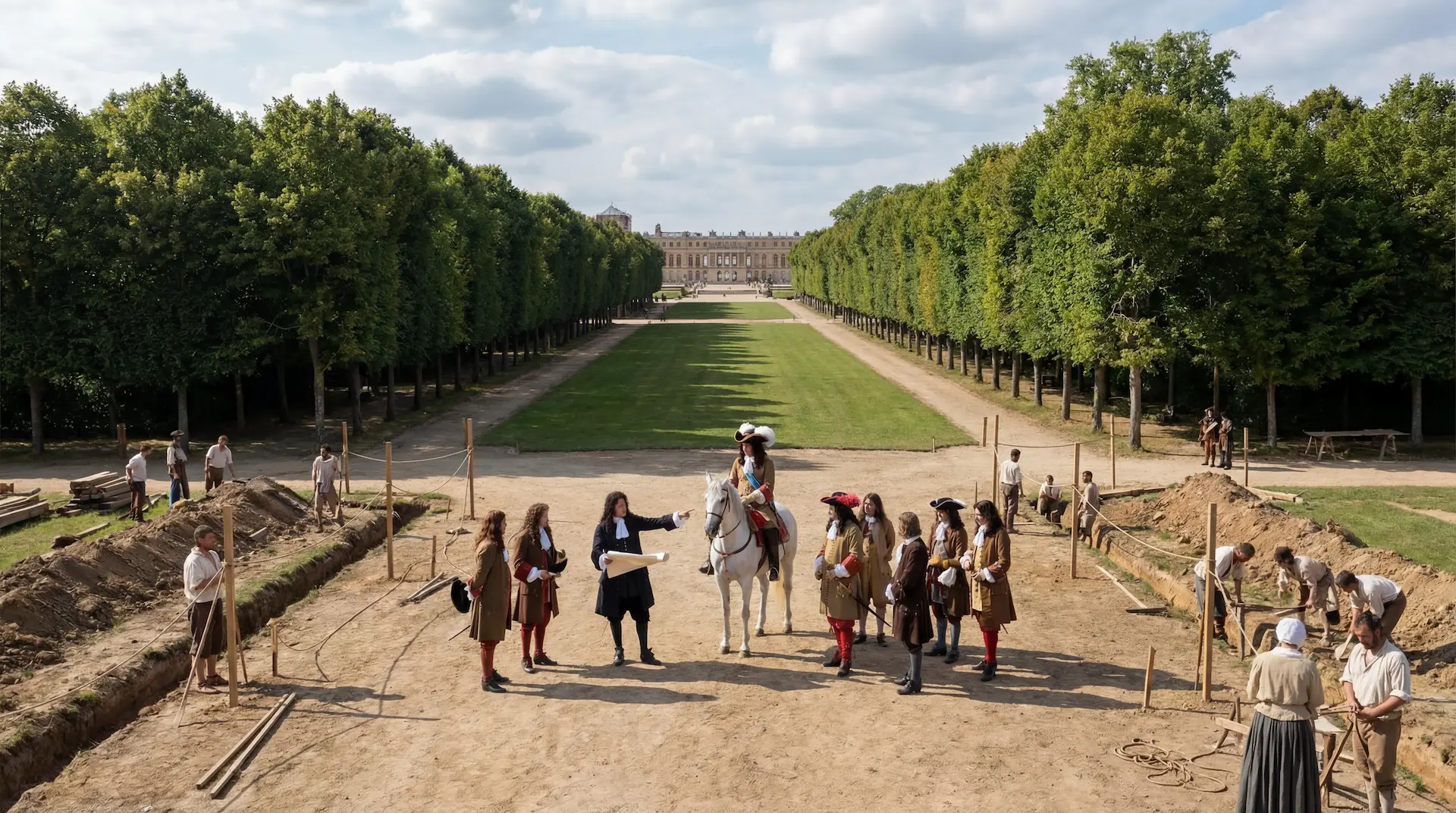 The Versailles Alignment to Oak Island→
Best Documented Artifact
4 min
The Menorah's documented history stretches further and is supported by more named witnesses than any other object proposed for the Money Pit. It was seen in the Temple by Josephus. It was depicted on the Arch of Titus by Roman sculptors. It was confirmed in Rome by rabbis whose names survive in the Talmud. It was recorded crossing to Carthage by Theophanes and returning to Constantinople by Procopius. It was reportedly sent back to Jerusalem on the orders of an emperor who feared a curse. After the sixth century, the record falls silent, and the next known occupants of the Temple Mount were the Knights Templar.
No artifact recovered from Oak Island has been identified as the Menorah. The medieval dating of the island's structures, the French provenance of its lead, the Middle Eastern origin of its human remains, and the engineering scale of the Money Pit are all consistent with the theory but do not prove it. What the evidence does establish is that someone with connections to medieval southern France, access to tropical trade networks, and the engineering capacity to build the most elaborate concealment system in the pre-industrial New World was on Oak Island during the period of Templar power. The Menorah theory offers the most documented chain of custody of any explanation for what that operation was designed to protect.
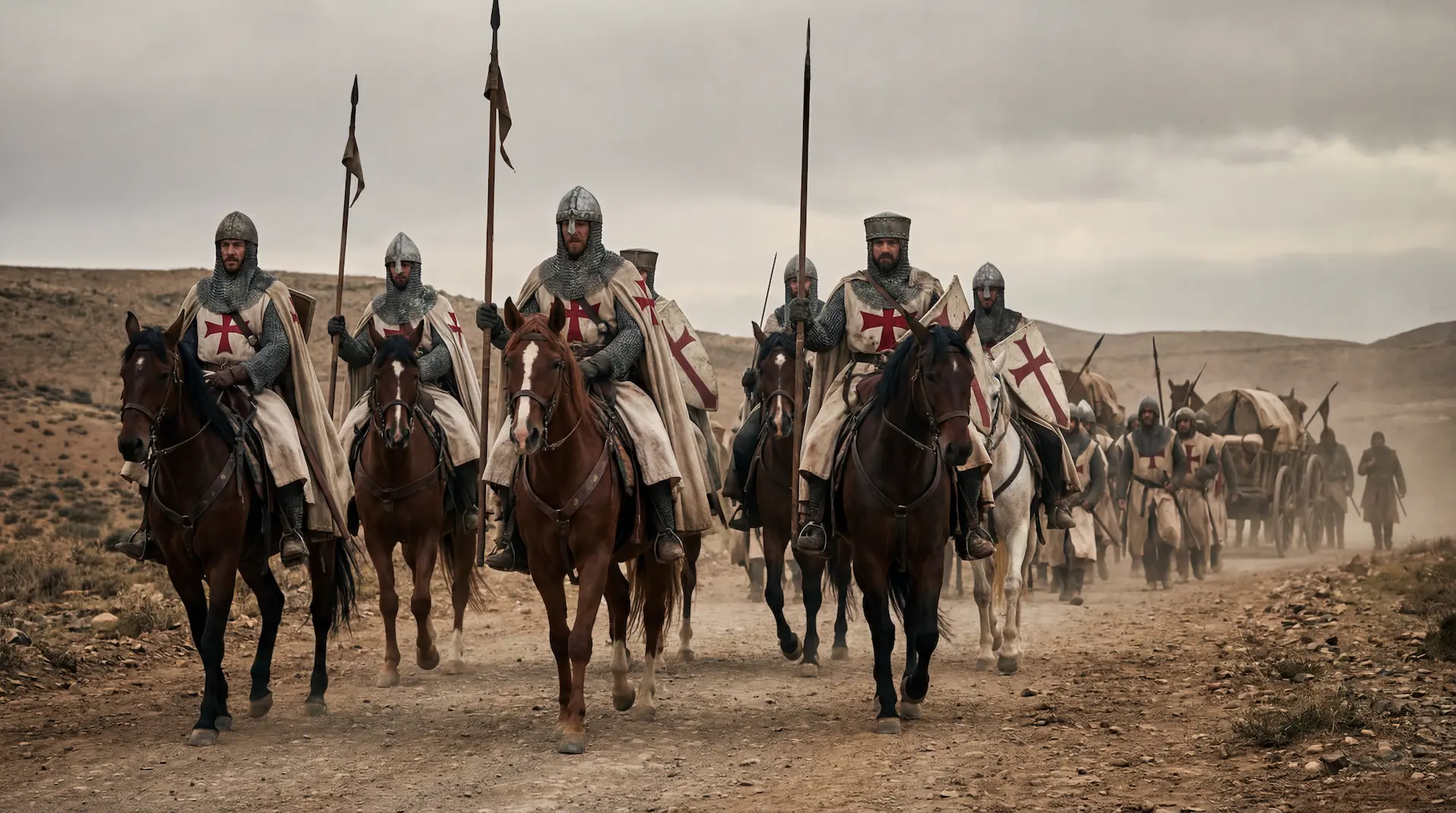 The Knights Templar on Oak Island→
Sources
Biblical and rabbinical:
- Exodus 25:31-40 (construction of the Menorah)
- 1 Kings 7:49 (Solomon's ten additional lampstands)
- Talmud, Menachot 28b (dimensions: 18 handbreadths, three legs)
- Talmud, Me'ila 17b (rabbinical visits to Rome)
- Apocalypse of Baruch (2 Baruch 6:1-10) (Temple treasures hidden beneath Temple Mount)
- Josephus, Antiquities of the Jews, 3.144-146 (description of the Menorah)
- Josephus, The Jewish War, 7.148-149 (triumphal procession in Rome)
Archaeological and art-historical:
- Rachel Hachlili, The Menorah, the Ancient Seven-Armed Candelabrum: Origin, Form and Significance (Brill, 2001). Definitive archaeological study. Analyses Arch of Titus relief, Mattathias Antigonus coins (40-37 BC), Jerusalem house graffito.
- Steven Fine, The Menorah: From the Bible to Modern Israel (Harvard University Press, 2016). Arch of Titus polychromy discovery (June 2012), Vatican question, State of Israel emblem debate.
The straight-arm debate:
- Maimonides, Mishneh Torah (12th century). Illustration showing straight, diagonal arms.
- Rabbi Yosef Qafih, supercommentary on Maimonides's Mishnah commentary to Menahot 3:7 (1965). Argues Maimonides' drawing was intentional.
- Rabbi Menachem Mendel Schneerson, sichas on Hanukkah (1982). Adopted Qafih's position for the Chabad menorah.
- Chief Rabbi Isaac Halevy Herzog, articles objecting to the Arch of Titus menorah on the State of Israel emblem.
Templar depictions:
- Menorah carvings at Domme castle guardhouse, Dordogne, France. Scratched into stone walls by imprisoned Templars after October 1307. Straight, diagonal arms.
- Menorah painting at the Templar commandery of Montsaunes, Haute-Garonne, France. Chapel completed 1180. Straight, diagonal arms.
Classical sources (chain of custody):
- Procopius, History of the Wars (6th century). Vandal sack of Rome (455), Justinian's recovery from Carthage (533), the Jew's curse warning, return to Jerusalem.
- Theophanes, Chronicle (9th century). Confirms Gaiseric took "the Jewish vessels which Vespasian's son Titus had brought to Rome."
- Rabbi Shimon bar Yochai, visit to Rome (2nd century AD). Recorded in Talmud.
- Rabbi Elazar bar Yosei, companion to Shimon bar Yochai. Confirmed sighting of the Temple curtain with Yom Kippur blood.
- Rabbi Simeon: "When I went to Rome there I saw the menorah." Recorded in Talmud.
The Lateran tradition:
- Eivor Andersen Oftestad, The Lateran Church in Rome and the Ark of the Covenant (Boydell Press, 2019). Documents the Lateran claim to Temple treasures including the seven-branch candelabra from c. 1100 to 1745.
- William Durandus of Metz, Rationale Divinorum Officiorum (13th century). Independently confirms "the golden candlestick and its seven branches" in the Lateran. English translation of Book One here.
- Ordo Officiorum Ecclesiae Lateranensis. Documents the annual Maundy Thursday ritual exposing the Temple objects including the candelabra. Discussed in Sible de Blaauw, "The Solitary Celebration of the Supreme Pontiff: The Lateran Basilica as the New Temple in the Medieval Liturgy of Maundy Thursday," in Omnes circumadstantes.
- Lateranensis basilice combustio tempore Clementis V rythmo descripta (14th-century Latin poem describing the 1308 fire). Preserved in Bibl. Vallicellane, Ms. F. 61. Published in Philippe Lauer, Le Palais de Latran.
- Benedict XIV removal decree, 2 May 1745. Archivio Segreto Vaticano, S.C. Visita Apostolica 98, no. 5. Latin text: "amoveantur vero ea, quae asseruntur Archa Foederis, virga Moysis et Baculus Aaronis, et amplius non ostendantur."
- The 13th-century stone tablet bricked into the wall of the Lateran basilica, stating the Ark and Temple objects (including the candelabra) are beneath the high altar. Still visible today.
Vatican question:
- Steven Fine, The Menorah: From the Bible to Modern Israel. Documents the 1996 meeting between Sephardi Chief Rabbi Eliahu Bakshi-Doron and Pope John Paul II. Vatican denied possessing Temple objects.
- Eivor Andersen Oftestad wrote to the Vatican Museum in 2008 asking if any remnants of the Temple objects existed. The curator and colleagues were unfamiliar with the tradition.
Templar testimony:
- Jean de Chalons testimony, Papal Inquisition at Poitiers, June 1308. Proces des Templiers, ed. Jules Michelet, 2 vols. (Paris: Imprimerie Royale, 1841-1851), vol. I.
- A single-page document from August 1308, Bibliotheque nationale de France, inserted into a letter by Pope Clement V entitled "these are the names of the brothers that have fled." Names "Gerard de Villiers and Hugh de Chalons who had armed 40 brothers." Also referenced by Heinrich Finke.
- E.-G. Leonard, Introduction au cartulaire manuscrit du Temple (1150-1317) (Paris, 1930). Identifies Hugues de Chalons as probably identical with Hugh de Villiers.
The Jerusalem Files:
- Corjan Mol and Christopher Morford, The Jerusalem Files (Watkins / Penguin Random House, 2024). Original findings: Versailles Menorah alignment pointing to Temple Mount and Oak Island.
Oak Island evidence cited:
- Lead cross isotope analysis by Tobias Skowronek, German Mining Museum, Bochum. Traces to pre-fifteenth-century ore deposits in the Montagne Noire, southern France.
- Coconut fibre radiocarbon dates: 1036-1374 AD across three independent samples, two laboratories (Beta Analytic and Woods Hole Oceanographic Institution).
- Human bone fragments from Money Pit (160-170 feet): two individuals, one European, one Middle Eastern origin.