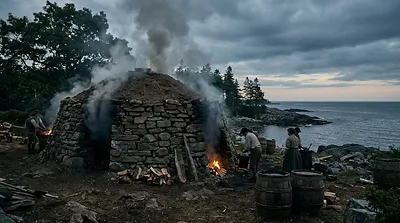
On Lot 15, the Lagina brothers and Doug Crowell meet with archaeologists Laird Niven, David MacInnes, Aaron Taylor, and Liz Michels at the stone structure. MacInnes reports that his trench has reached glacial till, leaving no more of the formation to excavate, and affirms his belief that the feature constitutes the remains of a pine tar kiln. He has sent a piece of charcoal from the excavation for carbon dating. The team plans to conduct deep earth scans in the area and pursue a broader archaeological excavation once the necessary permits are secured.
In the War Room, Rick, Marty, and Alex Lagina connect via Skype with Craig Tester and David Irving of Irving Equipment Ltd. to discuss the season's drilling strategy. Marty acknowledges the pandemic has cost too much time for any major caisson work that year, and the team confirms plans to hire Choice Drilling for a pattern drilling operation aimed at identifying future shaft locations. The prospect of the Big Dig, an enormous excavation of the Money Pit area, is raised, with Marty suggesting it may commence the following year.
On Lot 32, near the southwestern corner of the swamp, Gary Drayton and Peter Fornetti uncover three hand-forged single-bit axe heads during a metal detecting survey. Drayton notes their resemblance to the rigging axe he and Jack Begley found on Lot 15 in the season premiere and suggests the concentration of axe heads in such a small area could indicate a former work camp. Archaeologist Laird Niven examines the finds on site and confirms they are not modern, identifying them as forest axes used for light clearing work such as cutting limbs from trees.
The team gathers in the War Room for a Skype presentation by author and researcher Corjan Mol and researcher Chris Morford, who expand on the research they introduced in Season 7. Superimposing Nicolas Poussin's painting The Shepherds of Arcadia onto a map of Oak Island, Mol and Morford demonstrate that a line drawn along the column of Nolan's Cross aligns with the Royal Way of the Palace of Versailles and, when extended further, intersects the Temple Mount in Jerusalem. Mol and Morford outline their belief that the Knights Templar recovered the treasure of King Solomon and that the Palace of Versailles was deliberately oriented along this axis. Using a system of concentric circles and a pentagram centered on the swamp, Mol and Morford identify two points on the island where they believe treasure may lie.
The team investigates both locations. On Lot 11, they find a water-filled depression measuring 60 feet long, 15 feet wide, and nearly 4 feet deep, which appears to have been previously excavated. Dr. Ian Spooner takes a gravity core sample containing 30 centimetres of sediment, suggesting the feature is older than expected. Tom Nolan, on whose land the depression sits, agrees to let the team drain and clear it. At the second site on the border of Lots 12 and 13, the soil shows clear signs of disturbance, and Marty suspects Fred Nolan may have bulldozed the area years earlier. Tom Nolan excavates with a backhoe but a burst hydraulic hose forces the team to postpone the dig.