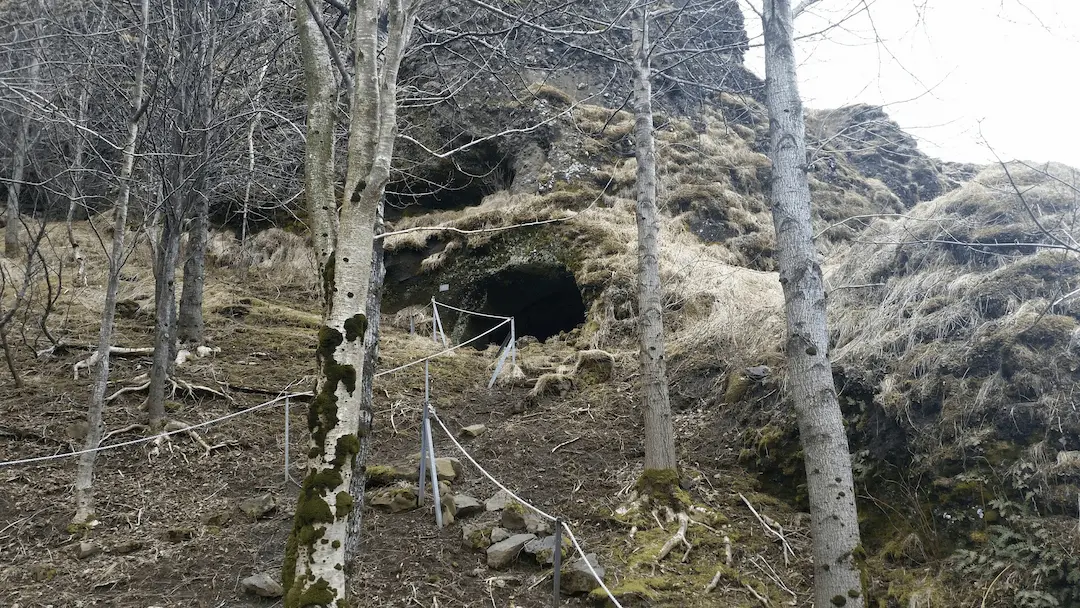
A cross was carved into the wall of a cave in southern Iceland sometime around the year 800. In the summer of 2023, the Oak Island team walked into the same cave with Italian historian Roberto Pagani and stood in front of it. The carving resembled the lead cross that Rick Lagina and Gary Drayton had recovered at Smith's Cove in 2017, an artifact later dated by Saint Mary's University to the fourteenth century. The Icelandic cross was older by half a millennium. Pagani identified the cave as the work of an Irish monastic order, abandoned when the Vikings arrived in 874.
That brief comparison in Kverkarhellir Cave reopened an old question. If Christian monks from Ireland and the Hebrides were carving crosses in Icelandic caves before any Templar existed, the western limit of their reach is worth establishing. The documentary and archaeological record, gathered across twelve centuries of medieval text and forty years of modern fieldwork, runs further than the conventional histories will allow.
 Kverkarhellir Cave→
Dicuil's Northern Islands
1 min
The earliest documentary witness is also one of the most rigorous. Dicuil was an Irish monk, astronomer and geographer who taught at the school of Louis the Pious in the Carolingian court between 814 and 816. In 825 he completed a geographical treatise titled Liber de Mensura Orbis Terrae, the Book on the Measurement of the World. It is preserved in several medieval manuscripts and remains the earliest clear European notice of habitation in Iceland.
Dicuil wrote that thirty years before, in 795, a group of Irish hermits had spent six months on an island they called Thule. They had arrived on the first of February and left at the start of August. They reported a midsummer sun that never properly set, a light bright enough to perform any ordinary task at midnight. From Thule they had sailed one day further north before encountering a wall of ice. Dicuil did not relay this from a saga or a chronicle. He had it from monks who had been there.
The same treatise contains an earlier passage describing other islands north of Britain. Dicuil noted that small islands lay scattered to the north and northwest, and that he had himself lived on some, visited others, and read about still more. Most modern scholars take this passage to refer to the Faroe Islands, and a separate paragraph describes hermits living there for nearly a century before being driven off by Norse raiders. The chronology Dicuil sets out matches the archaeological record. Norse settlement of the Faroes is dated to the early ninth century, which means Irish monks were there in the eighth.
The Papar in the Sagas
1 min
The Icelandic sources call them papar, a borrowing of the Latin papa, father. The two foundational Norse histories of Iceland both record that the papar were on the island when the first Norse settlers arrived. Íslendingabók, written by Ari Thorgilson around 1130, opens its account of the settlement by noting that Christian men whom the Norse called papar were here when the Norsemen came. Ari adds that they did not wish to live with the heathen and left behind Irish books, bells, and croziers, from which it could be understood that they were Irish.
The companion text, Landnámabók, repeats and expands the notice. Place names anchor it. Papey is the largest island off Iceland's east coast and means Island of the Papar. Papyli, on the south coast, means Settlement of the Papar. A cluster of similar Pap-names appears across the Scottish islands and in the Faroes, mapping a coherent geography of pre-Norse Christian activity stretching from the western Hebrides up through the stepping-stones of the North Atlantic.
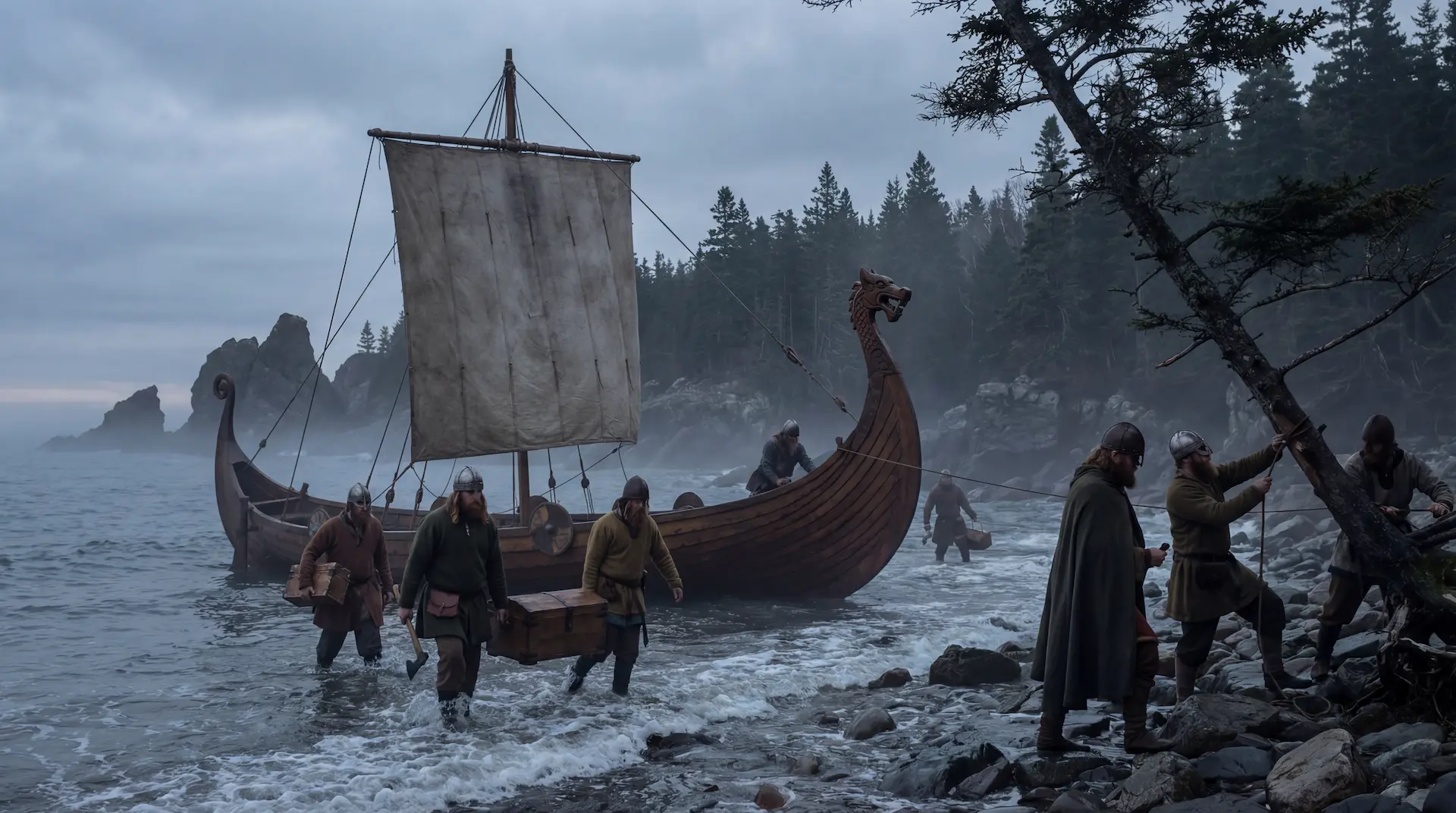
The sagas were committed to parchment by Norse Christians more than two centuries after the events they describe, and they do not preserve papar voices. What they do preserve is the consistent testimony, across multiple independent texts, that the Norse arrived to find Iceland already inhabited by Irish monks who fled rather than share the island with pagans.
 Vikings→
The Cave Crosses of Seljaland
2 min
For most of the twentieth century, the papar were considered a closed historical question. The Norse had left their books and bells, and that was that. The case was reopened by Kristján Ahronson, a Canadian-born archaeologist whose 2015 monograph Into the Ocean: Vikings, Irish, and Environmental Change in Iceland and the North, published by the University of Toronto Press, presented the results of more than a decade of fieldwork at a site called Seljaland on the south coast of Iceland.
Seljaland is a complex of artificial caves cut into soft tuff. One of them, Kverkarhellir, sits at the foot of a low cliff in farming country east of the village of Hvolsvöllur. Inside the cave and the alcoves around it are around thirty incised cross carvings of a type largely unknown elsewhere in Iceland. The local folk name for one of the chambers is Papahellir, the cave of the papar.
Ahronson set out to test whether the construction of Kverkarhellir could be dated by a method called tephrochronology. Iceland's volcanic systems have deposited a sequence of distinctive ash layers, or tephrae, across the southern lowlands over the past ten thousand years. Each major eruption leaves a thin, chemically identifiable horizon in the soil. By identifying the tephra layers above and below an archaeological deposit, the deposit can be bracketed in time.
The critical horizon for Iceland's settlement period is the Vatnaöldur tephra, dated to around 870 AD. This is the landnám tephra, the ash layer that fell across southern Iceland in the years immediately before the conventional date of Norse settlement. Anything sealed beneath it predates the first Norse landings.
Between 2001 and 2002, Ahronson excavated a debris pile outside Kverkarhellir, the spoil thrown out when the cave was cut into the cliff. The construction debris was stratified within a sequence of tephras. The base of the debris lay below the landnám tephra of 870. The cave had been dug, on the strongest interpretation of the evidence, around the year 800. The earliest published radiocarbon and tephrochronological work since has supported the date.
The carved crosses on the cave walls form a coherent sculptural tradition. Ahronson catalogued them in the seventh chapter of his book and compared them to early Christian sculpture across the North Atlantic world. The closest parallels, by some distance, are not Scandinavian and not Faroese. They are the early Christian cross carvings of western Scotland, dated to the seventh, eighth, and ninth centuries. The Seljaland sunken crosses with expanded terminals and bold V-cuts find their nearest matches in the Hebridean monastic sites at Cladh a'Bhile, Lochead, and St Molaise's Cave. The simplest explanation, Ahronson concluded, is that the Seljaland sculpture is the work of Gaelic monastic communities from the Scottish littoral.
The conclusion of the book is restrained but its consequences are not. Norse settlers, Ahronson writes, did not enter an uninhabited Iceland. By around 800 AD, a quarter-century before Dicuil sat down to write in the Carolingian court, Irish or Hebridean monks were already digging caves and carving crosses on the south coast of Iceland. The papar of the sagas were not legend.
 The Treasure of St. Andrew's Cathedral→
The Brendan Voyage
2 min
The historical sources describe Christian seafarers operating in waters that modern critics long considered impossible to navigate in the available craft. Dicuil's hermits made their way to Iceland and back. The Faroes, the Hebrides, and the Scottish mainland were already linked by regular sea travel in the eighth century. A genre of Irish monastic literature, the immrama or voyage tales, describes monks setting out on extended ocean pilgrimages. The most famous of these is the Navigatio Sancti Brendani Abbatis, the Voyage of Saint Brendan the Abbot, a tenth-century Latin text based on earlier oral material describing a seven-year voyage by the sixth-century Irish saint Brendan to a Promised Land of the Saints somewhere beyond the western horizon.
The Navigatio was treated for most of its history as a literary fantasy. Brendan and his monks encounter a floating pillar of crystal, a sea monster that breathes fire, an island that turns out to be the back of a whale, and a coast where boiling rocks are hurled at them from a fiery mountain. The episodes were read as monastic allegory. They were not.
Between 1976 and 1977, the British explorer Tim Severin built an exact replica of the leather boat described in the Navigatio and sailed her from County Kerry in Ireland to the coast of Newfoundland. The vessel was named Brendan. Her hull was built from forty-nine oak-bark-tanned oxhides, stitched together with flax thread waxed in wool grease, beeswax, and resin, and stretched over a frame of ash and oak. The leather skin was a quarter of an inch thick. The keel was riveted with half-inch copper rivets, a fastening technique known to have been used in early Christian Ireland. The boat had no metal nails in her hull.
 L'Anse aux Meadows→
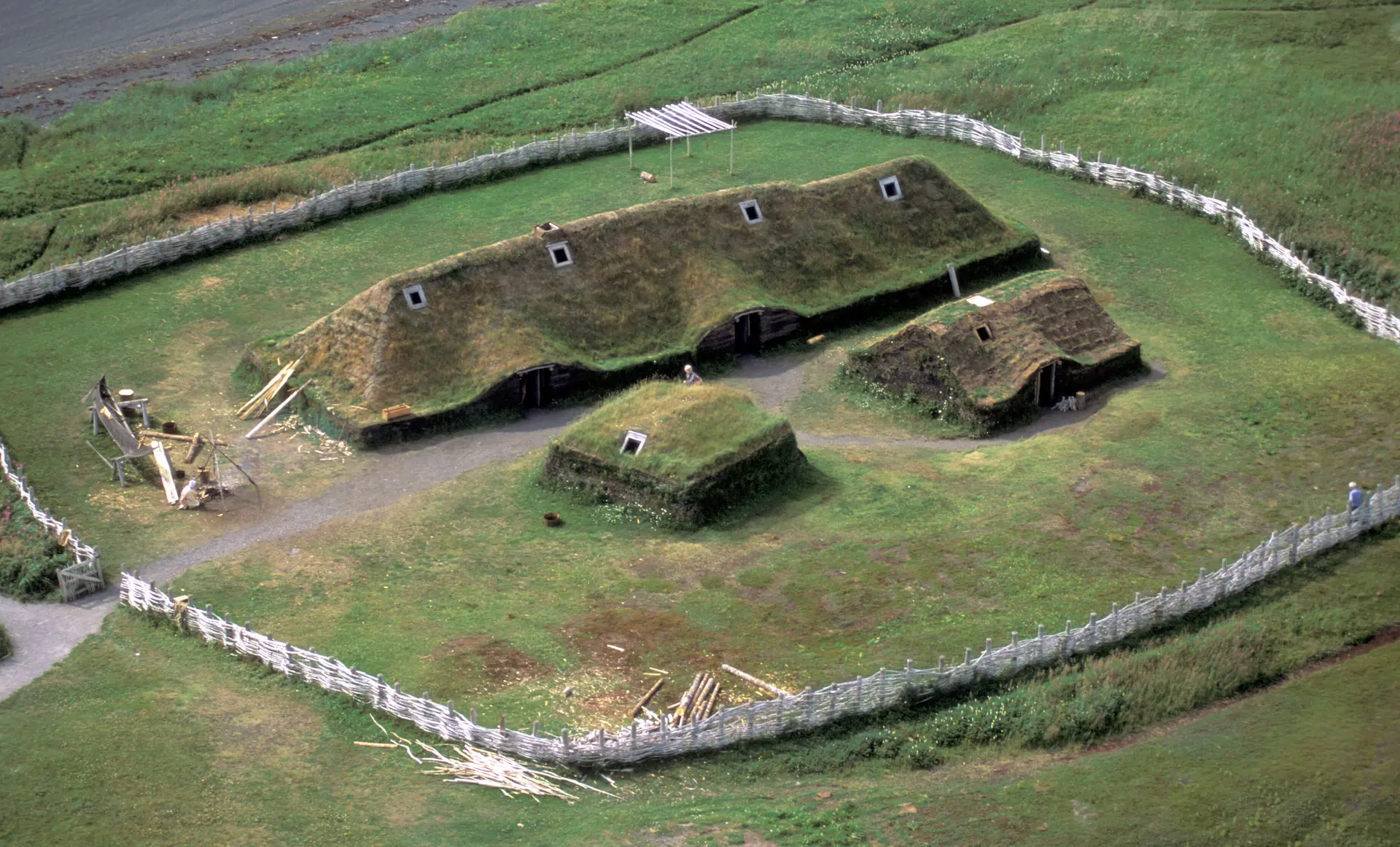
Severin sailed her in two seasons by what he called the Stepping Stone Route, the same chain of landfalls the Norse later used and the same route that early aviators flew in short-range aircraft. From Brandon Creek in Kerry, Brendan reached the Hebrides, then the Faroes, then wintered in Reykjavík. In the second season she sailed from Iceland past the pack ice off southern Greenland and across the Labrador Sea to Newfoundland. She made landfall at Peckford Island in the Outer Wadham Group, about 150 miles northwest of St. John's, at eight in the evening on 26 June 1977. The crossing from Reykjavík to Newfoundland had taken fifty days at sea.
The hull proved sounder at the end of the voyage than her sceptics had predicted at the start. The lanolin in the wool grease was still binding to the leather, in places hosting algae and barnacles, but the skin underneath was intact. The stitching had not failed. Brendan had run at up to 116 miles in twenty-four hours under sail in a Force 7 gale. Severin's conclusion, set out in the closing chapter of The Brendan Voyage in 1978, was characteristically measured. He had not proved that Saint Brendan reached North America. He had proved that the medieval text describing a leather boat capable of doing so was not, after all, a fantasy.
The Land of White Men
2 min
The Norse sagas place another landmass beyond Vinland that they call Hvítramannaland, the Land of White Men, also called Albania or Irland Mikla, Greater Ireland. Landnámabók records that an Icelander named Ari Marson, son of Mar of Reykhólar, was driven there by storms in the late tenth century, was baptized, and was held in honour and unable to return. Three separate informants are named as sources for the story. The first was Hrafn the Limerick Trader, a Norse merchant who picked up news of Ari from contacts in Ireland. The second was Earl Thorfinn of Orkney, who died in 988 and who relayed an account that other Icelanders had heard. The third was Thorkel Gellirson, Ari's own grandson, who passed the story to his nephew Ari Thorgilson, the author of Íslendingabók and Landnámabók.
A later passage in Eiríks saga rauða, the Saga of Erik the Red, repeats the geography. Two Native children captured on the coast of Markland, the wooded country south of Greenland, told Thorfinn Karlsefni's expedition that a land lay across from their own where people dressed in white clothing, walked in procession, and carried poles and banners. The saga adds: þat ætla menn Hvítramannaland, that is thought to be the Land of White Men.
The orthodox reading dismisses these passages as confused geography or pious invention. A different reading was set out by the Canadian writer Farley Mowat in his 1998 book The Farfarers: A New History of North America. Mowat had spent thirty years investigating what he called the Albans, a population he identified with the Pictish and Celtic seafarers of the Northern Isles. His argument was that the papar known from the Icelandic sources were one component of a much larger pre-Norse North Atlantic culture, a network of walrus-ivory hunters and Christian crofters operating from the Northern Isles westward across the stepping-stones. As the Norse expanded into the Northern Isles in the late eighth century, into the Faroes in the late eighth, into Iceland in the late ninth, and into Greenland at the end of the tenth, the Albans were displaced westward in advance of them. Mowat read the Hvítramannaland sagas as describing the last of these displaced populations, established on the coast of northeastern Newfoundland.
Mowat's argument was speculative in its details and he said so. He cited Gibbon in his preface on the limits of what can be inferred from fragmentary sources. The framework, however, rested on documentary footing: the Landnámabók and Eiríks saga passages naming Hvítramannaland, the Annals of Greenland placing Albania near Vinland, the consistent identification of Ari Marson by named witnesses across two generations, and the Icelandic cartographer Jón Guðmundsson's seventeenth-century map of the North Atlantic which labels Newfoundland as Albania, working from earlier maps now lost.
 Henry Sinclair: The Zeno Voyage→
Kverkarhellir and the Oak Island Cross
2 min
This is the documentary and archaeological frame against which the Oak Island team's visit to southern Iceland in 2023 has to be read. In Season 11 Episode 24, titled Hairy Situation, Roberto Pagani led Rick and Marty Lagina, Doug Crowell, Alex Lagina, and Peter Fornetti into the same Kverkarhellir cave system that Ahronson had dated by tephrochronology two decades earlier. Pagani identified the underground chambers as the work of an Irish Christian monastic order operating around 800 AD, later occupied by the Norse from 874 until the thirteenth century. Inside, the team examined a cross carving that Alex Lagina photographed and compared, side by side, with images of the lead cross recovered from Smith's Cove in 2017.
The two crosses are not identical. The Kverkarhellir example is incised into stone and belongs, on Ahronson's analysis, to the early medieval sculptural tradition of western Scotland and the Hebrides. The Smith's Cove cross is hand-wrought from lead, with anthropomorphic features that read as a figure of Christ and a square hole at the top for suspension on a cord. Initial forensic testing placed it in the 900 to 1300 AD range. Subsequent laser ablation work at the University of New Brunswick by Dr Chris McFarlane identified the lead as European in origin, with isotope ratios that do not match any North American source. Its closest documented visual match, identified by Templar researcher Jerry Glover and noted by Gary Drayton at the moment of discovery, is a cross carved into a wall of the medieval prison at Domme in the French Dordogne, where the Knights Templar were imprisoned by King Philip IV in 1307. Five hundred years and an ocean separate the Kverkarhellir cave from the closest plausible context for the Smith's Cove cross. What was filmed in Kverkarhellir was the side-by-side comparison itself: a cross from one Atlantic shore held up next to a cross from the other, the family resemblance enough for the team to record the observation, the difference in date and form enough to leave the question of any deeper connection open.
Other strands of the Oak Island record bear on the same period. In 2020 the team recovered a wooden piece at Smith's Cove that was carbon dated by Beta Analytical to between 660 and 770 AD, a range that places it in the centuries when, on the documentary record, the papar were already on the Faroes and approaching Iceland. The Cremona Document carried to Oak Island from the late researcher Zena Halpern's archive describes a twelfth-century Templar voyage that stopped at an island of oak, predating Columbus by more than three centuries. The 14th-century Portuguese coin recovered by James Pitblado in the Money Pit in 1849, and re-examined by the team in 2025 with the descendant Steve Salomon, carries Templar iconography and ties the deposit at Oak Island to the period when the Order of Christ had inherited Templar assets and continued operating Atlantic shipping lanes from the Iberian peninsula.
None of this, taken individually, proves that Irish monks reached Oak Island. The carbon dates and the cross comparison establish that activity on the island in the pre-Templar period is not categorically impossible, and that the seas in which the Templars later operated were already known to Christian seafarers from Ireland and the Hebrides by the late eighth century.
A Worked Sea
2 min
The Irish monks theory in its strongest form is not a claim that the papar built the Money Pit. The case the documentary and archaeological record will sustain is narrower and, in its own way, more interesting.
The papar were on the Faroes by the late seventh or early eighth century. They were on Iceland by the late eighth, with Ahronson's tephrochronology pushing the date of cave construction at Seljaland to around 800 AD. They were operating a regular sea route between western Scotland, the Hebrides, the Faroes, and Iceland that Dicuil described in 825 as already an established system of monastic migration. Their cross-carving tradition shows clear affinities with early Christian sculpture in western Scotland and, on the Oak Island record, plausible affinities with the medieval cross that surfaced at Smith's Cove in 2017. Severin's experimental archaeology removed the last serious objection to the physical possibility of the longer crossings. The Hvítramannaland passages in Landnámabók and Eiríks saga rauða, whatever their exact referent, were recorded by named Norse informants as accounts of a real western country occupied by Christian people in white clothing.
The case the record will not sustain is a direct chain of custody from a Gaelic monastery in the eighth century to the Oak Island works. No artifact recovered from the island has been attributed to the papar. The Smith's Cove lead cross is fourteenth century, not ninth. The Cremona Document, the Pitblado coin, and the iconographic links to the Templar and Cistercian orders point to a later phase of Atlantic activity in which the legacy of the early Irish voyages had passed through several centuries of monastic and military inheritance.
What the Irish monks of the North Atlantic establish, in short, is that the ocean between Ireland and North America was not an impassable barrier in the centuries before the conventional discovery dates. It was a worked sea, traversed by men in leather boats who carved crosses on the walls of the caves where they sheltered. Whether one of those caves, or the tradition that produced it, eventually reached a wooded island in Mahone Bay is a question the documentary record cannot yet answer. It can only say that the question is open.
Sources
2 min
Primary medieval texts
- Dicuil, Liber de Mensura Orbis Terrae (Book on the Measurement of the World), completed 825 AD. Critical edition: J. J. Tierney (ed.), Dicuili Liber de Mensura Orbis Terrae, Scriptores Latini Hiberniae vol. 6, Dublin Institute for Advanced Studies, 1967.
- Ari Thorgilson, Íslendingabók, c. 1130. The earliest written history of Iceland.
- Landnámabók (The Book of Settlements), 12th–13th century compilation. English translation: Hermann Pálsson and Paul Edwards, University of Manitoba Press, 1972.
- Eiríks saga rauða (The Saga of Erik the Red), mid-13th century. Old Norse text and English translation in Magnús Magnússon and Hermann Pálsson, The Vinland Sagas, Penguin Classics, 1965.
- Annals of Greenland, 11th-century Norse chronicle.
- Navigatio Sancti Brendani Abbatis (The Voyage of Saint Brendan the Abbot), Latin text c. 900 AD based on earlier oral material.
Modern scholarship
- Kristján Ahronson, Into the Ocean: Vikings, Irish, and Environmental Change in Iceland and the North, University of Toronto Press, 2015.
- Farley Mowat, The Farfarers: A New History of North America, Key Porter Books, 1998.
- Tim Severin, The Brendan Voyage, McGraw-Hill, 1978; Modern Library Exploration reprint with foreword by Jon Krakauer, 2000.
Scientific reports
- Beta Analytical, radiocarbon dating of wood sample from Smith's Cove (Oak Island), reported 2020. Calibrated age range 660–770 AD.
- Saint Mary's University, Halifax, lead composition analysis of the Smith's Cove cross (Dr Christa Brosseau and Dr Xiang Yang), reported 2017–2018. Identified as 14th-century lead consistent with European medieval origin.
- Vatnaöldur tephra dating, c. 870 AD, the landnám tephra of southern Iceland. Reference: Grönvold, Óskarsson, Johnsen, Clausen, Hammer, Bond, and Bard, "Ash layers from Iceland and the Greenland GRIP ice core correlated with oceanic and land sediments," Earth and Planetary Science Letters, 1995.
Reference works
- "Dicuil," entry in Encyclopædia Britannica, eleventh edition (1911), via Wikisource.
- Hjartarson and Gísladóttir, southern Iceland artificial cave inventory, 1983 (cited via Ahronson 2015).
- Jón Guðmundsson, manuscript map of the North Atlantic, early 17th century, working from earlier sources now lost. Reproduced and discussed in Mowat 1998.