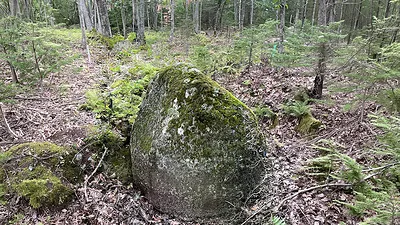
Borehole Bravo 1 reaches a depth of 137 feet with plenty of silt and sand but no wood. Scott observes that the sand resembles the material that flooded the Garden Shaft. In the lab, Emma uses XRD analysis to compare clay samples from the Money Pit, the round feature, and the rectangular feature on Lot 5. The rectangular feature proves a close match to a shallow Money Pit sample, while the round feature corresponds to maroon till from 118 feet deep. At St. Mary's University in Halifax, Charles and Jack bring the hair found embedded in the cement-like rock recovered from under the Nolan's Cross boulder on Lot 10 to Dr. Christa Brosseau and Dr. Xiang Yang for examination under a scanning electron microscope. The hair is covered in debris indicating significant age. Two strands are visible on screen but do not resemble typical human hair, and the animal species cannot yet be determined.
On Lot 5, Jack joins Helen and Fiona as they near the bottom of the rectangular feature. Fiona soon notices an iron-colored item with faceted edges that is heavy like lead. Helen suggests it could be a measuring weight, and Fiona believes it was carved to a specific standard. The piece is bagged for further analysis. In Roskilde, Denmark, Rick and members of the team visit the Viking Ship Museum where Dr. Morten Ravn shows them a vessel dating from the late Viking Age to the early medieval period. He explains how Norse ships evolved from oared craft to sail-powered vessels around 750 A.D., enabling open-ocean and eventually transatlantic voyages. Shipwright Marten Rodevad Dael demonstrates a reconstructed cargo ship built around 1060 that could carry roughly 20 tons to North America. Doug notes that a piece of wood found on Oak Island, dated to 660 through 770 A.D., resembled railing from the bow of just such a vessel.
In Reykjavik, the team visits the Arni Magnusson Institute where curator Professor Gunnlaugsson presents a manuscript written in Latin and Norse. Emiliano Sacchetti reminds the group that the Cistercian scriptorium at Morimondo produced over 100 manuscripts in the 13th century and that this knowledge eventually reached Iceland, which hosted more than 15 monastic houses between the 11th and 14th centuries. The manuscript names four specific stars, one of which is Arcturus, a reference star for the alignment of Nolan's Cross. Doug identifies the ribbon-like symbol from the Lot 8 copper piece appearing multiple times in the text. At the National Museum of Iceland, curator Armann Gudmundsson presents Roman coins unearthed in southern Iceland, minted in the 4th century but brought by Norse settlers during the 9th or 10th century, with one recovered from a 10th-century farmstead.
At Kverkarhellir Cave, historian Roberto Pagani leads the team through underground caverns created by an Irish Christian monastic order around 800 A.D. and later conquered by Vikings in 874 A.D., who occupied the site until the 13th century. Inside, the team discovers a cross carving that resembles the lead cross found at Smith's Cove and similar carvings observed in France and Italy. Back in the War Room, Doug recaps the symbols encountered across the trip that also appear on Oak Island. Alex presents the cave carving from Iceland alongside images of the lead cross, and the group discusses the growing evidence of a Templar presence on the island. Marty updates the team on the cement with embedded hair found beneath Cone E.