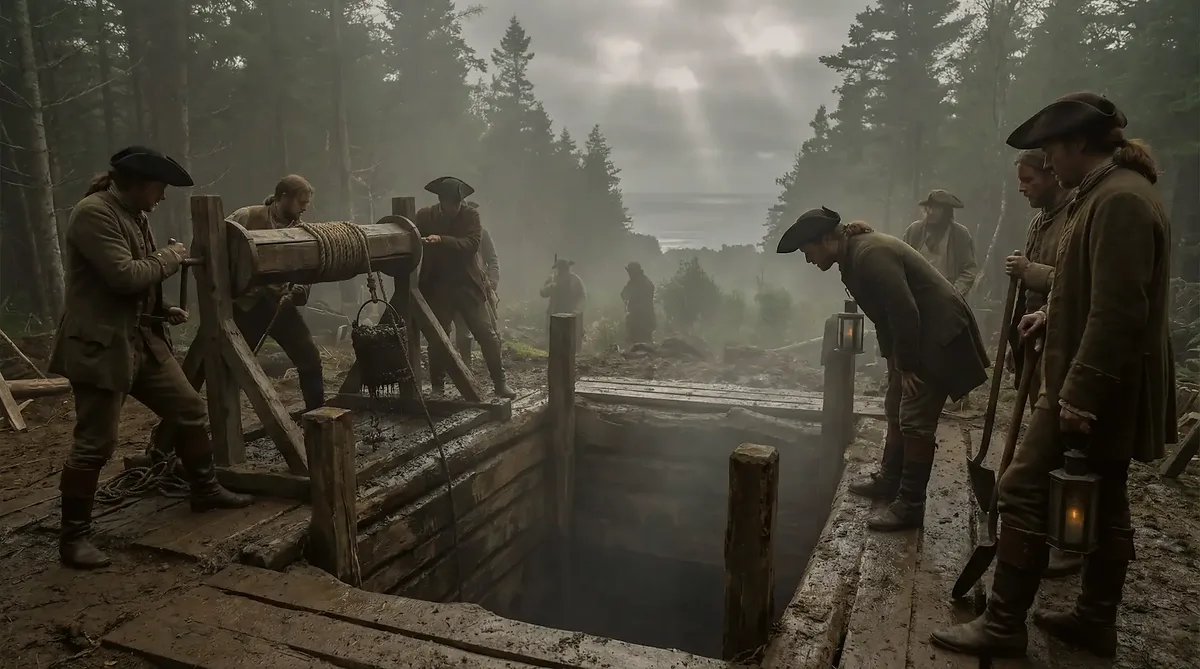
In the autumn of 1802, a group of businessmen from Onslow and Truro, Nova Scotia, formed a company with the sole purpose of recovering whatever lay at the bottom of a flooded shaft on a small island in Mahone Bay. They called themselves the Onslow Company. Their leader was Simeon Lynds, a wheelwright with family connections to the south shore. Their undertaking was not a secret. It required labour, equipment, and capital. It required access to land owned by John Smith of Chester. And it took place in a colony of perhaps 30,000 people, governed from Halifax by a small circle of interconnected officials.
At the centre of that circle sat Richard John Uniacke: Attorney General of Nova Scotia, Advocate General of the Vice-Admiralty Court, Worshipful Master of his Masonic lodge, Speaker of the House of Assembly, and the representative for Queens County on the province's south shore. He was, by any measure, the most powerful man in Nova Scotia. And the Onslow Company operated entirely within his jurisdiction.
The Old Attorney General
1 min
Richard John Uniacke was born on 22 November 1753 in Castletownroche, County Cork, Ireland, the fourth son of a Protestant Ascendancy family. He arrived in Philadelphia in 1774, partnered with trader Moses Delesdernier, married Delesdernier's daughter Martha Maria, and settled on the Bay of Fundy. In 1776, he joined the American rebels at the Battle of Fort Cumberland and was arrested for treason. The charge was dropped. By 1781, he had reinvented himself as a loyal subject of the Crown and was appointed Solicitor General of Nova Scotia.
His rise was swift and contested. He served in the House of Assembly from 1783, became Speaker in 1789, and was passed over for Attorney General in favour of Loyalist Samuel Sampson Blowers in 1784. That slight ignited a rivalry that lasted decades. When the position opened again in 1797, Uniacke appealed directly to the Duke of Portland, the British Home Secretary. Portland appointed him over the objections of Loyalist Governor John Wentworth, delivering one of the sharpest rebukes to a Nova Scotian governor on record. One of the defeated candidates, Jonathan Sterns, assaulted Uniacke in the street. Another challenged him to a duel.
Uniacke held the Attorney Generalship from 1797 until his death in 1830, a span of 33 years. He sat on the Governor's Council from 1808. He was instrumental in establishing King's College at Windsor, in blocking the legalization of slavery in 1787, 1789, and 1808, and in advocating for the Confederation of British North American colonies half a century before it became reality. Historian Brian Cuthbertson called him simply "the most influential Nova Scotian of his day."
The Vice-Admiralty Court
2 min
In 1784, when Blowers received the Attorney Generalship, Governor John Parr offered Uniacke a consolation: the position of Advocate General of the Vice-Admiralty Court. It was this appointment, held from 1784 until his death, that built Uniacke's fortune.
The Vice-Admiralty Court adjudicated the laws of trade and navigation, and in wartime it became the court of prize: the legal mechanism by which captured enemy ships and their cargoes were condemned, assessed, and distributed. The fees for court officials were substantial. Between the French Revolutionary Wars, the Napoleonic Wars, and the War of 1812, approximately 700 prize ships passed through the Halifax court. Uniacke accumulated an estimated £50,000 from his share of the fees alone.
He was not a passive beneficiary. Cuthbertson's biography records that Uniacke partly funded his eldest son Norman's legal education at Lincoln's Inn in London through "his speculative backing of Simeon Perkins' privateering ventures." Perkins was a prominent Liverpool, Nova Scotia, merchant and diarist who outfitted privateers operating along the south shore, the same coastline where Oak Island sits in Mahone Bay. As the court official who arranged "quick condemnation of the prizes," Uniacke controlled the speed at which seized cargo was legally released to investors. His dual role, backing the voyages with his own capital while adjudicating their legality from the bench, placed him at the nexus of Nova Scotia's entire maritime seizure economy. Every captured ship that entered Halifax harbour during three decades of almost continuous war passed through his office.
The War of 1812 proved especially lucrative. Fortunes were made in both trading and privateering, and Uniacke used the proceeds to build his country estate at Mount Uniacke between 1813 and 1815: an 11,000-acre property with a grand Georgian mansion overlooking Lake Martha, roughly equidistant between Halifax and the south shore harbours.
Of particular relevance is a detail buried in Cuthbertson's account of the post-war period. During the War of 1812, "public and private papers found on captured prize ships had been seized, and Uniacke as an official of the Vice Admiralty Court had read much of this correspondence." Most captures came from New England. The documents included personal letters, commercial records, and political correspondence. If any captured vessel ever carried intelligence about Oak Island, whether maps, journals, or shipping records related to the south shore, Uniacke's desk was where that information landed.
 Pirates & Privateers on Oak Island→
The Masonic Order
1 min
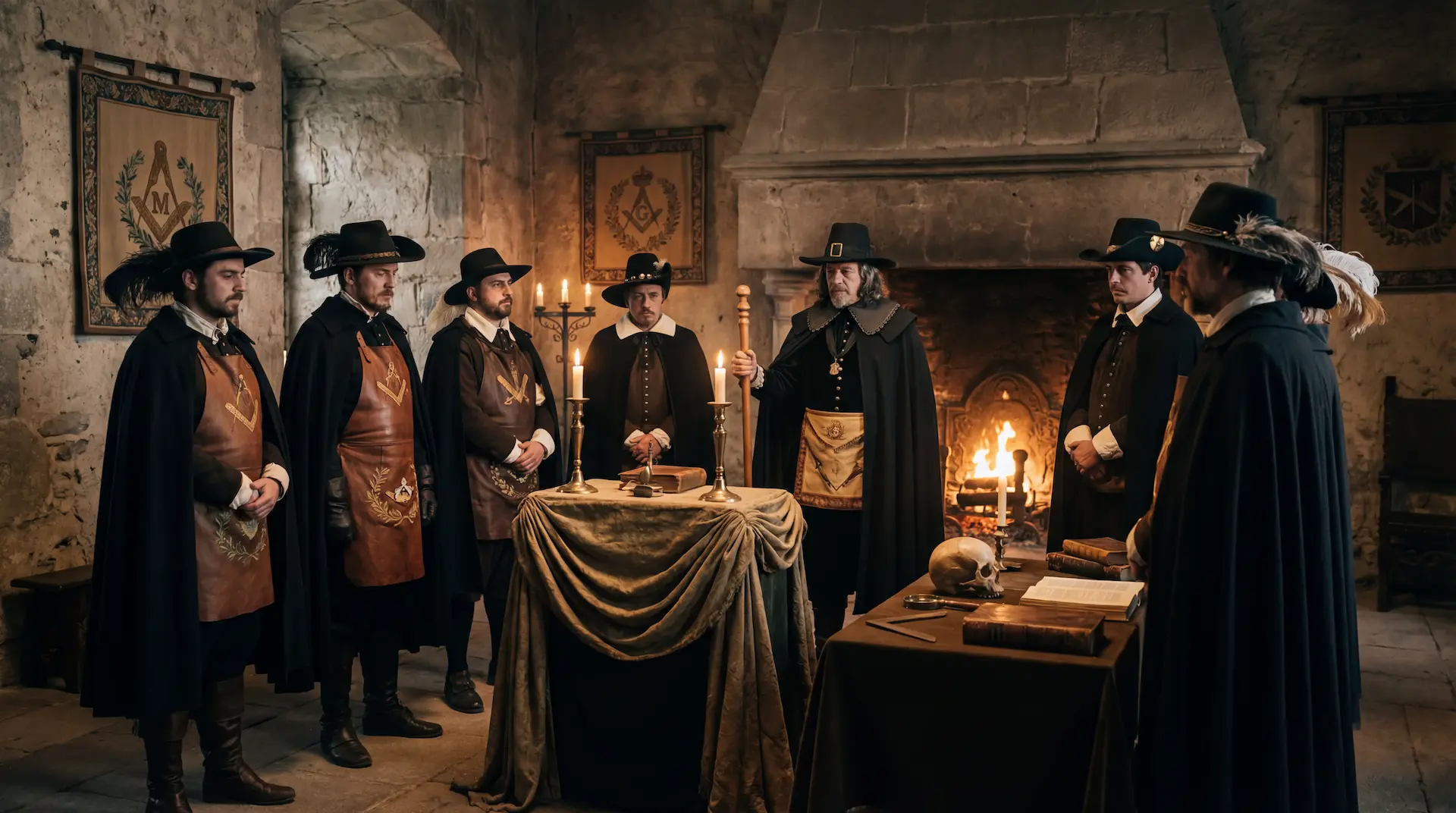
Cuthbertson records that Uniacke "joined the Masonic Order sometime in the 1780's. He belonged to the Grand Lodge and in all probability it was Parr, as Grand Master, who had drawn him into the order. In 1792 he was elected a worshipful master and three of his sons later joined."
This was not casual membership. The Grand Lodge of Nova Scotia was the institutional backbone of colonial governance. Cuthbertson notes that "most government officials and merchants were members" and that "Parr, Bulkeley and Wentworth became grand masters in succession." Richard Bulkeley had served as Provincial Secretary, Council member, Judge of the Admiralty, and Grand Master. John Wentworth succeeded Parr as both Lieutenant-Governor and Grand Master. Uniacke moved in this circle as a peer, not a peripheral figure.
 Freemasons on Oak Island→
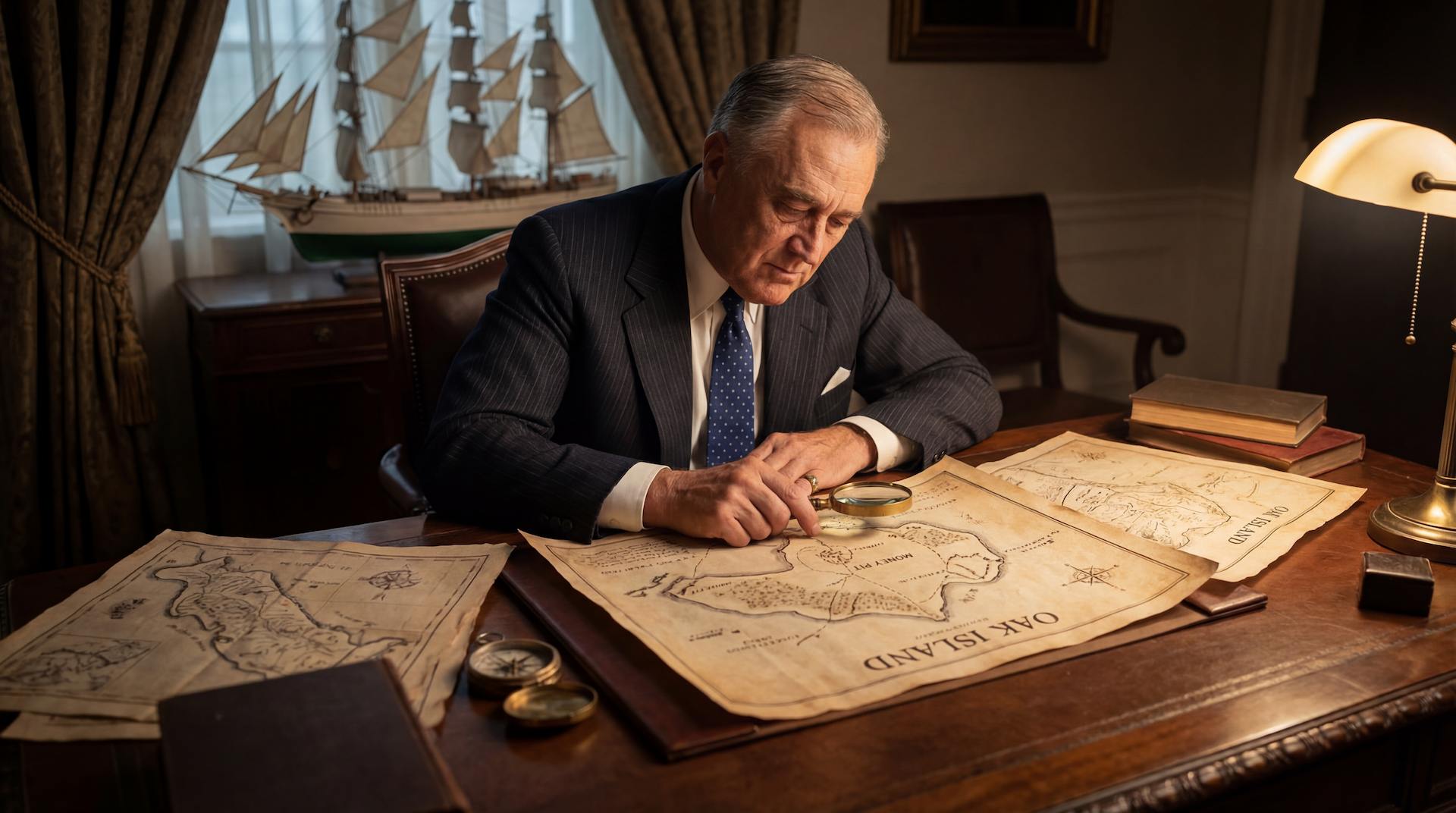
The Masonic connections to Oak Island are well documented. Scott Clarke's Oak Island Odyssey: A Masonic Quest (2023) traces the fraternal thread through the island's history, from the 1753 land grant by Masonic Lieutenant-Governor Charles Lawrence to the involvement of Masonic treasure hunters across two centuries, including Franklin D. Roosevelt and John Wayne. Mark Finnan's book Oak Island Secrets noted that the shaft and its layered contents "seemed to replicate aspects of a Masonic initiation rite involving a hidden vault with a sacred treasure." Whether one accepts the Masonic theory of Oak Island or not, Uniacke's documented rank within the Order places him inside the very fraternal network that repeatedly surfaces in the island's story.
 The Roosevelt Connection→
The Serpent Monument at Mount Uniacke
2 min
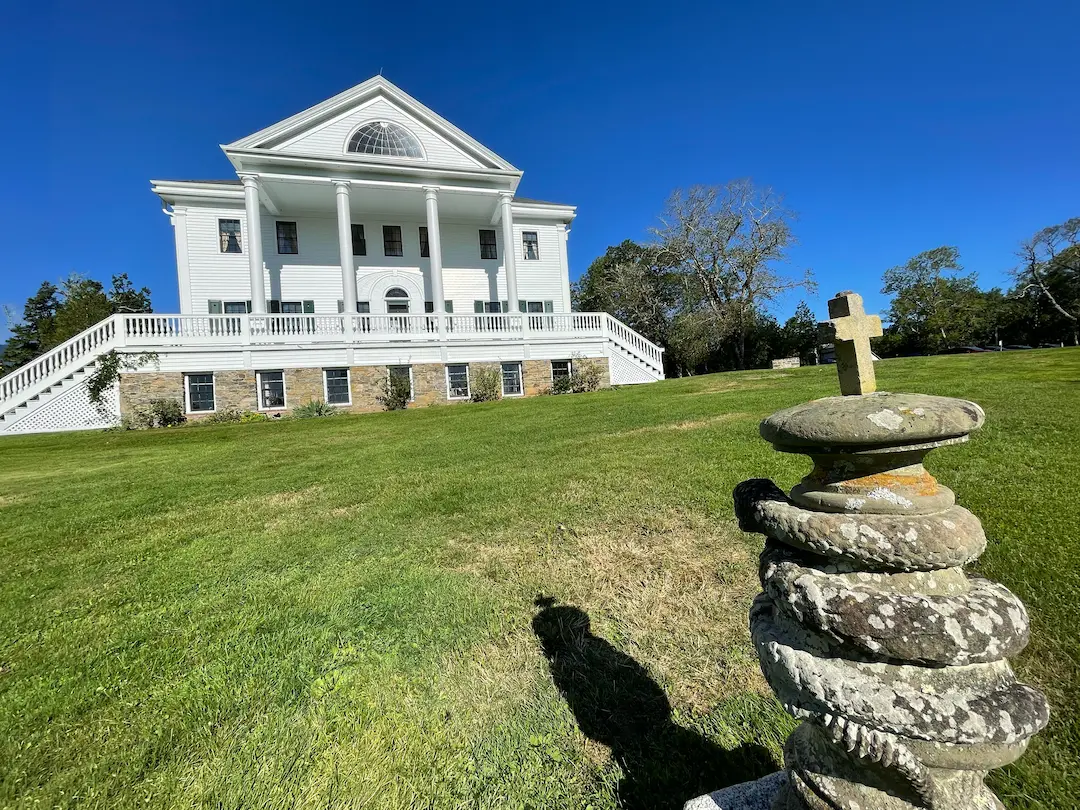
On the grounds of the Uniacke Estate Museum Park, near a sundial dated 1815, stands a stone monument placed by a member of the Uniacke family. The monument consists of a square stone base supporting a bulbous pillar, around which a serpent coils upward, the whole structure surmounted by a small cross. Museum guides describe it as representing "good over evil," a standard Christian reading of the symbol.
That interpretation is incomplete. In the Scottish Rite of Freemasonry, the 25th Degree is called the "Knight of the Brazen Serpent." Its central emblem is a Tau cross (or pillar) entwined with a serpent, a direct reference to the Nehushtan: the brazen serpent Moses raised on a pole in the wilderness so that the Israelites could look upon it and be healed (Numbers 21:8-9). In John 3:14, Christ's crucifixion is explicitly linked to this image. The degree's jewel combines a cross, a serpent, and a circle, and the ritual concerns the soul's journey through purification toward esoteric knowledge connecting Egyptian, Hebrew, and Christian mystery traditions.
The monument at Mount Uniacke matches this description with a precision that is difficult to attribute to coincidence. The Uniacke family's Masonic involvement is documented across multiple generations. To a visitor without Masonic knowledge, the monument reads as a Christian symbol. To a Freemason familiar with the Scottish Rite degrees, the cross-and-serpent combination is immediately recognizable as a 25th Degree emblem, with all that implies about the depth of the family's engagement with the Order's higher teachings.
The Nehushtan itself carries a further resonance. According to 2 Kings 18:4, the brazen serpent Moses made was preserved in the Temple of Solomon until King Hezekiah destroyed it. The Temple of Solomon is the foundational narrative of all Masonic ritual. The chain from Temple treasures to Templar custody to Masonic encoding is precisely the narrative thread that runs through the Templar theory of Oak Island. And here it stands, carved in stone, on the private estate of Nova Scotia's Attorney General.
The South Shore
1 min
Between 1798 and 1805, Uniacke represented Queens County in the House of Assembly and served as Speaker. Queens County encompasses the south shore of Nova Scotia, the same coastline where Oak Island sits in Mahone Bay, just across the water from Chester.
Cuthbertson describes Nova Scotia's south shore settlements as stretching "from Chester through to Minas Basin," a network of harbours established by New England farmers and fishermen in the 1760s. By the late 18th century, these communities were deeply involved in maritime trade, and, as the biography makes clear, in smuggling. The outbreak of war with France in 1793 made legitimate trade increasingly difficult, and Nova Scotia's coastal population "became habituated to smuggling to survive." An immense contraband trade grew up along the south shore, with American vessels exchanging provisions and fish for British manufactures, rum, and sugar.
Uniacke was embedded in this world from multiple angles. As Attorney General, illegal trade fell within his prosecutorial authority. As Advocate General of the Vice-Admiralty Court, seized vessels and their cargoes passed through his office. As the Assembly representative for the south shore, the communities engaged in smuggling were his constituents. His son Richard John Jr. would later kill the merchant William Bowie in a duel in 1819, a confrontation that began when the younger Uniacke accused Bowie of smuggling during a court proceeding.
Chester, the town nearest to Oak Island, was part of this network. Simeon Perkins, the Liverpool privateer backed by Uniacke, operated from these same waters. The geographic proximity is striking: Mount Uniacke sat on the Halifax-to-Windsor road, roughly 25 miles from Halifax, and the south shore harbours lay within a day's travel.
The Onslow Years
2 min
The Onslow Company operated on Oak Island from 1802 to 1805. No original documents from the company have survived, but oral accounts recorded in 1848 describe the excavation in detail: oak platforms every ten feet, layers of charcoal, putty, and coconut fibre, and at 90 feet a flat stone bearing an unusual inscription. The shaft flooded. A second shaft also flooded. The company disbanded.
During these exact years, Uniacke held simultaneous authority as Attorney General, Advocate General of the Vice-Admiralty Court, and Speaker of the House of Assembly representing the south shore. The Law of Treasure Trove, derived from the English statute of 1276, required that "treasures found hidden or concealed without any known owner belong to the King." In Nova Scotia, this royal prerogative passed to the provincial government. The Attorney General was the official responsible for enforcing it. In 1895, a later Attorney General, J.W. Longley, would explicitly declare that any treasure discovered on Oak Island belonged to the Crown. In 1802, that declaration would have come from Uniacke.
Simeon Lynds, who led the Onslow Company, was a wheelwright from the Truro/Onslow area of central Nova Scotia, backed by Colonel Robert Archibald, Captain David Archibald, and Sheriff Thomas Harris. These were men of standing in a small colonial society. The involvement of a colonel, a captain, and a sheriff suggests the venture carried some official awareness, if not sanction. No record of a treasure trove licence from this period has survived, but the legal requirement existed: the Crown's claim to hidden treasure was centuries old, and enforcing it fell to the Attorney General.
Uniacke's authority over land matters adds a further dimension. As Solicitor General in the 1780s, he had personally supervised the escheating of 1.3 million acres for Loyalist settlement, issuing over six thousand grants of land. He knew, quite literally, who owned every significant parcel in Nova Scotia. Oak Island had been granted as "Island 28" in 1753 by Masonic Lieutenant-Governor Charles Lawrence. By 1802, John Smith, one of the original three discoverers of the Money Pit, had purchased the lot containing the shaft. Any legal claim arising from the excavation, whether related to treasure trove, land use, or property rights, would have crossed Uniacke's desk. The idea that a formal excavation company could operate on the south shore for three years, employing labourers and digging a 110-foot shaft, without attracting the attention of the province's Attorney General and south shore representative, requires a very particular kind of credulity.
The Missing Papers
1 min
Brian Cuthbertson opens his biography with a lament. "Uniacke's personal papers, which must have been voluminous, were destroyed after his death by a daughter-in-law doing spring house cleaning." The loss, Cuthbertson writes, "makes the writing of a biography, of what was certainly an extraordinary and remarkable man, a most daunting task."
What those papers contained, we will never know. Uniacke served in public office for 49 years. He wrote extensively to British officials, colonial agents, and American correspondents. He read captured correspondence from prize ships. He managed the legal affairs of a maritime colony during three decades of war. He oversaw treasure trove claims. He supervised the escheating of nearly 100,000 acres of land between 1819 and 1821, deciding who owned what throughout the province.
If any written record ever existed linking Nova Scotia's colonial administration to the early treasure hunts on Oak Island, Uniacke's archive was the most likely place to find it. That archive is gone.
Assessment
1 min
No document has been found connecting Richard John Uniacke to Oak Island. His name does not appear in any surviving account of the Onslow Company or the Money Pit discovery. There is no smoking gun.
What exists instead is a web of circumstantial connections so dense that it resists dismissal. Between 1797 and 1805, the man who served simultaneously as Attorney General, Advocate General of the Vice-Admiralty Court, Worshipful Master of his Masonic lodge, the province's foremost private lawyer, the legal authority on treasure trove claims, the overseer of all land grants and escheats, and an active investor in south shore privateering ventures, also represented the very constituency where the Money Pit was being excavated. In a colony of 30,000 people.
No surviving account explains how the Onslow Company financed its operations, who granted permission to dig, or what legal framework governed their claim. The man who would have answered all three questions was Richard John Uniacke. His personal papers, which might have settled the matter, were destroyed by a family member after his death.
And at his country estate, built with the fortune he made from the same maritime economy that connects Oak Island to privateers, smugglers, and Masonic networks, stands a stone monument bearing the symbol of the 25th Degree of the Scottish Rite: a serpent coiled around a cross, the Knight of the Brazen Serpent, guardian of the Temple's secrets.
The question is not whether Uniacke knew about Oak Island. The question is whether it is conceivable that he did not.