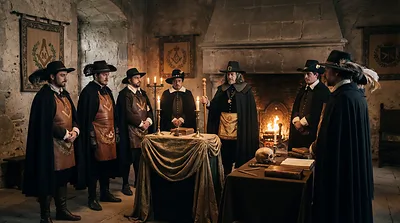
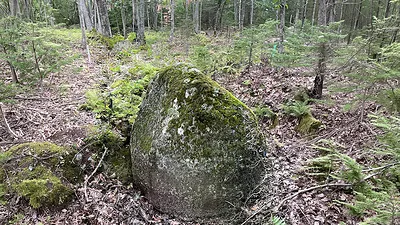
Geoscientist Dr. Ian Spooner presents his initial findings in the War Room, with Marty Lagina and Craig Tester joining by video conference. After analysing the swamp core samples collected over the previous two weeks, Spooner determines that sedimentation indicates the swamp is relatively young, perhaps only 300 to 400 years old, far younger than he expected. At the northern apex of the triangular swamp, in the area known as the pond, his team probed the bottom and encountered rock around the perimeter of an oval feature, forming what appears to be a circular stone formation. Vegetation has not crept into this feature in aerial photographs dating back to the 1920s, and Spooner believes human intervention is the most likely explanation. Following the presentation, Marty, Alex Lagina, metal detection expert Gary Drayton, and surveyor Steve Guptill take a boat into the pond to investigate. Gary wades in, at times up to his neck, and repeatedly hits iron with his pinpointer around the stones. Guptill maps every contact point with GPS. One large stone stands out: conical in shape with a flat edge on one side, resembling the Nolan's Cross boulders and carrying no metal signature, potentially serving as a marker. Marty dubs the feature the "Eye of the Swamp," noting the symbolic connection to the all-seeing Eye of Providence, a symbol adopted by both the Knights Templar and the Freemasons. In the War Room debrief, Guptill displays the mapped results, revealing a defined ring of rocks around the Eye with iron readings at nearly every point. The team unanimously agrees the swamp must be drained.
Rick Lagina, Alex, and other team members meet on site with Shawn Wilson of Wilson Excavation to assess three priority targets: the 200-foot ship-shaped anomaly at the swamp's centre, the stone roadway discovered by diver Tony Sampson, and the Eye of the Swamp. Wilson proposes using 16-foot trench cages, each weighing two to three tons, sunk through the peat to hard bottom to create isolated dig boxes while holding back the surrounding muck. The cages can be stacked up to 20 feet high as needed.
Alex Lagina, Peter Fornetti, and Charles Barkhouse travel to Saint Mary's University in Halifax, where Dr. Christa Brosseau, an associate professor of chemistry specializing in metals analysis, examines the two iron swages recently found on Lot 21. Working with colleague Dr. Xiang Yang, Brosseau uses a scanning electron microscope to analyse the chemical composition of the artifacts. The results show no traces of manganese, a key indicator that places the iron firmly before 1840, consistent with blacksmithing expert Carmen Legge's earlier assessment that the swages could date to the 1400s. Charles Barkhouse notes that only two known search operations predate 1840, the 1795 discovery group and the 1803 Onslow Company, and neither worked in the western area where the swages were found, suggesting the tools belong to either an earlier recovery effort or the original depositors.
At Smith's Cove, Rick, Doug Crowell, Paul Troutman, and geologist Terry Matheson begin a core drilling program targeting the upper beach area between the cove and the Cave-In Pit, where ground-penetrating radar has indicated possible tunnel locations. Choice Drilling sinks a borehole through cobbly, moisture-rich till, reaching a zone of amorphous soft clay mixed with small stones at roughly 91 feet, with no natural bedding structure remaining. At approximately 95 feet, the core produces fragments of dynamite, including paper wrapping and a section of the tube used to lower the charge. The find validates the historical record of the Oak Island Treasure Company's 1897 blasting operation, led by Frederick Blair, in which 50 to 75 pounds of dynamite were detonated in each of five boreholes drilled in a line some 50 feet above the high tide mark in an attempt to seal the flood tunnels. Shortly after that operation, water was reported boiling up and out of the Money Pit, suggesting the charges came close to their target.