The first pieces of the massive drilling equipment arrive at Oak Island as preparations for the Money Pit excavation enter their final phase. Multiple low-float rigs deliver components for 100-ton and 300-ton cranes along with 60-foot steel caissons and the oscillator that will grind them into the earth. Rick and Marty Lagina bring 93-year-old Dan Blankenship to the cleared and levelled Money Pit area to survey the operation. Working from archival maps and careful measurements, the team has identified two target sites: Valley 3, where evidence of a possible wooden vault was found at roughly 143 feet, and C1, the location of the gold-coloured object seen on camera in a void at 170 feet. The plan calls for a hammer grab to extract material from inside each 40-inch-wide shaft once it reaches depth.
In the War Room, researchers Doug Crowell and Kel Hancock present their investigation into the fate of the 90-foot stone, the inscribed slab pulled from the Money Pit by the Onslow Company in 1804 whose symbols reportedly translated to "forty feet below two million pounds are buried." Crowell traces its last known location to the Creighton and Marshall bookstore in Halifax, where it was displayed in the window to raise funds. In 1909, treasure hunter Captain Henry Bowdoin, accompanied by future U.S. President Franklin Roosevelt, visited the bookstore and was horrified to discover the stone being used as a cutting board for leather book jackets, its symbols apparently worn away. The bookstore closed in 1919 and the stone vanished. Alex Lagina, Charles Barkhouse, Crowell, and Hancock travel to Halifax to inspect the building, now the Halifax Seed Company, and explore its basement with Dr. Allan Marble of the Royal Nova Scotia Historical Society and building representative Joe Landry. They find original stone foundations and a boarded-up archway connected to Halifax's old military tunnel network but no trace of the stone. Dr. Marble then directs them to the Halifax Club, built in 1862 by Scottish stonemason George Lang, where a member reportedly told his son in 1982 that the stone was embedded in the floor. A search of the Club's basement and sub-basement reveals a large limestone slab, but its dimensions do not match the 90-foot stone.
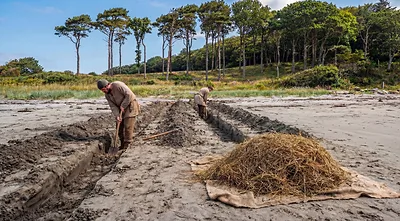
At Smith's Cove, Craig Tester and Jack Begley work with Matt Savelle and Luke Melanson of Canadian Seabed Research to conduct a ground-penetrating radar survey. They are searching for evidence of the box drains first discovered by the Truro Company in 1850, constructed of flat paving stones beneath layers of coconut fibre and eel grass and designed to feed ocean water into the Money Pit through underground flood tunnels. The GPR returns distinct U-shaped and V-shaped responses consistent with man-made subsurface features, and Craig identifies a promising area for a future excavation.
Lee Lamb, daughter of Robert Restall, returns to Oak Island with her children Claire Bradfield and Brook Helland. On August 17, 1965, Robert Restall was overcome by hydrogen sulphide gas while investigating a flooded 27-foot shaft at Smith's Cove and fell in; his son Bobby Jr. and two others, Cyril Hiltz and Karl Grasser, died attempting a rescue. Lee brings the 1704 stone, discovered by her mother Mildred on the Smith's Cove beach in 1960, its deeply carved numerals still sharp to the touch. The team walks Lee through their plans for the Money Pit excavation. When the final piece of equipment, the oscillator, arrives, the team invites Dan Blankenship to throw the switch and officially launch the first excavation of the Money Pit in more than half a century. The starter can, weighing roughly 30,000 pounds, begins cutting into the earth above the Valley 3 target.