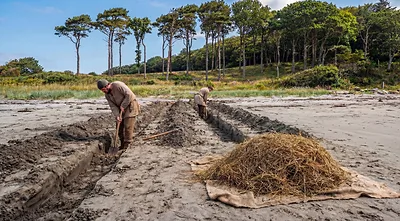
At Smith's Cove, the team finishes exposing the U-shaped structure first discovered by Dan Blankenship in 1971. Charles Barkhouse identifies Roman numerals XI and XII carved into additional uprights, continuing the numbering sequence found on earlier beams. Geologist Terry Matheson notes that vibrant blue clay packed against the exterior matches the clay-rich till found above 50 feet in the Money Pit, suggesting both sites may share the same builders. Rick Lagina observes there are no spikes or metal fasteners anywhere in the structure, only hand-cut notches and wooden pegs. Marty Lagina and archaeologist Laird Niven measure the formation at 65.5 feet across its leading edge. Laird confirms he has never encountered anything like it in Nova Scotia, and the absence of iron reinforces the possibility of considerable age.
In the War Room, Rob Hyslop and Ryan Levangie of Azimuth Consulting Limited present their three-dimensional laser scan analysis of the suspected 90 Foot Stone, the legendary artifact first recovered from the Money Pit at a depth of 90 feet by the Onslow Company in 1804. The scan reveals two carved letters, an "LN" on one side and a faint "A" when the image is rotated 180 degrees. Doug Crowell connects the finding to Captain Henry L. Bowdoin, who in 1909 visited the stone at the Creighton and Marshall bookstore in Halifax and reported that years of use as a leather-cutting surface had worn away most of the inscription, leaving only two initials. The team agrees this is likely the same stone Bowdoin described, though further testing is needed to recover any remaining hieroglyphic inscription.
Jack Begley, Gary Drayton, and diver Tony Sampson boat to Apple Island, half a mile east of Oak Island, to test astrophysicist Dr. Travis Taylor's star map theory, which uses the Freemason drawing template of Hiram Abiff to connect the constellation Taurus to specific points across Oak Island and neighboring islands. At the GPS coordinates Travis identified, the team finds three massive boulders, two of white granite and one pinkish-red, consistent with the stone markers found at other star map locations on Oak Island. Gary's metal detector registers multiple iron targets and at least one promising non-ferrous signal, but the team cannot dig because their treasure trove license covers only Oak Island.
At the Money Pit, Rick, Dave Blankenship, Charles, and Doug Crowell monitor the progress of borehole K-5.5, drilled by the Choice Drilling crew led by Brennan. The hole targets the Shaft Six tunnel at approximately 118 feet, where an 1861 treasure hunting team tunneled toward the original Money Pit before flooding and a catastrophic collapse scattered wood and possibly treasure across an underground debris field. At depth, the core sample reveals highly disturbed soil followed by five feet of wood between 118 and 124 feet. Rick interprets the finding as evidence they are in the collapse zone, and Marty notes the Money Pit collapsed in 1861 with a large quantity of wood that went unaccounted for. The team considers this their strongest confirmation yet that Shaft Six has been located.
Inside the U-shaped structure, Laird Niven, Terry Matheson, and Billy Gerhardt uncover a previously unknown wooden wall made of thick offset timbers built for strength, along with stacked rocks and blue clay consistent with a French drain system. Rick arrives and confirms the wall is well-built and entirely unrecorded on any historical map of Smith's Cove. Gary Drayton tests the wash plant by scanning spoil piles with his metal detector and recovers a 1963 coin, confirming the system can capture small metal objects. The team takes the new wall and French drain material as further evidence that extensive and sophisticated construction took place at Smith's Cove, potentially by the original depositors.