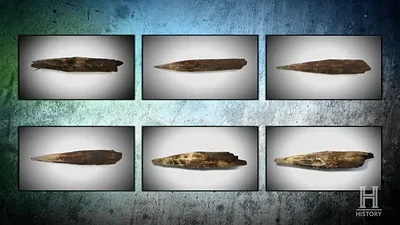
About This Artifact
A wrought iron spike recovered from the triangle-shaped swamp, one of numerous iron fasteners found across the island that point to large-scale construction activity predating the Money Pit's discovery in 1795. The spike was hand forged, with the irregular surface texture and fibrous grain pattern characteristic of pre-industrial iron production, where a blacksmith would heat raw iron in a charcoal forge and shape it by repeated hammering on an anvil.
Wrought iron spikes of this type served multiple purposes in 17th and 18th-century construction: securing heavy timbers in wharves and ship cribbing, fastening structural beams in tunnel construction, and joining planks in cofferdams and retaining walls. Their presence in the swamp placed them alongside other construction hardware including crib spikes that Carmen Legge dated to the mid-1600s at Smith's Cove, marlinespikes from the same era that he identified as sailors' rope-splicing tools, and ring bolts dated to the 1600s to 1760 that he identified as wharf pins. The swamp has produced the densest concentration of pre-1795 iron hardware on the island, consistent with the theory that it once served as a working waterfront where a vessel was brought in, offloaded, and the area subsequently flooded to conceal the operation.
Historical Context
Gary Drayton
Where It Was Found
Found at Swamp.