Terry reports that the first borehole, Avanti 1, produced only in situ material. Marty directs the team to move to the next target, designated Bravo 1, and expresses hope it will lead them to "Tango." On Lot 5, Marty and Jack check in on the rectangular stone feature where Helen has uncovered large pieces of creamware. The team also identifies a new area of bluish clay within the feature, and Marty requests a sample for testing.
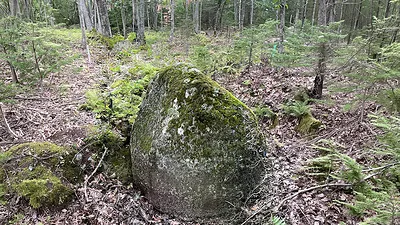
On Lot 10, the team begins an investigation of Cone E, one of the boulders forming Nolan's Cross. After Professor Gaspani's conclusion that Nolan's Cross was constructed in the 13th century by the Knights Templar, Marty obtained permission from Tom Nolan to move the boulder. Justin and Philip from Corkum Towing lift the stone, and Dr. Ian Spooner and Marty collect samples from underneath, including an unusual rock that Marty hopes is cement. In the lab, Emma's XRD analysis reveals quartz, albite, muscovite, and chlorite serpentine but nothing unusual for natural clay composition. While photographing the piece under the microscope, however, Laird notices a hair embedded in the rock. Additional testing, including DNA analysis, will be pursued.
In the Netherlands, Rick and members of the team visit Valkenburg Castle, a 12th-century fortress where Corjan Mol and cultural historian Jacquo Silvertant show them 14th-century carvings in the dungeon where Templars were once imprisoned. Among the markings are four-dot crosses and a goose paw symbol matching one previously seen in Liverpool, Nova Scotia. Corjan identifies what he calls a Viking Sail, a symbol resembling sails made from horizontal strips of cloth on Norse vessels. The team then travels to Bornholm, Denmark, to visit Nylars Church, believed to have been built in the 12th century by the Knights Templar. Author Erling Haagensen tells the group that Vikings helped the Templars prepare for transporting treasure to the New World. Inside the church, Rick examines runestones dating to the 4th century and notices symbols matching those reportedly found on the 90-foot stone, which was described as Swedish porphyry with an olive-green color. He also spots what appears to be a Templar cross at the top of one runestone.
At the Madsebakke site, historian Jeanne Cordua presents 3,000-year-old Bronze Age rock carvings believed to represent navigational tools aligned with stars in the night sky. She describes one carving as a Bronze Age compass that points to sunrise and sunset at the winter solstice, and explains how Norse mariners used translucent mineral Sunstones to navigate the open sea. The team identifies a four-dot cross among the carvings, and Doug connects nearby potholes representing the Hyades constellation to the stone piles on Lot 15, which Professor Gaspani also linked to Hyades. At the Ladby Viking Museum in Kerteminde, curator Ane Jepsen Nyborg shows the team the burial site of the King of Ladby, who died in 925 A.D. and was interred in a 70-foot Viking ship. When Doug presents a photograph of a crossbow bolt found on Oak Island in the 1960s, Ane produces a replica and confirms the artifact matches pieces from local archaeological digs, dating it to the early medieval period through the Viking Age, pre-1300s.