Before dawn on 21 June 1720, a single ten-gun sloop entered Trepassey harbour on Newfoundland's Avalon Peninsula. Her black flag carried a death's head and a sword-arm holding a cutlass. Her musicians played from the deck. Twenty-two merchant vessels and a hundred and fifty fishing boats lay at anchor in the bay. Their captains and crews, roughly twelve hundred sailors in total, abandoned every ship without firing a shot. The man at the helm was Bartholomew Roberts, the Welsh pirate who would take more than four hundred prizes in three years and become the most successful pirate of the Golden Age. He spent two weeks in the port. He sailed away with a new flagship. And before he came north that summer, he had raided mainland Nova Scotia. Of all the pirates whose names attach to the Oak Island question, Roberts is the one whose presence in Mahone Bay's home waters in the early eighteenth century is best documented.
 Pirates & Privateers on Oak Island→
The Trepassey Raid
1 min
Roberts came up from the Caribbean in the spring of 1720, chased out of the West Indies by French pirate hunters after a damaging engagement off Barbados. Ferryland was his first Newfoundland stop. Then Trepassey, the larger Avalon Peninsula port and one of the most important nodes in the migratory cod fishery. An eyewitness named William Matthew, whose account is preserved in the Boston Gazette of 22 August 1720, described Roberts's flag as "a death's head and an arm with a cutlass."
For two weeks Roberts kept the port. He took the Bristol Galley as his new flagship and renamed her Royal Fortune, the first of several ships he would give that name. A fisherman witness, cited in the modern Golden Age of Piracy reference compiled by Wayne Savage, said that Roberts burned only one ship and actually paid for supplies. A General History of the Pyrates attributed to Captain Charles Johnson and published in 1724 describes wider destruction. Either account establishes the same point. For two weeks in June 1720, Roberts had operational control of one of the busiest ports in eastern Canada.
The Nova Scotia Operations
1 min
Trepassey is the famous part of the northern campaign. The less famous part is what happened before it. The Wikipedia biographical entry on Roberts, drawing on Aubrey Burl's 2006 biography and Richard Sanders's 2007 work, records that the Fortune "next headed northwards towards Newfoundland, raiding Canso, Nova Scotia, and capturing a number of ships around Cape Breton and the Newfoundland banks." A May 2025 piece in the Penticton Herald, drawing on Guysborough County local history, describes Roberts's Canso visit in concrete terms. Dressed in a crimson coat, gold chain and a feathered hat, Roberts stormed into Canso Harbour, stole what he pleased, and burned what he did not.
Canso sits on the easternmost mainland of Nova Scotia, by the strait that separates the mainland from Cape Breton. By sea, the run from Canso to Mahone Bay is roughly one hundred and fifty to two hundred nautical miles along the same Atlantic coastline. Roberts entered that harbour and worked it without opposition.
After Canso, Roberts worked his way around Cape Breton, taking ships in the banks fisheries and at Ferryland on the Avalon shore, before the larger Trepassey raid on 21 June. Through July 1720 he captured nine or ten French ships off the Grand Banks; one of them, refitted with twenty-six guns, became the Good Fortune. Captain Samuel Carry of the Samuel, taken on 13 July 1720 about thirty to forty leagues east of the Newfoundland banks, gave the Boston News-Letter of 20 August 1720 the earliest American newspaper account of the new pirate.
The Mira River Shipyard Tradition
2 min
The Cape Breton connection is the substantive part of the Roberts case for Oak Island. A modern article by writer and historian David Dow, published as "Pirate Shipyard on the Mira River" in Cape Breton's Magazine issue 17, August 1977, on pages 43 to 45, argued that Roberts maintained a hidden careening yard on the Mira River, the long tidal river that drains into Mira Bay on the southeast coast of Cape Breton Island.
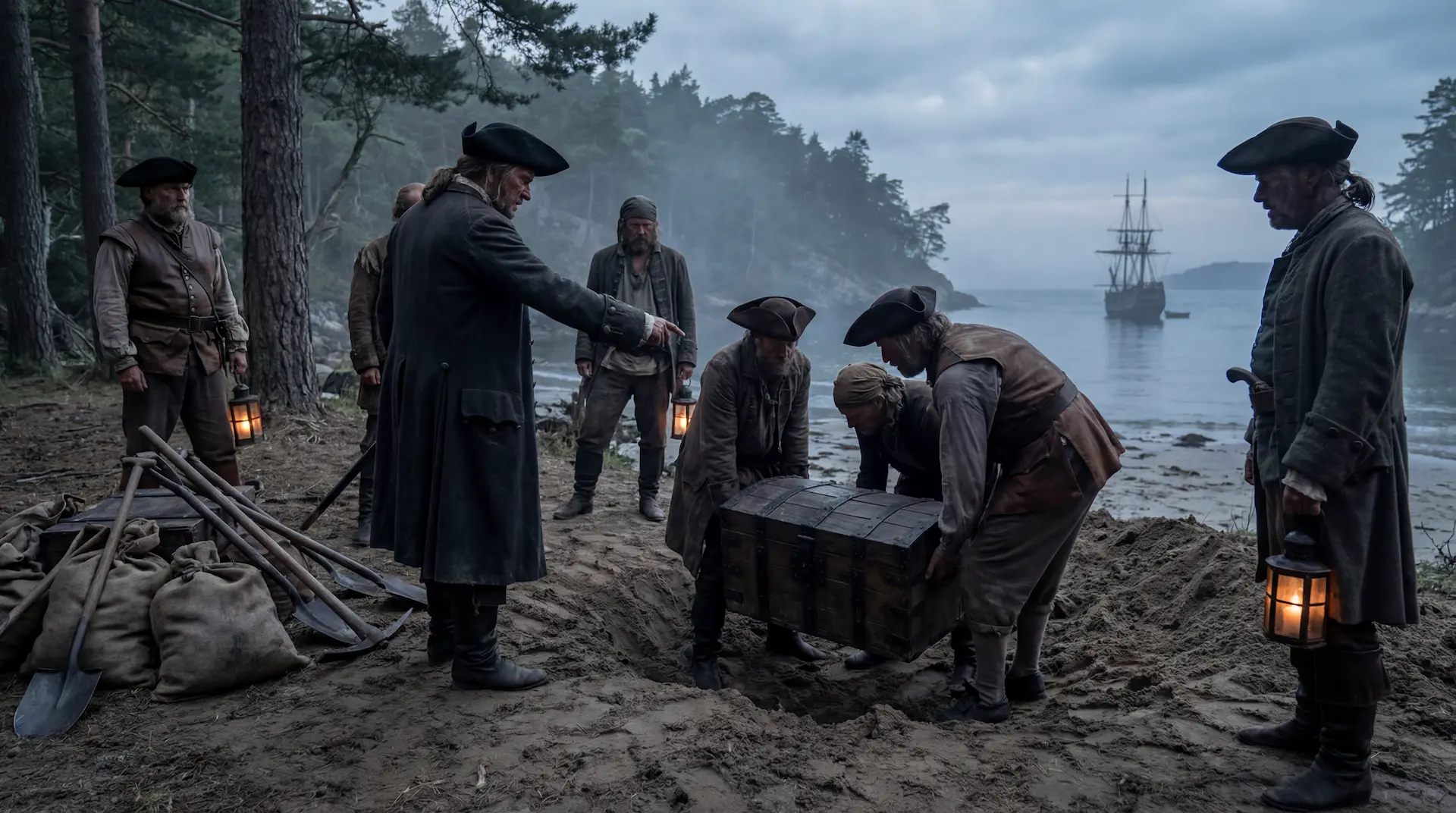
Dow's argument rested on physical features still visible at the site. A sloping sandy beach suitable for hauling and cleaning a ship. A man-made ramp. The remains of a mill race and a dam, interpreted as the water supply for a stamp mill used in ironwork. Cobbled flattened positions on the cliffs above the cove that Dow read as gun emplacements. The cove is concealed from the bay outside and lies out of cannon range from open water. Dow's reading was that ordinary shipyards in the period sat in trade centres surrounded by merchants and chandlers; this one was deliberately hidden.
Vanessa Childs Rolls, a local historian whose column appears in the Cape Breton Post, visited the site and confirmed the features Dow described. She also notes that the legend is contested. Some local writers argue the Mira River shipyard story was developed for tourism in the late twentieth century, and there is no surviving documentary evidence connecting Roberts personally to the site that predates Dow's 1977 article.
What Dow does have, from outside Cape Breton, is the local history of Trepassey, Newfoundland, which describes the 1720 raider as "a Captain Roberts from Mira River." That phrasing comes from a community independent of any Cape Breton tourism interest, and predates the 1977 piece. The Mira River sits roughly two hundred and fifty nautical miles east of Mahone Bay along the same Atlantic coast, in waters Roberts demonstrably operated in. If the tradition holds, he kept the closest documented pirate base of operations to Oak Island of any famous name in the entire Golden Age.
How Roberts Worked
1 min
Roberts ran one of the most disciplined pirate operations of the era. The Pyrate Articles he drew up for his crew, preserved in A General History of the Pyrates, governed the distribution of plunder, the conduct of voting, the carrying of women aboard, the use of candles after dark, and the resolution of quarrels. He preferred tea to rum. He banned gambling. He observed the Sabbath. His crew were drawn from press and from volunteers and were paid in shares from a common pot.
His operations were systematic in a way that distinguished him from earlier buccaneers. He used flags to deceive merchant captains into letting his ships approach. He recruited deliberately, prizing navigators and shipwrights. He careened his ships at regular intervals, which is the discipline that makes the Mira River tradition geographically and operationally coherent. A careening yard out of sight of trade routes, defensible from the cliffs above, with mill machinery for ironwork, fits the operational pattern of a captain who took prizes faster than he could repair the ships he wanted to keep.
His career moved at a tempo no earlier pirate matched. Over thirty months he took more than four hundred prizes. He moved between West Africa, the Caribbean, Brazil, and the North Atlantic in deliberate seasonal patterns. The June-to-September northern campaign of 1720 fits that pattern. Cape Breton in that period was largely unsettled by Europeans, lay close to the Great Circle Route used by treasure ships bound from the Spanish Main back to Europe, and offered cover within a day's sail of the French fortress at Louisbourg. For a captain who needed a maintained but hidden base on the Atlantic coast, Cape Breton was the obvious choice.
The Wealth Trail
2 min
Roberts's largest single haul came in late 1719, off the Brazilian coast at the Bay of Todos os Santos, where he and his crew took a Portuguese galleon carrying gold worth tens of thousands of moidores and a diamond-studded gold cross intended for King John V of Portugal. The cross became Roberts's personal ornament and was reported around his neck whenever he went into battle.
Within weeks of taking it, in October 1719 at the Surinam River, his quartermaster Walter Kennedy mutinied while Roberts was pursuing a brigantine and absconded with most of the plunder aboard the Royal Rover. Kennedy reached Scotland, lost most of his crew to the Edinburgh assizes (nine were hanged), spent his share in Dublin and London, and was himself hanged at Execution Dock on 21 July 1721. That part of the Roberts wealth is accounted for.
The rest is harder to track. Between his recovery from Barbados in early 1720 and his death at Cape Lopez in February 1722, Roberts took close to four hundred more vessels. Their cargoes ranged from cod and salt to tobacco, sugar, slaves, and gold dust. Most was traded, spent, or distributed in shares. Some was hidden ashore. His final large haul, eight pounds of gold dust per ship from eleven slave ships at Whydah in January 1722, was in his cabin on the Royal Fortune three weeks later when Captain Chaloner Ogle of HMS Swallow found him. The standard scholarly account, drawn from Marcus Rediker's Villains of All Nations: Atlantic Pirates in the Golden Age (2004), records that Ogle took gold dust from Roberts's cabin after the capture. King George I granted Ogle the right to retain the captured ships and the residual treasure. Ogle was knighted in 1723.
Two specific portions of the Roberts wealth are inventoried in the historical record: the Portuguese galleon haul taken by Kennedy in late 1719, and the Whydah gold dust taken by Ogle in February 1722. What passed through the Cape Breton operations in the summer of 1720, and through any return visits his crews might have made before the move to West Africa, is not. The Mira River yard, if it existed, served his fleet during that exact window.
Cape Lopez and the End
1 min
On 10 February 1722, HMS Swallow under Captain Chaloner Ogle engaged Roberts's flagship Royal Fortune at Cape Lopez on the coast of modern Gabon. Roberts dressed for the action as he always did, in a crimson damask waistcoat and breeches, a red feather in his hat, the Portuguese diamond cross at his neck, a sword in his hand, and two pairs of pistols slung over his shoulders. He was killed in the first effective broadside by grapeshot to the throat. His body was weighted and thrown overboard at his own standing order, before HMS Swallow could board and take the body for public display.
The action continued for two hours after his death. Two hundred and sixty-four of his men were taken. The trial at Cape Coast Castle in modern Ghana, conducted by a Court of Admiralty between 28 March and 20 April 1722, was the largest mass pirate trial in history. Fifty-two pirates were hanged, eighteen of them in chains. Twenty were sentenced to forced labour in West African mines. Seventy enslaved Africans who had been aboard the pirate ships were sold back into slavery. The trial transcript, preserved in the National Archives in London, names every defendant and records the evidence against each. It is the most complete documentary record of any pirate crew of the period.
What Roberts Brings to the Oak Island Question
1 min
Roberts is the one named pirate of the Golden Age who demonstrably raided mainland Nova Scotia. He is the one named pirate of the Golden Age with a sustained local-history tradition of a maintained operating base on the Atlantic coast of Cape Breton, less than three hundred nautical miles from Oak Island along the same shoreline. He operated in the waters Mahone Bay opens onto, in the period some Oak Island dating evidence points to. He commanded more men, more operational discipline, and more sustained wealth than any contemporary in those waters.
The pirate-era theory of Oak Island does not require Bartholomew Roberts personally as the depositor of anything specific. It requires that pirates of his profession were present in those waters in those years, with the manpower and the operational discipline to do the work attributed to them. Roberts is the single best-documented example of a pirate who was.
Sources
4 min
This article draws on contemporary newspaper accounts and trial records from 1720 to 1722, the standard primary work of pirate history published in 1724, the four modern biographies of Bartholomew Roberts, scholarship on the Golden Age of Piracy, regional Atlantic Canada pirate history including the local traditions of Cape Breton and Newfoundland, and the established Oak Island reference literature. Every named claim in the body of the article above traces to one of the following sources.
Contemporary Sources, 1720 to 1724
- Captain Charles Johnson, A General History of the Robberies and Murders of the Most Notorious Pyrates, T. Warner, London, 1724. The primary contemporary source for Roberts's career, written within two years of his death and drawing on the Cape Coast Castle trial proceedings. Authorship has been debated since the 1930s, when some scholars proposed Daniel Defoe as the writer behind the Johnson pseudonym; that attribution is no longer widely supported.
- Boston Gazette, 22 August 1720. The William Matthew eyewitness description of Roberts's Jolly Roger as "a death's head and an arm with a cutlass," recorded after the Trepassey raid.
- Boston News-Letter, 20 August 1720. The earliest American newspaper account of Roberts, drawn from Captain Samuel Carry of the Samuel, taken by Roberts on 13 July 1720 about thirty to forty leagues east of the Newfoundland banks.
- Court of Admiralty trial records, Cape Coast Castle, Gold Coast, 28 March to 20 April 1722. The largest mass pirate trial in history, where 264 of Roberts's men faced charges and 52 were hanged.
Modern Biographies of Roberts
- Richard Sanders, If a Pirate I Must Be: The True Story of Bartholomew Roberts, King of the Caribbean, Aurum Press, London, 2007 (Skyhorse Publishing reissue, 2014). The most recent scholarly biography, drawing on the trial records and the letters of colonial governors.
- Aubrey Burl, Black Barty: Bartholomew Roberts and His Pirate Crew 1718-1723, Sutton Publishing, Stroud, 2006. The fullest narrative account, with particular detail on the West African operations and the Cape Lopez engagement.
- Terry Breverton, Black Bart Roberts: The Greatest Pirate of Them All, Glyndwr Publishing, Llanrwst, 2004 (Pelican Publishing reprint). The Welsh perspective, by a historian based in Pembrokeshire near Roberts's birthplace.
- Stanley Richards, Black Bart, Christopher Davies, Llandybie, 1966. The earliest dedicated modern biography of Roberts, still cited for its handling of the Newfoundland operations.
Golden Age of Piracy Scholarship
- Marcus Rediker, Villains of All Nations: Atlantic Pirates in the Golden Age, Beacon Press, Boston, 2004. The standard modern academic treatment of pirate society. Source for the inventory taken by Captain Chaloner Ogle from Roberts's cabin after the Cape Lopez battle.
- David Cordingly, Under the Black Flag: The Romance and the Reality of Life Among the Pirates, Random House, New York, 1995. The standard popular history of the era, including the operational pattern of careening at hidden coves.
- Colin Woodard, The Republic of Pirates: Being the True and Surprising Story of the Caribbean Pirates and the Man Who Brought Them Down, Harcourt, New York, 2007. Useful comparative material on contemporaries of Roberts and the Royal Navy response.
- Peter Earle, The Pirate Wars, Methuen, London, 2003. Scholarly treatment of the suppression campaign that ended Roberts's career and the Golden Age with him.
- Angus Konstam, Piracy: The Complete History, Osprey Publishing, Oxford, 2008. The standard reference on pirate ship types, careening practice, and tactical engagements.
Atlantic Canada Pirate History
- Edward Rowe Snow, Pirates and Buccaneers of the Atlantic Coast, Yankee Publishing Company, Boston, 1944 (Commonwealth Editions centennial reissue, 2004). The classic Atlantic coast survey. The chapter titled "Buccaneer Roberts, the Gentleman Pirate Who Despoiled Newfoundland" is one of the earliest twentieth-century treatments of Roberts's northern campaign.
- Harold Horwood and Edward Butts, Pirates and Outlaws of Canada, 1610-1932, Doubleday Canada, Toronto, 1984 (Lynx Images reissue, 2003). The first wide-ranging popular history of pirates in Canadian waters, with attention to Peter Easton, the Cape Breton coast, and the privateer tradition.
- Harold Horwood, Plunder & Pillage: Atlantic Canada's Brutal and Bloodthirsty Pirates and Privateers, Formac Publishing, Halifax. A posthumous collection of Horwood's pirate writings, including material on Roberts's 1720 northern voyage.
- Dan Conlin, Pirates of the Atlantic: Robbery, Murder and Mayhem off the Canadian East Coast, Formac Publishing, Halifax, 2009 (expanded edition 2026). The current standard work by the curator of the Maritime Museum of the Atlantic in Halifax, with the most rigorous separation of documented pirate activity from folklore.
Cape Breton Local History
- David Dow, "Pirate Shipyard on the Mira River," Cape Breton's Magazine, Issue 17 (August 1977), pp. 43 to 45. The article that introduced the Mira River shipyard tradition into modern circulation, including the on-site physical features Dow attributed to a hidden careening operation.
- Vanessa Childs Rolls, "The Legend of the Pirate Shipyard," column for the Cape Breton Post. A local historian's modern review of the Mira shipyard site, confirming the physical features Dow described while acknowledging the contested status of the Roberts attribution.
- The History of Trepassey, town of Trepassey, Newfoundland and Labrador. The local-history source that describes the 1720 raider as "a Captain Roberts from Mira River," cited via Childs Rolls.
Institutional and Heritage Sources
- "Bartholomew Roberts (Black Bart)," Canadian Encyclopedia, Historica Canada. The standard national-encyclopedia entry on Roberts, confirming his June 1720 passage along the Nova Scotia coast.
- Robert Blyth, Captain Ogle's Cup: A Pirate Adventure, Royal Museums Greenwich, Spotlight series. The institutional treatment by the museum that holds Captain Chaloner Ogle's commemorative coconut cup, including documentation of the royal grant of the captured pirate treasure to Ogle and his knighthood in 1723.
- "When Black Bart Burned Trepassey," Product of Newfoundland heritage project. Newfoundland-Labrador heritage account of the Trepassey raid, drawing on local historical tradition.
- Penticton Herald, "A trove of tales, a labour of friendship," 21 May 2025. Account drawing on Guysborough County local history of Roberts's Canso raid.
- "Bartholomew Roberts," Wikipedia article, accessed May 2026. Aggregated secondary source useful for navigating the Roberts literature, with citations to the works above.