About This Site
Photo of the well copyright Alessandra Nadudvari, shown with kind permission.
About twenty-two miles inland from the Atlantic coast, on high ground above the Gold River in the northeast corner of Lunenburg County, lies a property that has drawn attention since the 1970s for its possible connection to pre-Columbian activity in Nova Scotia.
In the early 1970s, Joan Harris and her husband Ron began landscaping their newly purchased land outside New Ross and uncovered stone foundations, walls, and artifacts that Harris interpreted as the remains of a pre-Columbian castle. Her claims escalated over the years: first a Viking fortress with seven towers, then a Scottish mansion with twelve marble pillars and a golden dome. She eventually self-published A Castle in Nova Scotia, in which the property's history expanded to include Phoenicians, Celts, Norsemen, and other Europeans across multiple centuries.
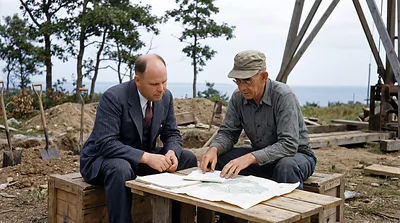
Parks Canada took the claims seriously enough to dispatch archaeologist Charles Lindsay to investigate. In his report, Lindsay concluded that nothing on the property predated the 19th century. The stone walls were mostly linear piles from field clearing, with some rough foundations of modest outbuildings. What Harris had identified as a Viking sword was, according to Lindsay, the blade of a scythe, likely from the 20th century. Historian Brian Culbertson later found an 1817 letter from Surveyor General Charles Morris directing Captain William Ross (who had settled New Ross in 1816 with 172 discharged soldiers) to find a suitable location for the blacksmith shop of a Daniel McKay. An 1860 survey map showed McKay's property allotment in the same location later occupied by the Harrises. The "castle," it appeared, was the remains of a blacksmith's works.
Author Michael Bradley nonetheless built on Harris's claims in Holy Grail Across the Atlantic, recasting the property as the site where Henry Sinclair had lived as Glooskap following his alleged 1398 voyage to the New World. The book brought national attention to New Ross and embedded it in the broader Sinclair-Templar narrative that connects Rosslyn Chapel in Scotland to Nova Scotia.
In Season 4, Rick Lagina, Charles Barkhouse, and Doug Crowell visited the property, then owned by researcher Alessandra Nadudvari and her partner Tim Loncarich. Nadudvari believed she had identified a Templar cross carved onto a stone that Joan Harris had called a "burial stone." Loncarich directed the team to a stone-lined water well he called the "holy well," built with four-foot-thick walls of fitted stones from the Gold River and a level flagstone floor. Professional diver Tony Sampson descended in a bosun's chair, rotating 360 degrees as he examined the walls, and became excited by a rock that appeared to bear a carved triangle with what might be an eye in the centre, a symbol he suggested could be the Eye of Providence. On a second descent in a dive helmet and wet suit, Sampson discovered a "broad arrow" carved onto another rock. Zena Halpern's controversial 1179 map labels a point near this location as "RhoDon," and the Gold River itself flows from New Ross directly to Mahone Bay, a geographical corridor that Halpern traced as a route for transporting treasure.
James McQuiston connected New Ross to his broader thesis linking the Knights Baronet of Nova Scotia, the Templar inheritance through Mary Queen of Scots, and the emergence of Freemasonry in the early 1600s. Whether the stone foundations predate European colonial settlement or belong to Daniel McKay's 19th-century blacksmith shop remains unresolved. The well, with its precision stonework and carved symbols, is harder to dismiss, though it too lacks independent archaeological dating. New Ross sits at the intersection of the Sinclair voyage theory, the Templar-Masonic lineage, and the physical geography of the Gold River corridor to Oak Island, a crossroads where speculation and documented history have been difficult to separate since Joan Harris first put a spade in the ground.