Since Fred Nolan first plotted the positions of five cone-shaped boulders on Oak Island in 1981, the formation that bears his name has been one of the most debated features of the island. Supporters argue the stones were placed deliberately, forming a precise geometric pattern that could not have occurred by accident. Sceptics counter that five glacial boulders on a drumlin island could fall into any number of apparent patterns if you look hard enough. For forty years, the debate has circled the same problem. If Nolan's Cross was designed, it was designed by someone who understood geometry, astronomy, and large-scale surveying. But no one had ever found anything like it anywhere else. A formation of five megalithic stones in a cross pattern, with those specific angles, on that scale, existed in exactly one place on earth. Without a precedent, Nolan's Cross remained an anomaly, and anomalies are easy to dismiss.
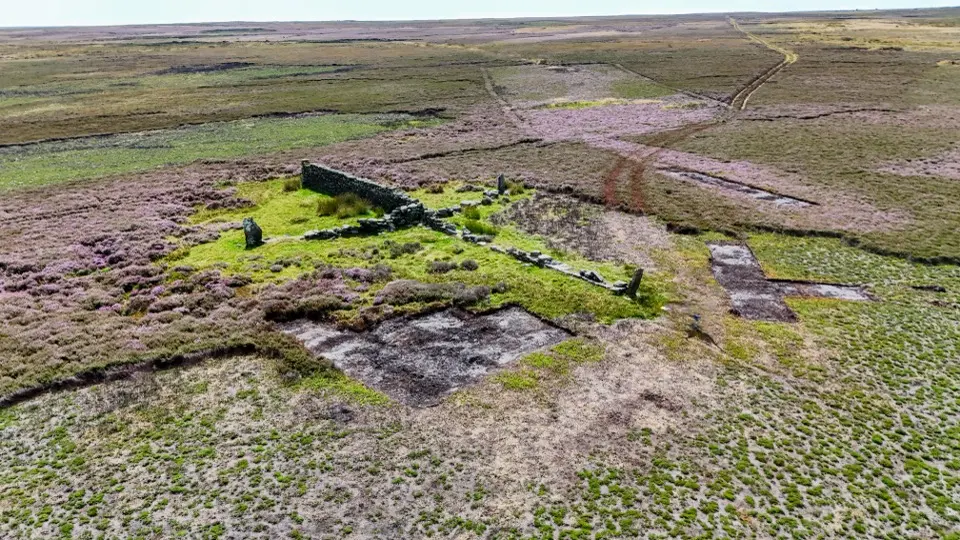
Remarkably, a precedent does exist. It stands on a hilltop in the North Yorkshire Moors, between the moors of Danby and Lealholm, in a region the Knights Templar used to graze their sheep. The place is called Temple Beeld Hill. "Temple" denotes land once held by the order. "Beeld" is an old English word for shelter, or image. On its summit stand five megalithic stones arranged in a cross-like formation. The arms meet at angles of 60 and 150 degrees. One of the stones has no obvious role in creating the cross shape. Later walls were built between the stones, using the megaliths as guides, to shelter the flocks that still graze there. The builders of those walls were careful not to damage the standing stones. The mortarless walls appear to be a few hundred years old at most. The megaliths themselves are estimated to be at least fifteen hundred years old. It is unknown when they were placed, or by whom. But their geometry is not unknown. It is identical to Nolan's Cross.
The Geometry
1 min
Researcher Stanhope White was among the first to draw attention to the Temple Beeld formation, noting a parallel with the Nether Largie Standing Stones near Temple Wood at Kilmartin in Scotland, another cross-shaped arrangement of ancient stones on land with Templar associations. But the more striking parallel lies across the Atlantic.
The configuration of the Temple Beeld stones is, in its essential geometry, identical to Nolan's Cross on Oak Island. Both formations consist of five standing stones. Both have the same angular relationship between their arms: 60 degrees and 150 degrees. Both include a fifth stone that serves no clear purpose in defining a cross shape. The Temple Beeld formation is rotated 90 degrees relative to Nolan's Cross, but the proportions are the same. When GPS coordinates of the Temple Beeld stones were recorded using a Garmin GPSMAP 66SR and plotted against the known positions of the five cone-shaped boulders on Oak Island, the geometric correspondence was precise.
Two formations of five stones, separated by an ocean, built to the same angular specifications, each including a stone that appears extraneous to the cross pattern. If one is deliberate, it becomes difficult to argue that the other is accidental.
The Cupmarks
1 min
The central stone of the Temple Beeld formation bears a number of cupmarks carved into its surface. Some are deeper than others, and some appear to have weathered significantly over the centuries, making precise mapping difficult on a stone whose surface is slightly curved. The marks are not random scratches or erosion patterns. They are deliberate depressions, carved by hand.
If the cupmarks were intended to represent a constellation, the closest match is Cygnus, the Swan. This is the same constellation that researcher Petter Amundsen identified as an overlay on Nolan's Cross, and the same alignment that Professor Adriano Gaspani confirmed at Bianzano Castle in Italy, a documented Templar site in the Cavallina Valley near Bergamo. The Cygnus connection now appears in three separate locations: a Templar castle in northern Italy, a megalithic formation on Oak Island, and a megalithic formation on Templar land in Yorkshire. Three sites, three countries, one constellation.
The Templar Heartland
2 min
North Yorkshire was a region of significant economic importance during the Middle Ages, largely due to its flourishing wool trade. Between 1132 and 1156, the region saw the establishment of no fewer than eight Cistercian abbeys and thirteen Templar commanderies and preceptories, forming a network of religious and military influence across the moors. Yorkshire was the centre of Templar power in England outside London, and the order's holdings in the county were so extensive that a chief preceptor was appointed specifically for Yorkshire from early times. Their estates included preceptories at Copmanthorpe, Faxfleet, Foulbridge, Penhill, Ribston, Temple Cowton, Temple Hirst, Temple Newsam, Westerdale, and Whitley, as well as the manors of Alverthorpe and Etton. The Templars operated the first fulling mill in England at Temple Newsam, where they manufactured woollen cloth. The North Yorkshire moors were particularly suited to grazing sheep, and the Templars used them extensively.
 The Knights Templar on Oak Island→
The foundation of Temple Newsam in Leeds, one of the most important Templar preceptories in the north of England, arose from a grant of land at Newsam, Skelton, Chorlton, and Whitkirk made to the order by William de Villiers, who died in 1181. The Templar survey of 1185 records that the property at Newsam, amounting to sixteen carucates, was obtained from William de Villiers. The earliest recorded appearance of the De Villiers surname in England is in this very document: "William de Viliers in the register of the Knights Templar of Yorkshire in 1185." The Templars of Temple Newsam in Leeds appointed Westerdale as the head preceptory for North Yorkshire, the same Westerdale that controlled the valley of the River Esk just miles from Temple Beeld Hill. The De Villiers donation did not create Temple Beeld. But it enabled the Templar infrastructure that surrounded it, and the family whose bloodline would run from the Norman Conquest through the Templar suppression, through the Knights Hospitaller, and finally to Isaac de Razilly and the founding of Acadia, enters the English historical record in the same county where these five stones stand.
The Westerdale preceptory, situated in the valley of the River Esk just miles from Temple Beeld Hill, was donated to the order by Guido de Bovingcourt in 1203. The Templars of Temple Newsam in Leeds appointed Westerdale as the head preceptory for North Yorkshire. It prospered for approximately two hundred years until the suppression in 1308, when its last preceptor, William de la Fenne, appears to have encouraged his brethren to convert their valuable possessions to cash. The inventory of removable property taken at the time of suppression was suspiciously small for what had been declared the head preceptory of North Yorkshire. The granary contained only four bushels of rye. After the suppression, the Westerdale estates passed to the Knights Hospitaller, who continued farming the land.
The Owners
2 min
Temple Beeld Hill itself was not a preceptory. It was part of the broader network of Templar-associated land in the North Yorkshire Moors, and its ownership can be traced through the Domesday Book and subsequent records. In 1086, the lands of Crunkly, Lelum, and Danby, encompassing the area around Temple Beeld, were held by Hugh Fitzbaldric, Sheriff of Yorkshire. By 1106, the land had passed to Nigel d'Aubigny. In 1129, upon the death of Nigel d'Aubigny, the land passed to his nine-year-old son Roger de Mowbray.
Roger de Mowbray was a tenth-generation Norman in the direct male line from Malahulc, Jarl of Norway, who had participated in the Viking siege of Paris alongside Rollo. Following their baptisms and a peace treaty with King Charles the Simple in 911, Rollo and his descendants were granted the county of Normandy. Rollo's direct lineage through the House of Normandy produced the medieval Kings of England, including William the Conqueror, whose emblem was a cross with four surrounding dots, a symbol rooted in Viking traditions brought from the north by Rollo and Malahulc. That same cross with four dots was found carved into a rock on Oak Island in the 1930s. The d'Aubigny family had crossed the Channel with William the Conqueror in 1066, and within three generations had amassed one of the largest landholdings in northern England. Mowbray himself was one of the most significant Templar patrons in English history. He donated four preceptories and large tracts of land that enabled the order to develop its Yorkshire network. He fought in both the Second and Third Crusades, and when he was captured during the Battle of Hattin in 1187, it was the Knights Templar who paid his ransom. He was also a knight of the Order of St. Lazarus. He died in Tyre in 1188.
His grandson, William de Mowbray, continued the family's connection to the Templars. William was one of the twenty-five barons appointed as executors of the Magna Carta in 1215, and the ceremony took place at Temple Church in London, the Templars' English headquarters. The family that owned the land on which the Temple Beeld stones stand was not merely sympathetic to the Templar cause. They were among its most important English supporters, bound to the order by donations, ransoms, and the blood of two Crusades.
Five Miles from Mulgrave
1 min
Within five miles of Temple Beeld Hill lies Mulgrave Castle, the ancestral seat of the Phipps family. The castle was the birthplace and childhood home of Constantine Phipps, who served as Lieutenant-Governor of Nova Scotia from 1858 to 1863. Phipps held the title of Baron Mulgrave of New Ross, and the village of New Ross in Nova Scotia was named after him in 1863. There is no documented connection between the Phipps family and the Templars, and no suggestion that Constantine Phipps knew what stood on the hilltop five miles from his home. But the geographic proximity between a formation of five megalithic stones on Templar land in Yorkshire and the family seat of a man who governed the province containing Oak Island is, at minimum, a coincidence that warrants attention.
 William Phips, the Treasure of the Concepción→
The Mirror
1 min
What stands on Temple Beeld Hill is not a ruin, not an inscription, not an artefact that can be carbon dated or sent to a laboratory. It is five stones on a hilltop, arranged in a pattern. But it is a pattern that matches. The angles match. The number of stones matches. The presence of a stone with no function in the cross shape matches. The potential Cygnus encoding matches. And the land on which the stones stand was owned by Templar patrons whose family fought in the Crusades, donated preceptories, and was ransomed by the order after one of the most catastrophic battles in the history of the Holy Land. The broader Templar network in Yorkshire was enabled by a land grant from William de Villiers, whose donation founded Temple Newsam and whose successors at Temple Newsam appointed Westerdale as the head preceptory for North Yorkshire. The same family whose descendants would establish the French colony twenty miles from Oak Island four and a half centuries later.
 De Villiers: The Treasure Bloodline→
Nolan's Cross has been studied, measured, and debated since Fred Nolan first plotted the positions of its five boulders in 1981. In all that time, the question has been what the formation means. Temple Beeld Hill suggests a different question: what does it mean that there are two of them?