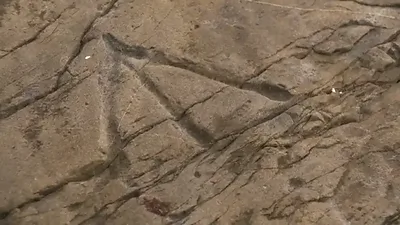
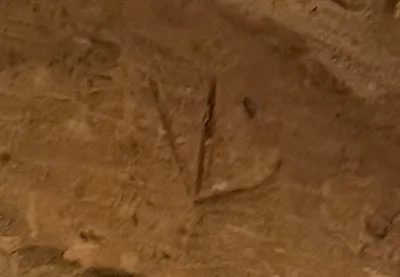
About This Carved Stone
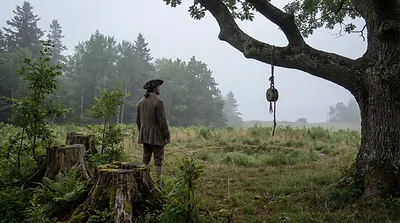
Carved symbols found on stones inside a deep, intricately constructed well on a property in New Ross, Nova Scotia, roughly 20 miles north of Oak Island. The well itself has walls approximately four feet thick, built from fitted stones sourced from the nearby Gold River, with what appeared on camera to be a level flagstone floor at the bottom. The property, originally claimed by Joan Harris in the 1970s as the site of a Viking castle, was later owned by researchers Alessandra Nadudvari and Tim Loncarich, who invited the Oak Island team to investigate.
Professional diver Tony Sampson descended the well in a Bosun's chair rigged to a pulley, with safety diver Mike Huntley on standby. Partway down, Sampson identified a carved triangle with what appeared to be an eye in the centre, a symbol consistent with the Eye of Providence associated with both the Freemasons and, according to some researchers, the Knights Templar. Underwater, he located a second carving that he called a possible broad arrow, which could also be a goose paw symbol.
Historian Doug Crowell noted that both a triangle and an arrow symbol appear among the markings reported on the 90-foot stone found in the Money Pit in 1804. Parks Canada archaeologist Charles Lindsay, who visited the property in an earlier decade, concluded that nothing he examined there predated the 19th century and that the stone foundations were remnants of a blacksmith shop belonging to a Daniel McKay, documented on an 1860 survey map. The symbols in the well remain a point of disagreement between those who see Masonic or Templar connections and those who attribute them to 19th-century stonemasons.
Historical Context
Found by Tony Sampson during a dive of the well.
Where It Was Found
Found at New Ross, Nova Scotia, Canada.