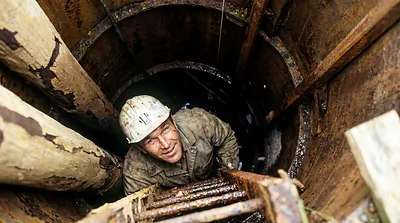
At the Money Pit, the eight-foot-wide caisson at borehole OC-1 pushes past 50 feet, grinding through the remains of the Hedden Shaft, the 12-by-24-foot wood-cribbed structure built by treasure hunter Gilbert Hedden in 1937 to reach 125 feet. Rick and Marty Lagina, Craig Tester, and geologist Terry Matheson monitor closely as the team from Irving Equipment Limited and ROC Equipment advance. Pit-sawn timbers emerge from around 105 feet, potentially suitable for dendrochronology. At the Hedden shield depth, the caisson passes through the bottom of the searcher shaft into undisturbed ground. Local historian Paul Troutman joins Rick at the wash plant, where they recover a large piece of bone from roughly 120 feet, possibly human, echoing the 17th-century bone fragments found in nearby borehole H8 two years earlier. At approximately 147 feet, a rounded wooden piece with a tapered edge and stave emerges, identified as the bottom of a small barrel or keg. The find connects directly to the 1861 Shaft Six story, in which a worker narrowly escaped drowning during a sudden flood and grabbed the circular end of a keg as he fled. Hand-hewn timbers from undocumented construction also appear at this depth. By 158 feet, however, the shaft reaches bedrock with no further artifacts, and the team terminates OC-1.
In the swamp, Rick and metal detection expert Gary Drayton search along the northern edge near the beach road. Gary recovers an ornate ring with an intricate floral pattern, thick and well-made, small enough to fit a woman's finger. At the Research Centre, archaeologist Laird Niven examines it under a Grobet digital microscope, noting a central flower motif, evidence of two different metals including possible silver repairs, and crude joining work. Via video conference, Professor Charles Lewton-Brain of the Alberta College of Art and Design confirms the floral design was chiseled by hand, a technique used before saw blades became available to jewelers in the 1730s. He dates the ring to prior to 1730 and identifies the pattern as European, possibly Spanish, a connection that echoes the 1652 Spanish maravedi coin previously found in the swamp.
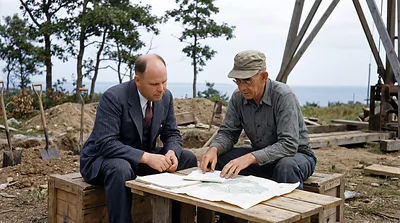
Rick, Doug Crowell, and Dave Blankenship visit the home of the late Dan Blankenship, where Dan's daughter Linda Flowers grants them access to her father's vast archive. The collection includes decades of Dan's own research alongside records from searchers Erwin Hamilton, M.R. Chappell, and Gilbert Hedden. Among the papers, Doug discovers a scaled survey map drawn by Erwin Hamilton during his 1938-1943 excavation partnership with Hedden and Frederick Blair, documenting the positions of more than 20 shafts and tunnels including Shaft Six and its lateral tunnel toward the Money Pit.
In the Research Centre, Rick presents the Hamilton map to the team. The survey places the Shaft Six tunnel in an area slightly southwest of OC-1, offering the most precise positioning data they have ever had. The team decides to sink a new caisson designated 8-A, roughly 20 feet southwest of OC-1, targeting the Shaft Six tunnel intersection. Rick reflects that without Dan Blankenship's archived materials, they would be at square one. Alex Lagina, Gary Drayton, Scott Barlow, and Charles Barkhouse join the team as Irving and ROC reposition the equipment. Operator Jared Busby begins driving the caisson, with Vanessa Lucido expecting 30 to 40 feet of progress on the first day.