At the Money Pit area, Choice Drilling continues its pattern drilling operation while Terry Matheson, Charles Barkhouse, and Rick Lagina inspect a core sample extracted from borehole H5.5. The 108 to 128 foot section yields little more than water, loose earth, and crushed granite left behind from previous backfill operations. Matheson notes the team should expect more promising material below 175 feet, with the primary target being a void in the bedrock beginning at a depth of roughly 215 to 220 feet.
In the War Room, researchers Erin Helton and Judi Rudebusch return via Skype to expand on their theory connecting Zena Halpern's map to Oak Island's landscape. Helton reveals she used a 3D printed replica of the Smith's Cove lead cross as a navigational tool, drawing lines along its crossbeam edges to produce a diamond shape on translucent paper. When aligned with the anchor points she identified in the previous episode, the square hole at the top of the cross falls directly over a point on the South Shore Cove, which Helton believes marks the location of the stone triangle first discovered by Captain John Welling in 1897 and later destroyed by Robert Dunfield in 1965.
Rick Lagina and Dr. Ian Spooner return to the southeastern corner of the swamp, where Spooner's sonar scan had previously indicated a buried wall. Probing the swamp floor with a metal rod, Spooner strikes a flat rock resting 40 centimetres below the surface. Additional probes reveal more rocks at the same depth, forming a straight pattern that the pair marks with wooden stakes. One stake falls at the edge of what appears to be a three metre drop-off. The stone formation measures approximately 20 feet wide and 70 feet long and appears to point directly toward the Lot 15 tar kiln, a trajectory Rick connects to the ox shoe trail discovered in Episode 3.
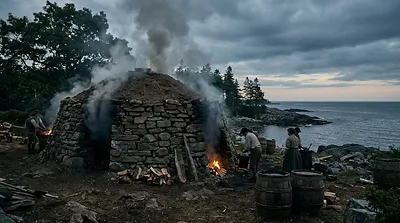
On Lot 15, Doug Crowell, Steve Guptill, Rick Lagina, and Gary Drayton search for stones bearing metal ringbolts that Fred Nolan reportedly found in 1969. Though the ringbolts remain elusive, the group locates several large boulders and an iron artifact that Drayton identifies as a potbelly stove fragment. Crowell notes that Nolan himself discovered old cast iron stove parts beneath one of his ringbolt locations. Alex Lagina, Jack Begley, and Peter Fornetti bring the find to blacksmith Carmen Legge in Centreville, who dates it to the early 1700s.
Alex Lagina, Dr. Spooner, and Tony Sampson then conduct a sonar scan off the South Shore Cove aboard Sampson's boat, searching for paleo shorelines and submerged structures. The scan reveals a 12 metre deep anomaly off the Boulderless Beach that the team suspects may be a shipwreck, along with an 8 by 8 foot square feature further offshore that Dr. Spooner suggests could be the remnants of an old wharf. Back on the island, Doug Crowell confirms the second anomaly matches a wharf-like object visible in old aerial photographs.