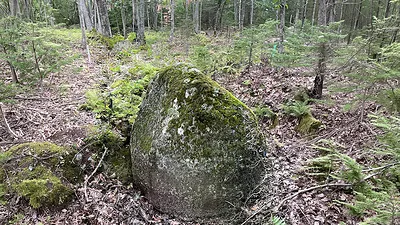
Rick, Alex, and Jack head to the island to assess damage from Hurricane Lee. The causeway is intact, but the swamp is flooded and Rick starts the pump to begin draining it. At the Money Pit, Roger Fortin and the Dumas team are already at work in the Garden Shaft, which has reached a depth of 99 feet. The next step is to expose the timbers of the seven-foot tunnel running below the shaft. In the War Room, archaeoastronomist Professor Adriano Gaspani joins the team by video conference with interpreter Michael Amadio. Having previously dated Nolan's Cross to 1200 A.D. based on boulder coordinates and stellar alignments during a 2022 meeting in Italy, Gaspani now presents his analysis of the Lot 15 stone piles and the Stone Triangle. The stone piles show alignments with the sun at the equinoxes and the moon at rising and setting positions reached only every 18.5 years. With so many alignments converging, Gaspani declares himself nearly 100 percent certain the piles were placed around 1250 A.D. The Stone Triangle encodes two astronomical lines corresponding to sunrise and sunset at the winter solstice. Gaspani concludes that between 1200 and 1300, people arriving from Europe encoded messages by arranging stones in astronomically significant patterns, knowledge belonging to monastic, religious, and knightly orders rather than common people. He identifies the Templars as the most likely builders of Nolan's Cross, the Stone Triangle, and the stone cairns.
Borehole F.25-8.25 is drilled near RF1, 55 feet southwest of the Garden Shaft. In 2019 the team recovered massive timbers and a pickax from RF1 at depths below 100 feet, and recent testing showed the wood originated in Europe while water samples revealed high traces of gold and silver below 150 feet. A core from 8 feet below grade contains cobble. At 151 feet, Charles finds wood in what Terry describes as undisturbed material, possibly placing the borehole in the original Money Pit. A core from 171 feet hits bedrock and gypsum, and the team moves to the next target. On Lot 15, Gary and Jack search the area around the stone cairns, which were described in the 1960s as pyramid-shaped structures standing 5 to 7 feet tall but have since been partially dismantled by searcher activity. Gary recovers a shaped and decorated piece of lead that he considers medieval, based on similar finds at sites in England.
At the Garden Shaft, Roger reports that substantial wood has been uncovered at the bottom. Scott descends and finds 12-to-14-inch planks with rounded edges that may still have bark attached. He pulls out a wedge that appears to retain some bark, and Rick is called down to inspect. Rick stresses the importance of dating the wood, noting that previous samples placed the tunnel in the 17th century. Gary and Steve descend next: Gary's metal detector picks up nothing, but the pin pointer locates a non-iron artifact and a piece of shaped metal that Rodney confirms Dumas did not use, suggesting it may date to the tunnel's original construction. Steve records measurements of the tunnel. The following day, timbers are brought to the surface. Rick identifies adze-cutting marks, a tool dating back to ancient Egypt and used through the 18th century. Dumas will now begin a probe-drilling program to ensure the tunnel is safe enough for the team to enter and explore.
In the lab, Emma analyzes the lead artifact from Lot 15 and reports it is a 99 percent compositional match to a twisted lead rod found on Lot 13 in 2021. Doug reminds the group that Dr. Chris McFarlane attributed the earlier piece to possible Scandinavian origin. Alex points out that the only group known to have made a pre-Columbian trip to North America were the Norse, raising the question of whether the Norse and the Templars were connected and whether that link extends to the stone cairns on Lot 15.