About This Artifact
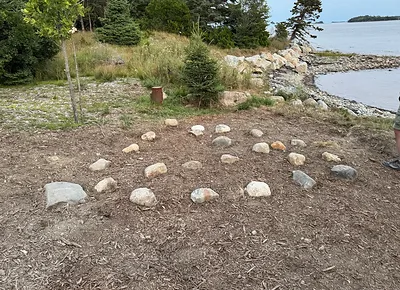
A hand-forged iron object with a tapered point, recovered roughly ten inches below the surface on the Lot 26 beachfront by Gary Drayton, Jack Begley, and geophysicist Mike West. The beach was once the property of 18th-century privateer Captain James Anderson, who fled the United States after spying for the British and faced treason charges from Governor Thomas Jefferson. The team was surveying with an EM61 deep-scanning detector capable of sensing metal up to 20 feet underground.
Gary initially identified the artifact as a crossbow bolt, dating it between 1000 and 1500 AD. Archaeologist Laird Niven noted the piece was finely made with hardened iron showing minimal rust. Marty Lagina argued that a weapon, unlike a cross or keepsake, indicates actual activity on the island when it was lost. At St. Mary's University in Halifax, Dr. Christa Brosseau and Dr. Xiang Yang performed scanning electron microscope analysis confirming the metal is iron with manganese, an element used in iron production since as early as the ninth century BC.
California antiquities expert Gabriel Vandervort then re-examined the artifact. After initially suspecting a medieval European origin, he found the long neck inconsistent with crossbow bolts and reclassified the object as a Roman pilum, a throwing javelin carried by legionnaires from the first century BC through the fifth century AD. The thin iron neck was designed to penetrate armor and break off inside the target. Vandervort noted such artifacts are rare even in Europe and virtually unheard of in North America. A strikingly similar tapered iron object was later recovered at Smith's Cove among the slipway spoils.
Historical Context
Found by Gary Drayton, Jack Begley, and geophysicist Mike West during EM61 deep-scanning survey of Lot 26 beach. SEM analysis by Dr. Christa Brosseau and Dr. Xiang Yang at St. Mary's University, Halifax. Reclassified from crossbow bolt to Roman pilum by California antiquities expert Gabriel Vandervort.
Where It Was Found
Found at Lot 26 beachfront, southwest shore. Location: the shoreline areas of Oak Island.