About This Artifact
A hand-wrought nail and an assembly described as either a nut or a washer were recovered from a south shore shaft on Oak Island during the period when Dan Blankenship was deepening the shaft Robert Dunfield had abandoned in 1965. Published sources disagree on the exact date. Lionel and Patricia Fanthorpe place the find in 1966. Randall Sullivan's main narrative likewise treats the discovery as part of Blankenship's 1966 work on the Dunfield south shore shaft, before David Tobias became his partner. Randall Sullivan's timeline and Scott Clarke both date the find to 1967, after the formation of the new syndicate with Tobias. The depth is consistently reported as 60 feet, at which level Blankenship also recorded a layer of round granite stones, each about the size of a man's head, lying in a pool of stagnant black water.
Hand-wrought nails of this type were produced by blacksmiths working iron by hand on an anvil, a method standard before the industrialisation of nail manufacture in the early nineteenth century. The combination of a nail with a nut or washer indicates a fastening assembly rather than simple structural nailing, suggesting a more complex piece of construction or equipment at that location. The deliberately placed stones found at the same level were interpreted by Blankenship as part of the old south shore flood tunnel, the existence of which Frederick Blair's 1898 dye test had confirmed when red dye poured into the Money Pit at ninety feet seeped out at Smith's Cove and at several points along the south shoreline.
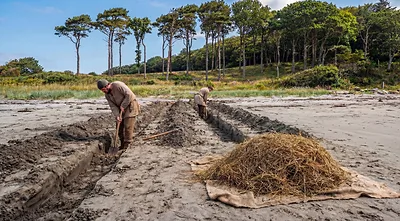
The south shore has received less investigation than Smith's Cove despite Blair's dye test confirming a flood tunnel exit on that side of the island. In 1972, P. J. Mallon of Northern Ireland discovered a stone triangle on the south shore. In Season 7, the team uncovered an intact box-shaped wooden drain preserved in puddled clay along the south shoreline. The nail and the nut or washer from the south shore shaft remain among the few artifacts recovered from this area of the island's underground works.
Historical Context
Randall Sullivan, The Curse of Oak Island (New York: Atlantic Monthly Press, 2018), main narrative on Blankenship's 1966 deepening of the Dunfield shaft and the appended chronology placing the find in 1967. Lionel and Patricia Fanthorpe, The Oak Island Mystery, revised ed. (Toronto: Hounslow Press, 1995), placing the find in 1966. Scott W. Clarke, Oak Island Odyssey: A Masonic Quest (Nimbus Publishing, 2023), placing the find in 1967 after the Blankenship-Tobias-Dunfield-Nolan syndicate formed in January 1967. Frederick Blair sworn affidavit on the 1898 dye test, archived with the Oak Island Tourist Society. Documentation of P. J. Mallon's 1972 stone triangle: contemporary press accounts. Box-shaped wooden drain on south shoreline: The Curse of Oak Island, Season 7.
Where It Was Found
Found at South shore shaft, 60-foot depth. Location: Oak Island, Nova Scotia, Canada.