What Is Archaeoastronomy
1 min
Archaeoastronomy is the study of how people in the past observed and used the sky. It examines the ways ancient and medieval cultures aligned their monuments, temples, roads, and burial sites with the positions of the sun, moon, stars, and planets. The discipline sits at the intersection of archaeology, astronomy, and history, and its methods are grounded in physics: the predictable, calculable motion of celestial bodies over time.
The field gained academic credibility in the 1960s and 1970s through the work of researchers such as Alexander Thom, who surveyed hundreds of stone circles across Britain and demonstrated that many were oriented toward solstice and equinox positions. Gerald Hawkins applied computer modelling to Stonehenge in 1965, showing that its stones tracked lunar and solar cycles with precision. Since then, archaeoastronomical analysis has been applied to sites on every continent, from the pyramids of Giza to the temple complexes of Angkor Wat and the Mayan observatories of the Yucatan.
On Oak Island, archaeoastronomy entered the investigation in Season 10, when Professor Adriano Gaspani, an archaeoastronomer and astrophysicist, was asked to analyse the stone formations on the island. His work has since produced some of the most specific dating evidence in the history of the Oak Island search.
 The Oak Island Star Map→
How Celestial Alignments Can Be Dated
1 min
The ability to date a structure through its astronomical alignments rests on a fundamental property of the Earth: it wobbles. The planet's rotational axis traces a slow circle against the background stars over a period of roughly 25,772 years, a phenomenon known as precession. As a result, the positions at which stars rise and set on the horizon shift gradually over the centuries. A structure aligned to the rising point of a particular star in 1200 AD would not point to the same star today, because that star's rising azimuth has moved. The rate of drift is approximately one degree every 72 years.
A second factor is the obliquity of the ecliptic, the tilt of Earth's axis relative to its orbital plane. This angle changes slowly over millennia, and it affects the extreme positions of the sun at the solstices and the moon at its standstills. The International Astronomical Union adopted a standard formula in 2006 (IAU 2006) for calculating the obliquity at any point in history, and this formula is used in modern archaeoastronomical research to reconstruct where the sun rose and set on specific dates in the past.
A third element is the lunar standstill cycle. Every 18.6 years, the moon reaches its most extreme rising and setting positions on the horizon, known as major lunar standstills. Cultures across the ancient world tracked this cycle, and structures aligned to standstill positions can be dated by working backward through the geometry.
When multiple alignments at a single site converge on the same historical period, the case for intentional construction becomes difficult to dismiss as coincidence. This is the method Professor Gaspani applied to Oak Island.
Nolan's Cross: Six Stars and an Epoch
1 min
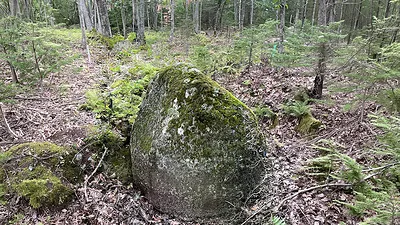
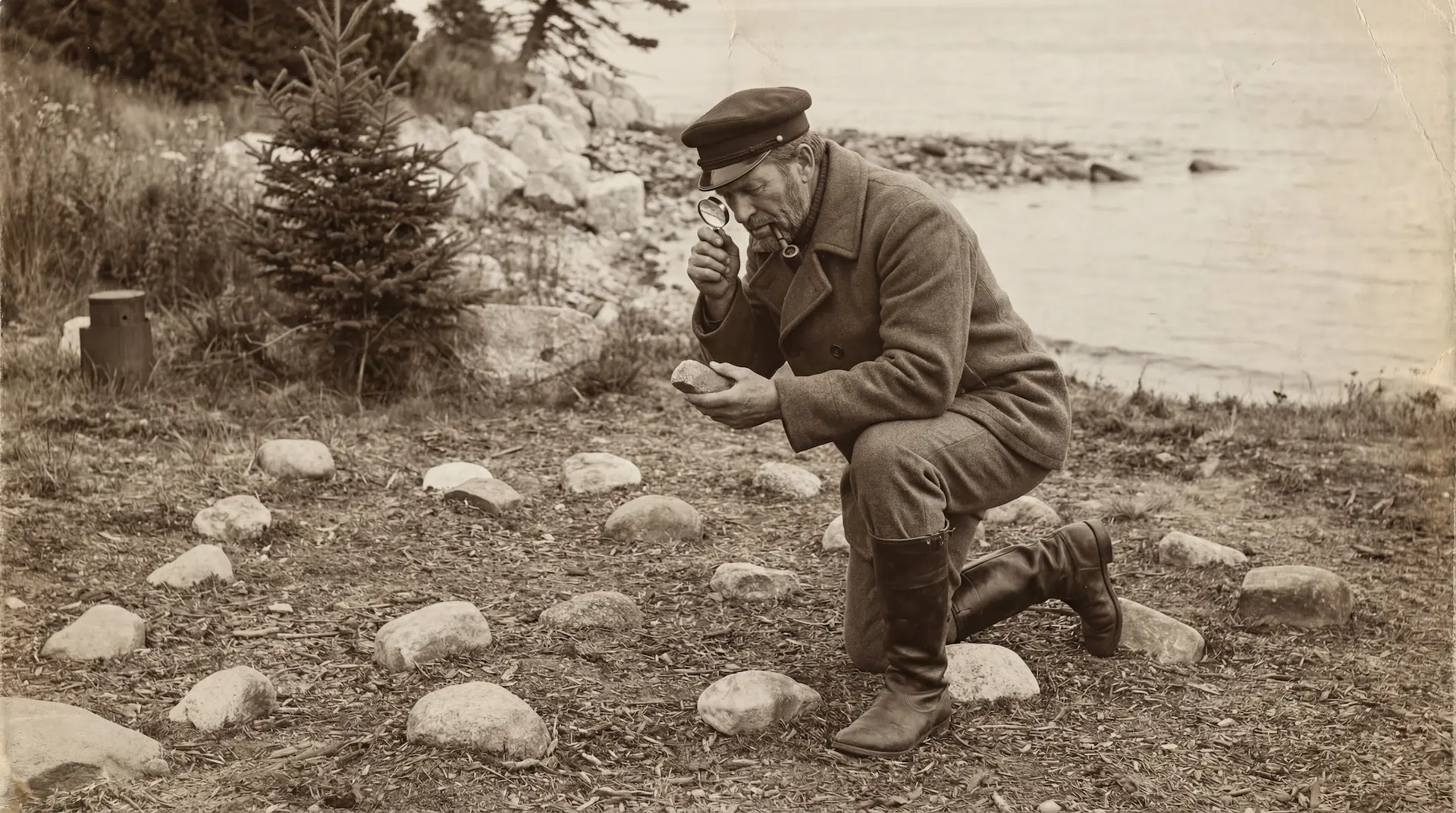
Fred Nolan discovered the formation now known as Nolan's Cross in 1981: six large cone-shaped boulders arranged in a symmetrical cross on his property in the centre of Oak Island. For decades, debate centred on whether the formation was natural or man-made. Nolan was convinced it was deliberate, a conclusion supported by Halifax geologist Petra Mudie and later verified by engineer and surveyor William Crooker.
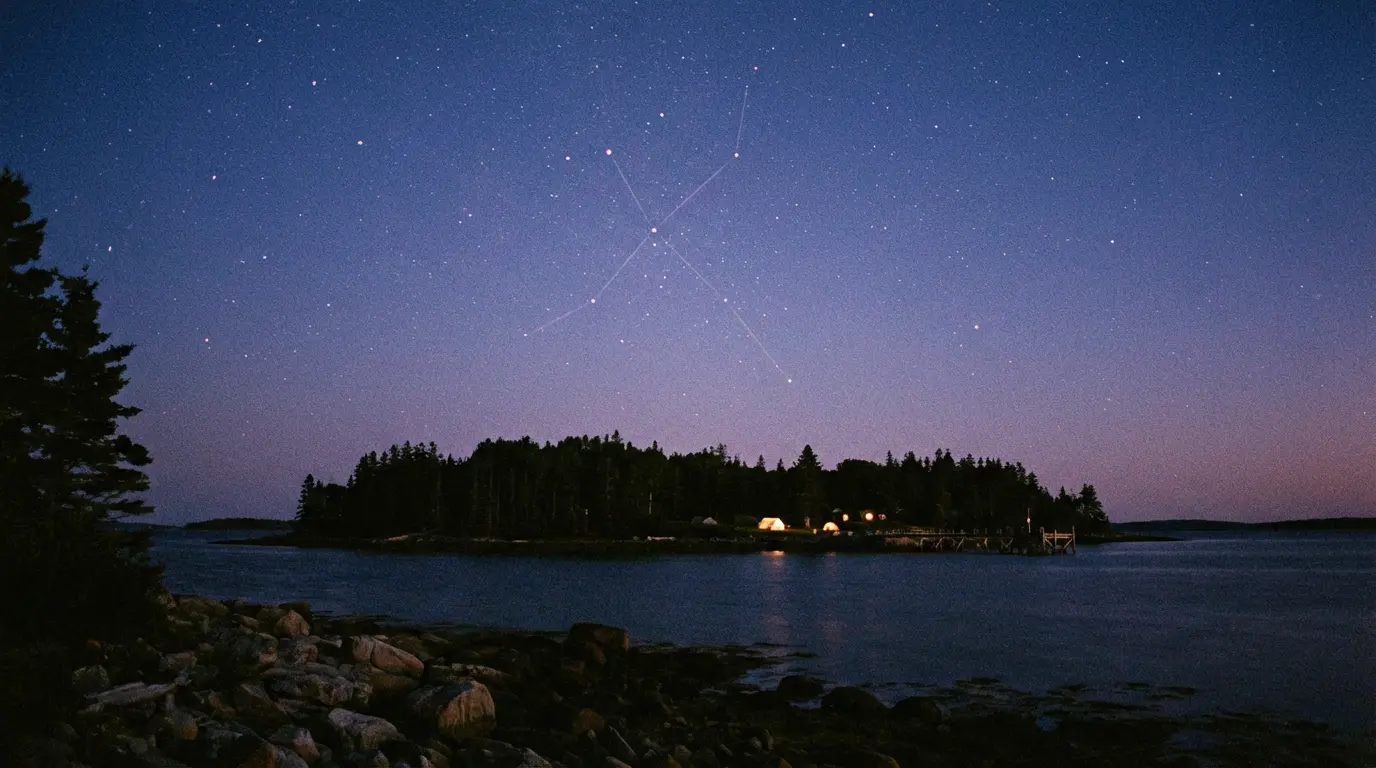
In Season 10, Episode 22 ("Starry Knights"), the team travelled to Italy to meet Professor Adriano Gaspani, an archaeoastronomer and astrophysicist at the Brera Observatory in Milan who had spent his career studying the astronomical orientation of medieval European sites. Using the GPS coordinates of the six boulders provided by surveyor Steve Guptill, Gaspani calculated which bright stars would have risen or set along the lines connecting the boulders at various points in history.
He identified six stars whose positions aligned with the cross: Capella, Arcturus, Antares, Bellatrix, Alphard, and Fomalhaut. All six alignments converged on a single epoch: approximately 1200 AD. Doug Crowell noted that this date matched the radiocarbon dating of the stone platform in the swamp and aligned with the proposed Templar voyage of 1179 documented in researcher Zena Halpern's manuscript.
Gaspani published his findings in a peer-reviewed paper, making the Nolan's Cross analysis one of the few pieces of Oak Island evidence to have undergone formal academic scrutiny.
 The Geometry of Nolan's Cross→
The Stone Triangle and the Lot 15 Cairns
1 min
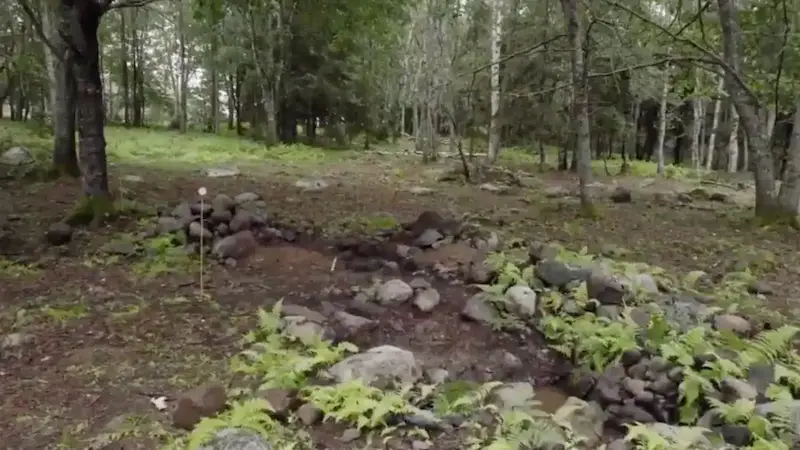
Following the Nolan's Cross results, Rick Lagina asked Gaspani to apply the same methodology to two additional stone features on the island: the Stone Triangle on the south shore and the five stone cairns on Lot 15. Both had been documented by Fred Nolan, who believed the cairns pointed toward the swamp and the triangle pointed toward the original Money Pit.
Gaspani received GPS data for both sites and presented his analysis in Season 11, Episode 17 ("Piling On"), joining the War Room by video conference with interpreter Michael Amadio. His findings added two new layers of evidence.
The Lot 15 stone piles showed alignments with the sun at the equinoxes and with the moon at rising and setting positions reached only during the 18.6-year lunar standstill cycle. With multiple alignments converging, Gaspani declared himself nearly 100 percent certain the piles were placed around 1250 AD. He later connected the cairns to the star cluster Hyades, the same formation the team would encounter carved into stone during a research trip to Bornholm, Denmark.
The Stone Triangle encoded two astronomical lines corresponding to sunrise and sunset at the winter solstice. Gaspani concluded that between 1200 and 1300, people arriving from Europe encoded messages by arranging stones in astronomically significant patterns, and that this knowledge belonged to monastic, religious, and knightly orders rather than to common people. He identified the Knights Templar as the most likely builders.
The Italian Connection: Bianzano Castle
1 min
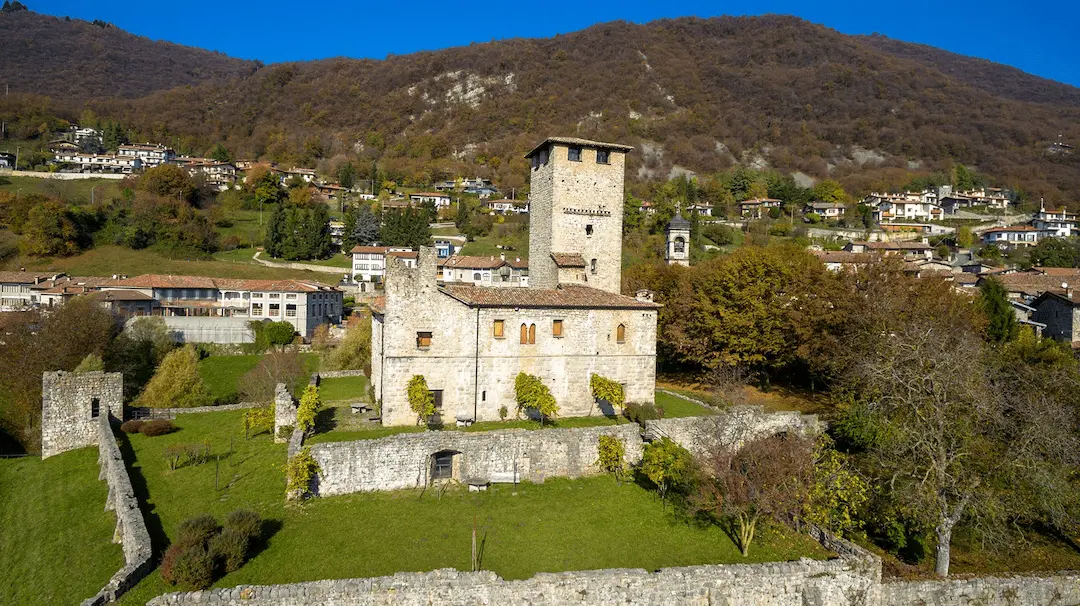
In Season 11, Episode 22 ("Abbey Road"), the team visited Bianzano Castle near Bergamo, believed to have served as the Italian headquarters of the Knights Templar in the 13th century. Professor Gaspani had prepared an analysis of the castle's orientation, and his findings created a direct link to Oak Island.
The external walls of Bianzano Castle aligned with the rise and set of the Cygnus constellation and pointed toward the star Arcturus: the same celestial references encoded in Nolan's Cross. Gaspani concluded that whoever designed the castle belonged to the same cultural environment as whoever placed the cross on Oak Island. Inside the castle, Doug Crowell noticed an eight-pointed star that Gaspani identified as Polaris in medieval iconography, a form used to design octagonal church structures and for celestial navigation.
At the same meeting, Emiliano Sacchetti presented Gaspani with the Cremona Document and asked him to consider the devices it described, particularly the Abetor. Gaspani demonstrated a reconstruction he had built of this navigational instrument, showing how it could guide a vessel across the Atlantic on a fixed route. He also proposed that the same device could have been used to lay out Nolan's Cross on the ground, providing a practical explanation for how a precise astronomical formation could be constructed in a remote location without a fixed observatory.
 Bianzano Castle→
Sacred Numbers and Geometry
1 min
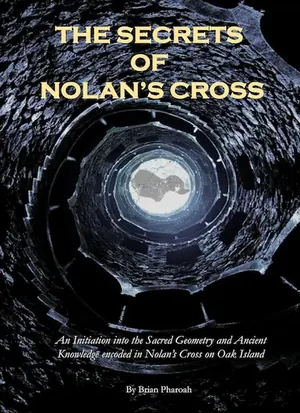
Professor Gaspani's work represents one approach to the astronomical evidence on Oak Island: empirical measurement of celestial positions against physical structures, tested through mathematical models. A complementary approach, rooted in sacred geometry, was presented by researcher Brian Pharoah in Season 10, Episode 13 ("All's Well").
Pharoah told the team that Nolan's Cross was a megalithic and mathematical phenomenon that could not be happenstance. He demonstrated how the measurements of the cross incorporated a set of sacred numbers: 144, 288, 360, 432, 720, and 864. These numbers, Pharoah argued, are encoded in sacred sites across Europe and the Middle East, including Chartres Cathedral, Rosslyn Chapel, and the Temple Mount in Jerusalem. He revealed hidden geometry within the cross and, using his method with the team's own boulder positions, surveyor Steve Guptill calculated a point a few feet north of the Garden Shaft. When Rick Lagina asked who he thought had created this, Pharoah answered: the Templars.
Pharoah's approach differs from Gaspani's in that it relies on geometric and numerical relationships rather than stellar positions, but both arrive at the same conclusion regarding the builders and the approximate period of construction.
Archaeoastronomy in the Field
1 min
The calculations Gaspani performed for Oak Island required specialised astronomical software, access to star catalogues, and expertise in precession models. Until recently, verifying an alignment in the field meant recording a compass bearing, looking up the corresponding celestial positions for a historical date, and running the mathematics by hand or with desktop software.
That process has become considerably more accessible. Modern smartphone tools such as My Solar Compass and My Cosmic Compass use the same IAU 2006 precession formula used in professional research to calculate sunrise, sunset, and star-rise positions for any date from 3000 BC to the present. A visitor to Oak Island, or to any of the European sites connected to the investigation, can now point a phone along a structure, capture the bearing, and see which celestial events align with it across centuries of history. My Solar Compass handles sun positions and feast day matching; My Cosmic Compass extends the analysis to stars, planets, and the 18.6-year lunar standstill cycle. Both tools were developed with fieldwork at historical and archaeological sites in mind.
 The Versailles Alignment to Oak Island→
What the Evidence Establishes
1 min
Professor Gaspani's archaeoastronomical analysis of Oak Island has produced a consistent set of results. Nolan's Cross, the Stone Triangle, the Lot 15 stone cairns, and the swamp survey stakes all yield dates in the range of 1200 to 1300 AD when analysed through stellar and solar alignments. The Nolan's Cross study has been peer-reviewed and published. The methodology is well established in the academic study of medieval European sites, and the convergence of dates across four separate features on the island is, as Gaspani stated, difficult to attribute to chance.
The analysis also establishes a cultural connection. The same celestial references found in the Oak Island formations appear in the orientation of Bianzano Castle, a known Templar site in northern Italy. Gaspani concluded that the builders of both sites belonged to the same tradition.
What the evidence does not establish is who, specifically, was on Oak Island in the 13th century, or what they built or buried there. Archaeoastronomy can date a layout and identify the cultural knowledge required to create it, but it cannot tell us the purpose of that layout.
What can be said is that the stone formations on Oak Island were not placed at random. They encode astronomical information that points to a specific century, and the knowledge required to create them was not widely held. The investigation has, through Gaspani's work, moved from speculation about who may have visited the island to measurable, peer-reviewed evidence of when and with what level of sophistication.