About This Structure
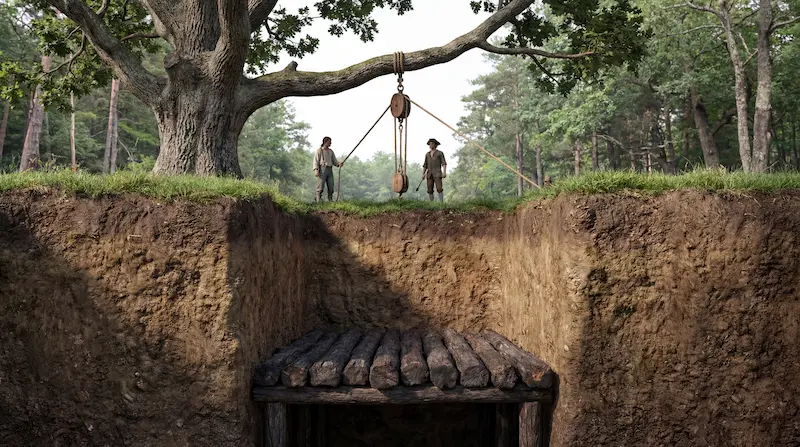
The oak log platforms are the most frequently cited structural feature of the Money Pit. The earliest detailed account, written by Truro Company manager Jotham McCully and published in the Liverpool Transcript on October 16, 1862, states that the Onslow Company sank the pit to ninety-three feet, "finding a mark every 10 feet." McCully describes "some charcoal and some putty" among these marks, and notes that the diggers were "confined to a diameter of 16 feet, by the softness of the ground within that limit." Pick marks were visible all around the sides of the pit, confirming it had been dug and refilled by human hands. Later accounts expanded the description to include solid oak platforms at each ten-foot interval from ten to ninety feet.
The Onslow Company, organised by Simeon Lynds of Onslow, Nova Scotia, began work around 1803 with a crew of roughly twenty-five to thirty men. They picked up where McGinnis, Smith, and Vaughan had stopped at about thirty feet. As they progressed, they encountered layers of charcoal, putty, and coconut fibre between the timber platforms. Hiram Walker, a ship's carpenter from Chester who worked on the excavation, later told his granddaughter (as recorded by Fanthorpe) that he had seen "bushels of coconut fibre" lifted from the shaft. The quantity was significant: one account records that enough putty was recovered from a single platform to glaze the windows of more than twenty local houses. At approximately eighty to ninety feet, the team found the inscribed stone slab. The Onslow Company probed with a crowbar at ninety-three feet and struck what appeared to be a level wooden platform at ninety-eight feet before the shaft flooded overnight to tide level with salt water.
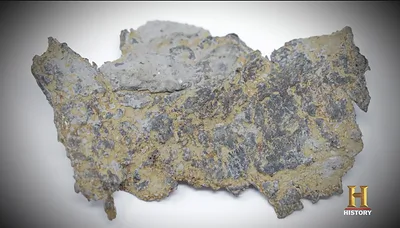
The oak used in the platforms was not native to Oak Island, meaning it was transported to the site for this specific purpose. The consistent spacing and the volume of sealing materials between layers point to an organised construction effort rather than improvised work. Modern drilling programs have repeatedly struck hand-hewn timbers at depths consistent with the original platform levels. In Season 7, a massive oak timber recovered from roughly 114 feet in borehole 8-A was described as consistent with the platform construction McGinnis observed during the 1804 excavation. In Season 4, a round piece of wood recovered from the T-1 shaft at 105 feet raised the possibility of a previously unknown tenth platform below the ninety-foot stone.
Historical Context
Onslow Company excavation
Where It Was Found
Found at Money Pit, every 10 ft (10-90 ft). Location: the original 1795 excavation shaft on Oak Island, Nova Scotia.