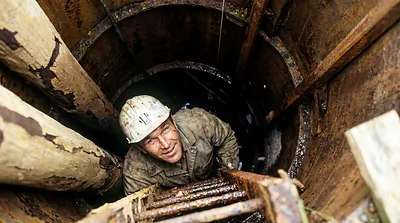
At the T-1 shaft, the hammer grab continues bringing up material from depths beyond 100 feet. Craig Tester is particularly intrigued by a piece of wood recovered at approximately 102 feet that features a peg and a wedge shape clearly cut by hand. A second piece, recovered around 118 feet, is far denser, darker, and heavier than anything else found this season, with a foul odour and an extremely fine grain that Dan Blankenship recognises as consistent with very old wood. The team speculates these could be remnants of the oak log platforms that the original 1795 discoverers reported finding at ten-foot intervals in the Money Pit. Dan examines the finds at his home and confirms he has never seen material like this come out of any previous excavation on the island. Sections are cut from both pieces and sent for carbon-14 testing.
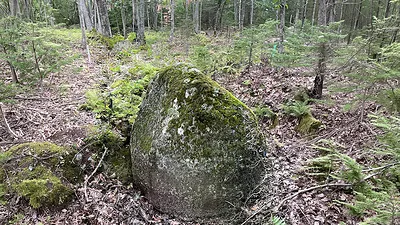
Rick Lagina and Charles Barkhouse invite local stonemasons Monk Chicken and Mike Whelan to examine two features of Nolan's Cross: the carved headstone at the intersection of the cross's stem and arm, and the large cone-shaped granite boulder at the bottom of the formation. The headstone, a sandstone piece discovered by Fred Nolan in 1981, once bore a clearly defined face with features resembling a cutlass indentation, but years of exposure and repeated burial have accelerated erosion. The stonemasons cannot make a definitive statement about whether the face was carved, though they note that sandstone weathers rapidly once disturbed. At the bottom boulder, however, they find something unexpected: the underside is unusually smooth compared to the rough granite surface elsewhere on the stone. They conclude the smoothness is consistent with the stone having been dragged over a long distance, leaving a polished surface like a footprint. The finding suggests the five massive boulders forming Nolan's Cross, each weighing up to five tons, were deliberately transported to their positions rather than occurring naturally.
Carbon dating results arrive in the War Room. The timber recovered at 102 feet returns a 95th-percentile range of 1672 to 1780. The round log from a similar depth dates to between 1655 and 1695, placing it squarely in the era before the Money Pit's 1795 discovery. Rick observes that the smaller-dimensioned log could be one of the platforms described in the original accounts, pieces not meant to support weight but simply to separate layers so each could collapse independently of the one above. Dan Blankenship notes that the blackened wood with its distinctive odour matches what he has always said original Money Pit material should look like. The results confirm that T-1 has intersected wood from the correct period, though the team has not yet reached the vault itself.
As digging continues past 150 feet, the hammer grab begins returning nothing but clay with no wood, no artifacts, and no metal. At approximately 156 feet, the drill teeth start breaking on an impenetrable layer. The team considers whether it could be the metal plate that William Chappell reportedly encountered at 171 feet in 1897, but subsequent grabs confirm the obstruction is bedrock. The T-1 shaft has hit bottom without finding the vault. Rick and Marty face bitter disappointment, but rather than concede defeat, they consult with Dan Blankenship's archival maps and drilling consultant Greg Dwyer to plot a fourth hole. Dwyer reasons that the 1861 collapse of the Money Pit would have scattered the debris field to the south, and recommends a location seven feet south and four feet west of the Valley 3 bottom hole. Rick is given the honour of choosing the final drill site, a gesture the team feels he has earned after more than 50 years of dedication to the mystery. Irving Equipment repositions the cranes and begins slamming the caisson for G-1, the team's last chance of the season.