At the Money Pit, the eight-foot-wide caisson at borehole 8-A pushes past 78 feet, targeting the Shaft Six tunnel, which according to archival records connects directly to the original Money Pit. Vanessa Lucido monitors progress as the oscillator pressure builds to 2,500 pounds per square inch at roughly 103 feet, suggesting the caisson is cutting through a structure. Dan Henskee watches the gauges alongside the drilling crew. Moments later, the hammergrab brings up loads of hand-hewn, ax-cut wood, and Rick and Marty Lagina, Charles Barkhouse, Scott Barlow, and Terry Matheson are confident they have intercepted the Shaft Six tunnel. Gary Drayton scans the spoils and recovers fragments of leather resembling the bookbinding found two years earlier in borehole H8, along with a strange pointed metal object. At roughly 114 feet, a massive oak timber emerges, consistent with the oak-log platforms described by Daniel McGinnis during the original 1804 excavation. Jack Begley and Steve Guptill find a small handwrought iron hinge at the wash table that archaeologist Laird Niven identifies as non-mining-related and possibly from a chest. Despite these promising finds, the shaft produces only water and clastic sediments below 140 feet, and the team makes the difficult decision to terminate 8-A without locating the full collapse zone or treasure.
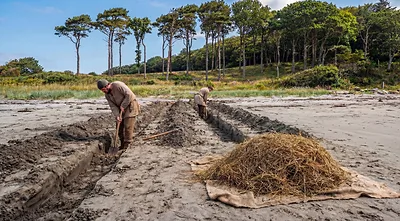
In the swamp, Alex Lagina, Gary Drayton, and Billy Gerhardt continue excavating near the Eye of the Swamp and uncover what appears to be an extension of the stone-paved feature, with uniform rocks set in clay. Gary recovers two large iron spikes similar to the cribbing spikes found at Smith's Cove, along with burnt, ax-cut wood chips from the same area. Rick arrives to inspect and notes that cribbing spikes in the swamp, combined with the tunneling pick found weeks earlier by Gary and Jack Begley, suggest something significant happened in this part of the island beyond what they have yet uncovered.
Marty, Alex, and Gary travel to the Ross Farm Museum to consult blacksmithing expert Carmen Legge. He identifies the swamp spikes not as cribbing spikes but as marlinespikes, tools used by sailors from the early 17th century onward for splicing and tying rope on ships. The finding adds to growing evidence that a large vessel was once present in what is now the swamp. Legge then examines the pointed metal object from 8-A at 114 feet and identifies it as a possible booby trap spike, designed to injure anyone who stepped on it. The team is stunned, as this suggests the original Money Pit builders may have installed physical traps beyond the known flood tunnel system.
Craig Tester and the team review the results of the 8-A excavation. Though the shaft failed to produce treasure, they found hand-hewn timbers, leather, possible oak platforms, a chest hinge, and evidence of the Shaft Six tunnel itself. Rick concludes they found evidence of a collapse zone but were not close enough to the Money Pit's core. The team resolves to apply what they learned to their next dig, with Marty noting the connection between the Shaft Six tunnel and borehole H8, just ten feet away, potentially confirming that H8 did intersect the original Money Pit as he has long believed.