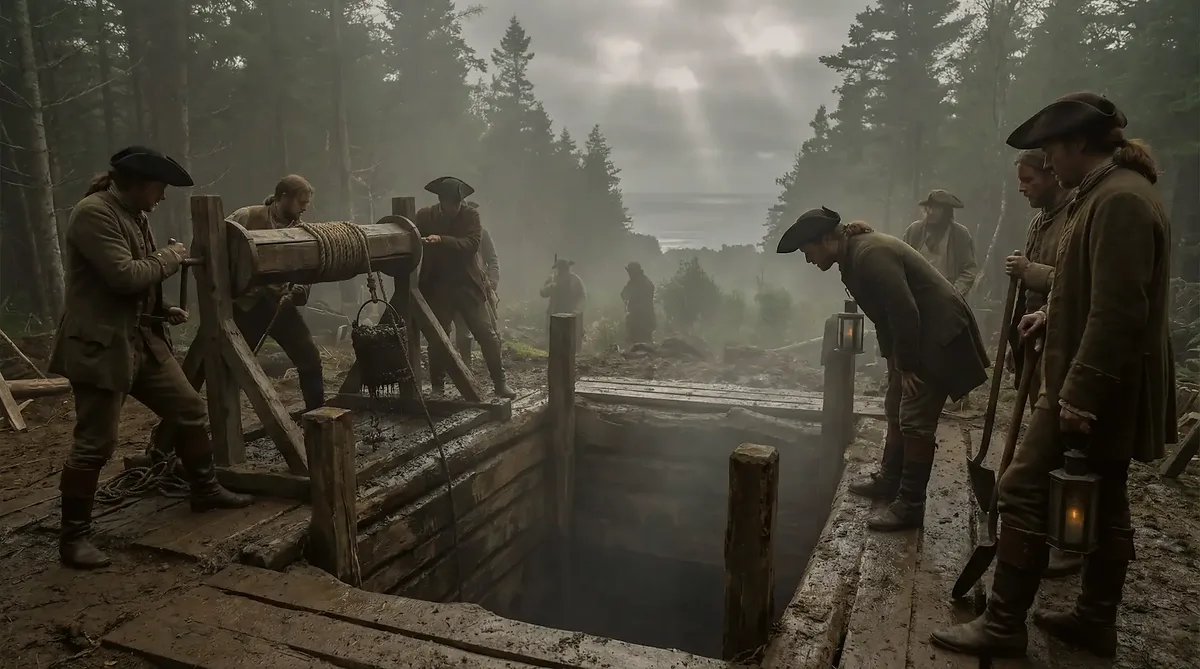
Every theory about Oak Island begins with an assumption: that somebody built the Money Pit. Pirates, Templars, the British Navy, agents of the French Crown; the candidates differ, but the premise is the same. A deep, engineered shaft was constructed on a small island in Mahone Bay, booby-trapped with flood tunnels, and sealed with platforms of oak logs at regular intervals. The natural formation theory starts from the opposite premise. What if nobody built the Money Pit at all? What if the most famous treasure shaft in the world is simply a hole in the ground, shaped not by human hands but by water, time, and the slow dissolution of rock?
The Geology Beneath
1 min
Oak Island was first mapped geologically in 1924 by J.W. Goldthwait of the Geological Survey of Canada, who identified the island as a composite of four drumlins, elongated hills of till (a mixture of sand, silt, clay, gravel, and boulders) deposited by retreating glaciers roughly 12,000 years ago as the last ice age ended. These glacial deposits rest on two distinct types of bedrock. The northwestern portion of the island is underlain by Cambro-Ordovician Halifax Formation slate, a hard and relatively impermeable rock. The southeastern portion, where the Money Pit is located, sits on Mississippian Windsor Group limestone and gypsum, and it is this distinction that forms the foundation of the natural formation theory.
Limestone and gypsum are among the most soluble rocks on Earth. When acidic groundwater, charged with carbon dioxide absorbed from the atmosphere and the soil, comes into contact with these minerals over centuries or millennia, it dissolves them. The process, known as karstification, creates an underground landscape of widening fractures, channels, caves, and voids. Eventually, when a cavity grows large enough or the material above it loses its support, the surface collapses. The result is a sinkhole: a circular or oval depression that can range from a few feet across to hundreds of metres wide, with soft, disturbed fill that differs markedly from the undisturbed ground around it. Nova Scotia has hundreds of documented sinkholes, many of them in areas underlain by the same Windsor Group formations that sit beneath the eastern end of Oak Island.
A Pit That Explains Itself
1 min
The natural formation theory proposes that the depression Daniel McGinnis discovered in 1795 was not evidence of a buried treasure but the surface expression of a collapsed karst cavity. If the Money Pit began as a sinkhole, several of the features reported by early treasure hunters can be reinterpreted without invoking human engineering.
The soft, loose fill that gave the impression the ground had been previously excavated would be a natural characteristic of a sinkhole, where collapsed material settles unevenly and remains less compacted than the surrounding glacial till. The "platforms" of logs reported at regular ten-foot intervals could be explained by trees toppled into the depression over the years by storms, blowdowns, or natural decay, their trunks accumulating at different levels as sediment continued to fill the void beneath them. The layers of charcoal, putty, and coconut fibre described at various depths could represent accumulated organic debris, including material washed in by tidal action or deposited by earlier, non-treasure-related human activity on the island. The persistent flooding that defeated every early excavation attempt need not be the work of ingenious flood tunnels at all; it could simply be groundwater entering through the natural fractures and channels in the karst bedrock, rising and falling with the tides as seawater communicates freely through the porous glacial gravels and dissolved limestone beneath the island.
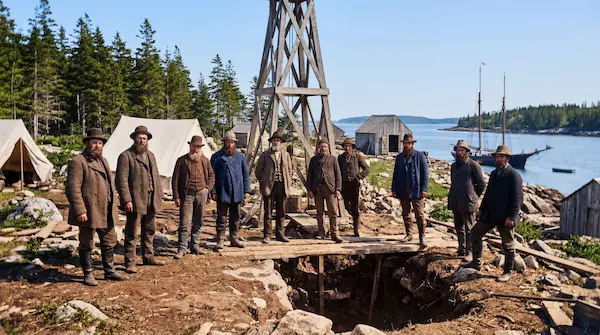 The Money Pit→
The Cave-in Pit and Other Precedents
1 min
The strongest single piece of evidence for natural subsidence on Oak Island appeared in 1878, more than eighty years after the Money Pit's discovery, when a farmer named Sophia Sellers was ploughing a field roughly 350 feet east of the Money Pit. Without warning, the ground collapsed beneath her oxen, opening a well-like hole that became known as the Cave-in Pit. Later investigation by the Oak Island Treasure Company suggested the pit sat directly above the path of the supposed flood tunnel from Smith's Cove, leading treasure hunters to interpret it as an air shaft used during construction of the tunnel system. But the Cave-in Pit also fits comfortably within a geological explanation: a separate karst collapse in the same belt of soluble bedrock that runs beneath the island's eastern end.
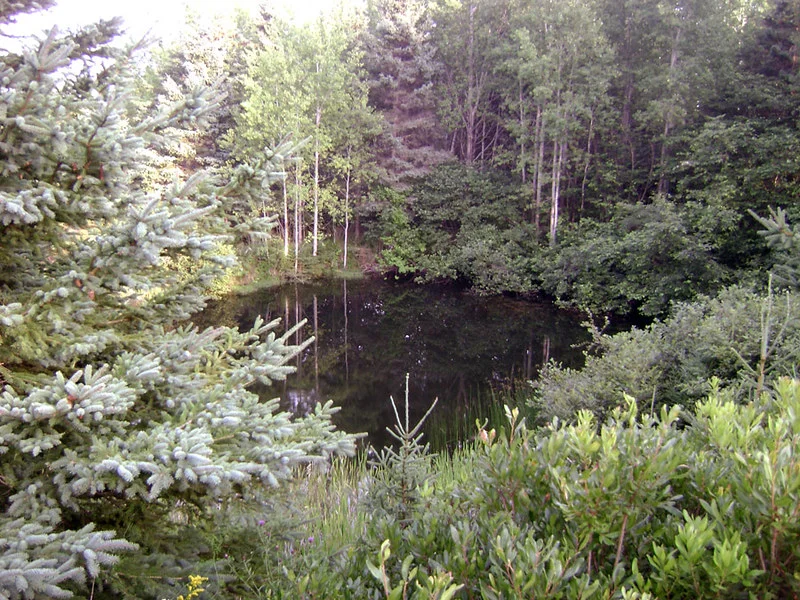 Cave-in Pit→
The phenomenon is not isolated. In 1875, during the construction of a sewage-disposal system on the mainland roughly 3,000 feet north of Oak Island, heavy excavating machinery broke through a rock layer and exposed a natural cavern 52 feet deep. In 1949, a natural pit was discovered on the shore of Mahone Bay, five miles south of Oak Island, when workers digging a well broke into a void below. The surrounding region offers numerous examples of karst-related subsidence in Windsor Group formations, suggesting that Oak Island's celebrated underground features may be part of a broader geological pattern rather than a unique feat of engineering.
The Scientific Studies
1 min
Three professional geological assessments form the backbone of the modern natural formation argument. In the late 1960s and early 1970s, consulting firms Warnock Hersey and Golder Associates conducted reports on the island's subsurface conditions. Both documented the presence of anhydrite and gypsum in the bedrock beneath the Money Pit area, materials highly susceptible to dissolution by groundwater.
The most significant study came in 1995, when the Woods Hole Oceanographic Institution, one of the world's premier marine research bodies, conducted a two-week survey of Oak Island at the invitation of businessman David Mugar. After running dye tests in boreholes, the Woods Hole team concluded that the flooding of the pit was caused by natural interaction between the island's freshwater lens and tidal pressures in the underlying geology, directly refuting the man-made flood tunnel hypothesis. The Woods Hole scientists also reviewed the murky underwater footage captured during a 1971 camera descent into Borehole 10-X and concluded that nothing definitive could be determined from the images.
In 2020, retired geologist Steven Aitken synthesized these earlier reports in a widely discussed analysis presented to CBC News. Drawing on decades of experience in the oil industry, Aitken argued that the geological evidence pointed unambiguously to a sinkhole. The limestone and gypsum beneath the Money Pit area are, in his words, "prone to dissolution" under the right conditions of temperature, pressure, and pore fluid composition, and the resulting cavity would produce exactly the kind of surface depression and underground void that treasure hunters have spent two centuries trying to explain through engineering. Aitken also noted the proximity of other sinkholes on and near the island, reinforcing the pattern of natural karst collapse. His conclusion was blunt: "There is no treasure at the money pit."
The Skeptic's Toolkit
1 min
The natural formation theory draws additional support from a broader skeptical tradition surrounding Oak Island. In a widely cited 2000 article for Skeptical Inquirer, investigator Joe Nickell argued that the Money Pit legend had grown through a process of gradual embellishment. Nickell noted that the earliest published accounts of the discovery did not appear until 1857, more than sixty years after the supposed events of 1795, and that subsequent retellings added increasingly dramatic details: the regularity of the log platforms, the inscribed stone at ninety feet, the sophistication of the flood tunnel system. He suggested that some details may have been exaggerated or fabricated by treasure-hunting syndicates seeking to attract investors, and that the log platforms and other supposedly engineered features could be naturally occurring debris accumulated in a sinkhole or geological fault.
Captain Henry L. Bowdoin, an engineer who conducted borings on the island in 1909 and 1911 (in an expedition partly financed by the young Franklin Roosevelt), reached a similar conclusion, stating publicly that the treasure was fictitious. His findings were largely dismissed at the time but anticipated the geological arguments that would be made a century later.
What Geology Cannot Explain
2 min
The natural formation theory is the most parsimonious explanation for the Money Pit itself, but it struggles with the broader body of evidence accumulated on Oak Island, particularly in recent seasons of the show. Geology can account for a depression in the ground, underground voids, and persistent flooding. It cannot easily account for coconut fibre, a material not native to Nova Scotia, found at depth in the pit and at Smith's Cove. It does not explain the hundreds of artifacts recovered across the island: coins dating from the 1600s and 1700s, hand-forged iron tools, lead crosses, garnet brooches, military buttons, pieces of bookbinding leather, human bone fragments carbon-dated to the medieval period, and wood samples with dates spanning several centuries. It does not address the construction features documented at Smith's Cove, including the box drains, the U-shaped structure, and the slipway, which show clear evidence of deliberate human construction regardless of whether they are connected to the Money Pit's flooding.
Nor does the theory account for the concentration of activity on the island. A single sinkhole on an uninhabited island in Mahone Bay would not, by itself, generate two centuries of investigation. Something drew people to Oak Island before 1795, and the archaeological record confirms that human activity on the island extends back centuries before Daniel McGinnis arrived. The question posed by the natural formation theory is not whether people were present on Oak Island, which the evidence now overwhelmingly confirms, but whether the specific feature called the Money Pit was their handiwork or simply a geological accident that inspired a legend.
It is worth noting that the two possibilities are not entirely exclusive. Oak Island's karst geology may well have created natural voids and depressions that earlier visitors discovered and exploited, using existing cavities as ready-made storage or burial sites rather than engineering an entire shaft from scratch. In that scenario, the geology and the human activity are not competing explanations but complementary ones, each necessary to account for part of what has been found on the island. The truth about the Money Pit may lie not in choosing between nature and design, but in understanding how one might have served the other.