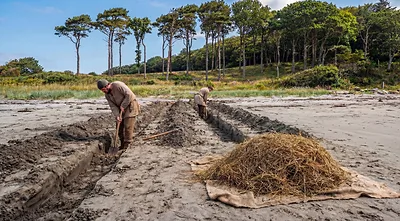
At the Oak Island swamp, Rick Lagina, Alex Lagina, Jack Begley, and Gary Drayton investigate the shallow northern end of a 200-foot ship-shaped anomaly identified earlier in the season by seismic scanning, buried at an angle from 15 feet at one end to 55 feet at the other. Jack spots a wooden stake similar to other ancient markers found in the swamp. Gary and Jack then uncover a hollow metal point with a fastener and wooden dowel embedded inside, found near a conical boulder. Paul Troutman, Dave Blankenship, and Billy Gerhardt dig the trench deeper but hit densely packed clay that is too hard for the excavator, forcing the team to pause. Marty Lagina, Alex, and Gary later take the metal object to blacksmithing expert Carmen Legge at the Ross Farm Museum in New Ross, Nova Scotia. Legge identifies it as an 18th-century pike pole tip, a docking tool used on shipping wharfs to guide sailing vessels, adding to the growing collection of nautical artifacts recovered from the swamp.
In the War Room, Oak Island theorist James McQuiston returns with expanded research linking the Knights Baronet of Nova Scotia to the Money Pit. Founded in 1625 by Sir William Alexander, a Scottish royal advisor to King James I, the order recruited clan chieftains who McQuiston connects backward to the Knights Templar. He argues that Alexander also led a secret Templar Masonic order and that subsequent Masonic leadership in Nova Scotia passed to the Maclean family, to whom Daniel McGinnis was closely connected through John Smith, whose mother was a Maclean. McQuiston proposes that McGinnis and Smith did not stumble upon the Money Pit by chance in 1795, but had prior knowledge of its existence through generations of Masonic tradition. From Traverse City, Michigan, Marty and Craig Tester call Vanessa Lucido of ROC Equipment to plan the largest excavation yet attempted at the Money Pit. Lucido confirms she can supply eight-foot diameter caissons with 220 feet of pipe and larger hammer-grabs, providing two and a half times more material recovery than the five-foot caissons used in previous seasons.
On Lot 21, Marty, historian Charles Barkhouse, surveyor Steve Guptill, and archaeologist Laird Niven begin a permitted near-surface archaeological excavation of the Daniel McGinnis house foundation, where GPR scanning earlier in the season detected anomalies including a strong hit at approximately four feet deep suggesting a possible sub-basement. Using three-foot test pit grids designed by Laird, the team begins methodically excavating for artifacts or features that might reveal whether McGinnis found something significant during his decades of searching.
In the Uplands near Smith's Cove, Jack, Gary, and Billy resume efforts to locate the main flood tunnel. They uncover massive amounts of wood, stacked timbers forming what appears to be a collapsed tunnel or shaft, with boards and beams running in the direction of the Money Pit. Jack discovers large clumps of coconut fiber among the wood, a material not indigenous to the Northern Hemisphere that was famously found covering the five stone box drains at Smith's Cove by the Truro Company in 1850. The excavation suddenly hits a gusher of water and reveals a deep hole with no apparent bottom, leading the team to believe they may have intercepted Shaft Five, the 1850 Truro Company shaft that encountered the flood tunnel at 35 feet after removing a large boulder. In the War Room, Dr. Ian Spooner confirms by phone to Rick, Marty, Doug Crowell, Steve Guptill, and Alex that the material is confirmed coconut fiber, representing original construction work and corroborating historical accounts of the booby-trapped flooding system.