
High in the hills above the Italian Riviera, a few miles from the French border and within sight of Monaco, sits the village of Seborga. It is a tiny place, home to around 320 people, perched on a hilltop surrounded by olive groves and flower farms. To the casual visitor it looks like any number of picturesque Ligurian hill towns. But Seborga has a story it tells about itself, one involving Knights Templar, sacred relics, and a secret so profound that a vow of silence was sworn to protect it. That story, as we will see, is largely a modern invention. What is not an invention are the 34 inscribed stones scattered across the hills surrounding the village, stones that mark the boundaries of what was once an independent territory. In August 2023, I hiked the trails around Seborga to document these stones. What I found carved into them stopped me in my tracks.
Seborga and Its Claims
2 min
To understand Seborga, you have to separate what is documented from what is claimed. What is documented is this: in 954 AD, Marquis Guido, Count of Ventimiglia, donated the territory known as Castrum Sepulchri and the church of San Michele di Ventimiglia to the Abbey of Saint-Honorat on the island of Lerins, off the coast of Cannes. From that point forward, the abbots of Lerins governed Seborga as a principality. In 1079, Pope Gregory VII authorized the abbots to claim the title of Prince-Abbot. The territory was small, remote, and largely left to its own devices for centuries. This much is in the historical record.
What is claimed is far more dramatic. According to a narrative promoted heavily within the village, the nine founding Knights Templar traveled from Jerusalem to Seborga in 1127, where Bernard of Clairvaux ordained Hugues de Payns as the first Grand Master of the Order. The Templars then allegedly managed the Principality from 1159 onward, using it as a repository for relics and treasures brought from the Holy Land, including items recovered from beneath the Temple Mount. Fifteen of the twenty-three Templar Grand Masters were supposedly also Princes of Seborga. The village was, in this telling, the secret heart of the Templar world.
 The Knights Templar on Oak Island→
It is a compelling story. It is also, according to the available evidence, not true. Elena Bellomo, an expert on Templar orders in northwest Italy at Cardiff University, has stated plainly that there is "no medieval evidence that there were Templars in the area of Seborga." The Templar narrative was largely constructed in the 1960s by Giorgio Carbone, a local floriculturist who proclaimed himself Prince of Seborga in 1963 and built the village's identity around Occitan and Cathar-Templar traditions that have no documented connection to the place. The Order of the Temple was founded in Jerusalem in 1118, not in Seborga, and Bernard of Clairvaux's involvement with the Templars is well documented through the Council of Troyes in 1129, not through any ceremony on a Ligurian hilltop. Today Seborga operates as a self-declared micronation, complete with its own currency, elected princess, and competing chivalric orders, none of which are recognized by the Catholic Church or the Italian state.
None of this should be taken as a dismissal of Seborga's genuine historical interest. The Lerins Abbey connection is real and documented. The territory's status as a semi-independent ecclesiastical principality is real. The name Castrum Sepulchri, meaning "Castle of the Sepulchre," is attested in medieval documents and raises legitimate questions about what was kept there and why it bore that name. But the specific Templar claims that have made Seborga famous, and that connect it to Oak Island through Zena Halpern's Cremona Document, rest on a foundation that academic historians do not accept.
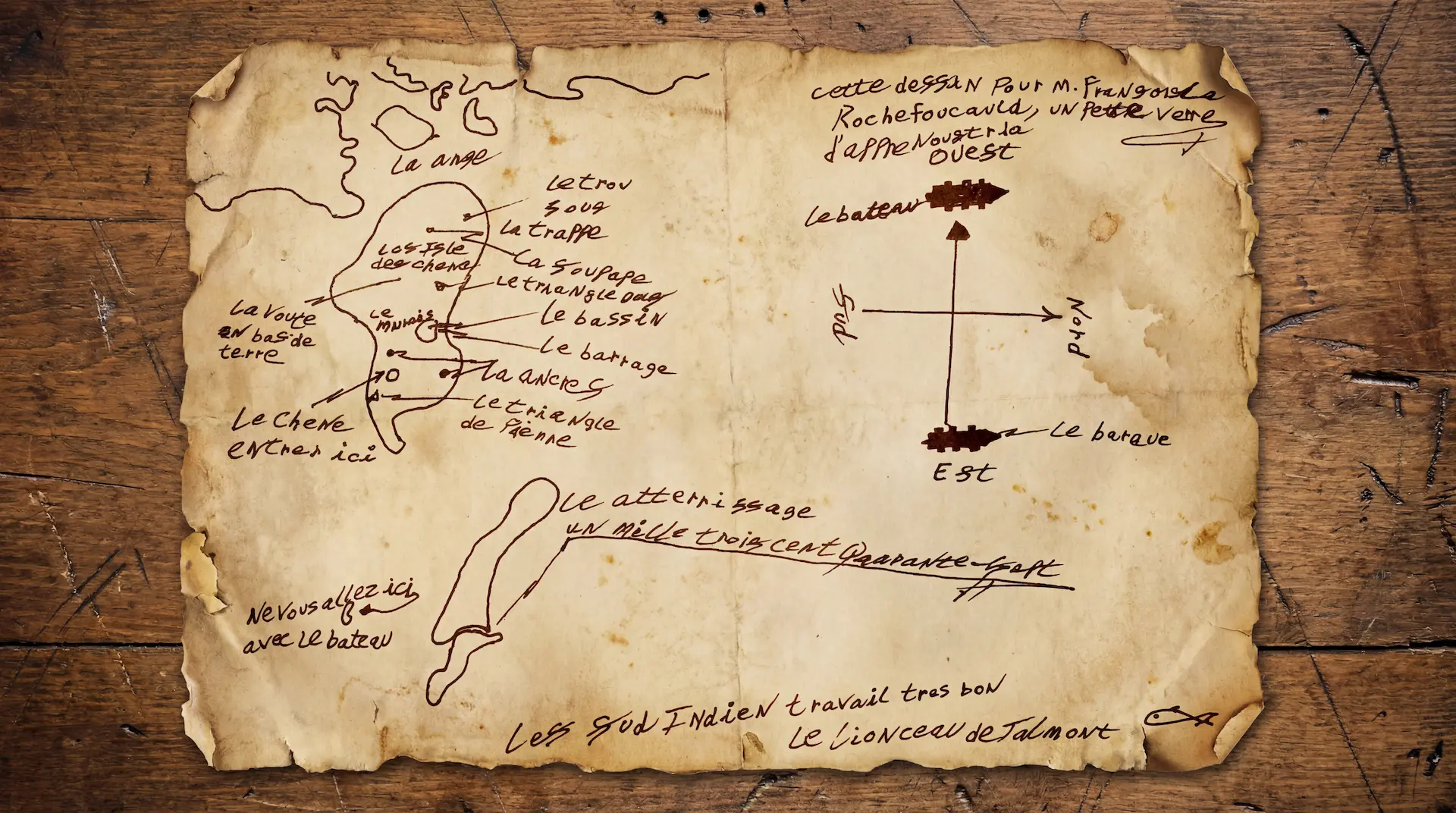 Zena Halpern's Templar Map→
The Boundary Stones
1 min
What is unquestionably real, and what no one disputes, are the stones. Thirty-four inscribed boundary stones surround the territory of Seborga, marking the limits of the former Principality. They are carved into boulders and rock faces along the ridgelines and footpaths in the hills above the village, reachable by hikes ranging from ten minutes to over an hour from the town square. Some are easily visible from the trail. Others require local knowledge to find.
Local historian Stefano Albertieri has studied these stones extensively and dates them to the 12th through 15th centuries, with most likely carved in the 14th century. The numbers visible on some of the stones were probably added later, possibly after the Congress of Vienna in 1817 when European borders were being redrawn. The stones themselves, however, are medieval. They served a practical purpose: marking where the jurisdiction of the Prince-Abbot of Seborga ended and the territory of neighboring communities such as Coldirodi, Ospedaletti, and Vallebona began.
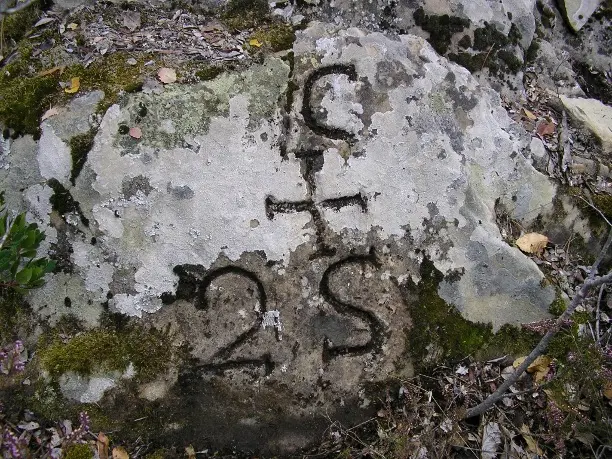
These are not decorative objects. They are administrative markers, carved by people who needed other people to know where one authority stopped and another started. That is what makes them interesting. The symbols and letterforms carved into them were not chosen for artistic effect. They were chosen to communicate, using the visual language of the institution that governed the territory.
The H+O Stone Connection
1 min
The H+O stone is one of Oak Island's most enigmatic artifacts. It is a fragment salvaged by Gilbert Hedden in 1936 from a large inscribed boulder on the island's northern shore that earlier searchers had dynamited in 1921. The surviving piece bears the letters H and O, or possibly H and a cross, carved in a distinctive serif style. Its meaning has been debated for nearly a century.
One of the Seborga boundary stones immediately caught my attention. Located on the path marking the territorial limit between Seborga and Coldirodi, it bears a carved cross that functions as a boundary marker: the "+" symbol indicating the dividing line between jurisdictions. The typography of the carving is what matters here. The style of the serifs, the weight of the strokes, and the proportions of the letterforms are strikingly similar to what we see on the H+O stone fragment from Oak Island. This is not a vague resemblance. The carving technique and letter style are close enough to suggest a shared tradition.
The Seborga stone does not have the four dots that appear on the H+O stone, and the inscription is simpler. But the question it raises is direct: if the institution that governed Seborga marked its territorial boundaries using this typographic style, and a stone with the same typographic style was found on Oak Island, does that suggest a connection between the two places? Or, more precisely, does it suggest that the people who carved boundary markers in one place also carved them in the other?
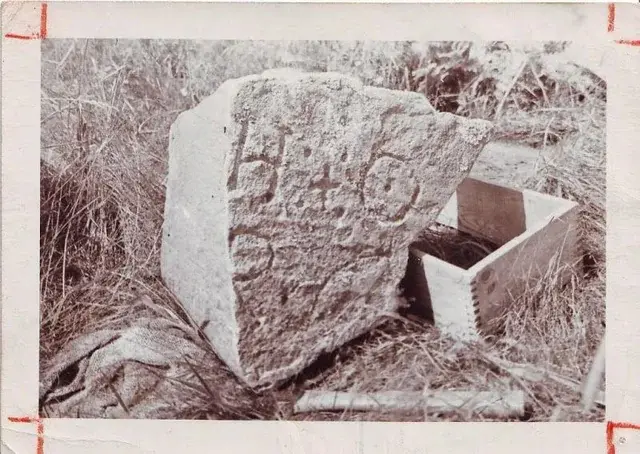 H+O stone→
The "8-Stone" and the Lead Cross
1 min
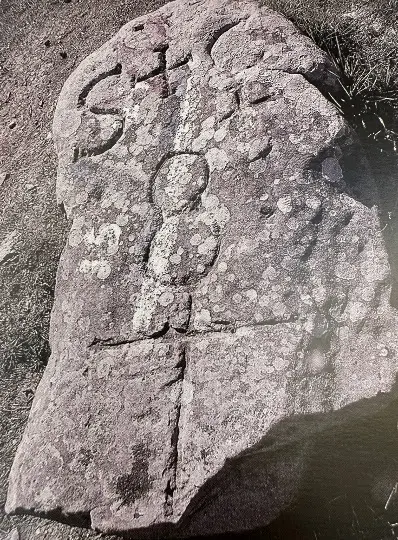
Another stone in the Seborga boundary system is known locally as the "8-stone" because its inscription appears at first glance to depict the number 8. On closer inspection, the carving is not an 8 at all. It consists of two circles that touch in the middle, one above the other, with an uneven-armed cross carved below them.
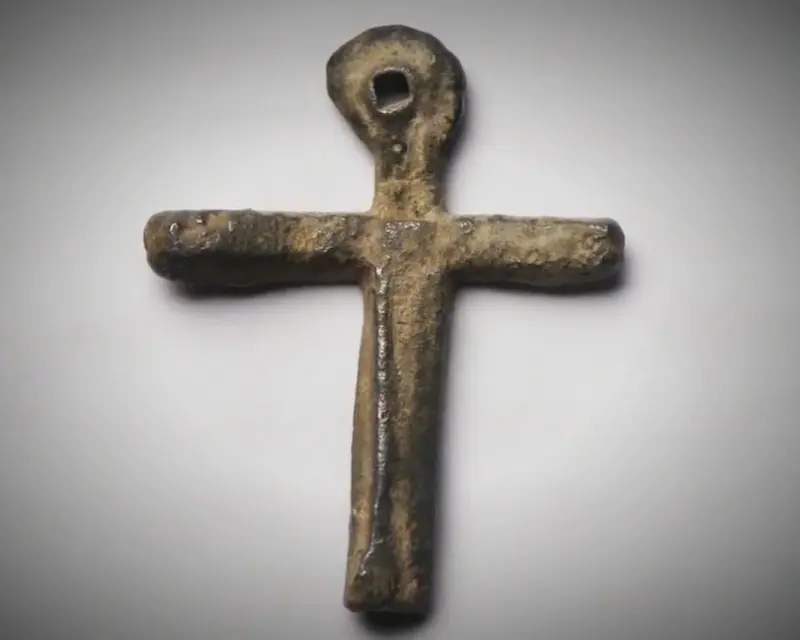
If you isolate the bottom circle and the cross beneath it, the combined symbol bears a remarkable resemblance to the lead cross found at Smith's Cove on Oak Island in 2017. The lead cross, which has been dated through metallurgical analysis to between the 13th and 17th centuries, features an uneven-armed cross with what some researchers have interpreted as a human figure and others as a representation of the Phoenician goddess Tanit. The proportions of the Seborga carving, the unevenness of the arms, and the relationship between the circular element and the cross below it mirror what we see in the Oak Island artifact.
A similar inscription has been documented at the Templar prison in Chinon, France, where Knights Templar were held after the arrests of 1307. The Chinon carvings were made by imprisoned Templars and represent some of the most direct physical evidence we have of Templar symbolic language. The presence of a comparable symbol on a boundary stone in Seborga, a territory governed by the Lerins Abbey during the same period, is at minimum a coincidence worth examining.
The top circle on the "8-stone" may have been added later, possibly to convert the original symbol into a number when the stones were catalogued. This would be consistent with Albertieri's observation that the numbering system on the boundary stones postdates the original carvings.
 Lead cross→
Assessment
1 min
The Templar claims that surround Seborga are not substantiated by medieval sources, and the village's modern identity as a Templar stronghold was largely constructed in the second half of the 20th century. This article makes no argument based on those claims. The Cremona Document that routes Templar relics through Castrum Sepulchri is, as detailed in our article on Zena Halpern, a modern forgery.
But the boundary stones are not forgeries. They are in the ground, they have been there for centuries, and they are independently dated to the 12th through 15th centuries by a local historian with no connection to Oak Island or its theories. What I documented in August 2023 are typographic and symbolic parallels between these stones and two of the most discussed artifacts found on Oak Island: the H+O stone and the lead cross.
The connection does not require the Templar narrative that Seborga promotes about itself. It requires only what is documented: that Seborga was governed for centuries by the Abbey of Lerins, that the Cistercians were closely affiliated with the Knights Templar through their shared founder Bernard of Clairvaux, and that the boundary stones were carved during a period when both orders were active across the Mediterranean and beyond. If the people who marked territorial boundaries in Seborga used a typographic tradition that also appears on Oak Island, the question is not whether Seborga was a Templar state. The question is whether the tradition traveled, and if so, who carried it.
The stones do not answer that question. But they ask it in a way that no forged document can: silently, in carved rock, exactly where they have been for seven hundred years.