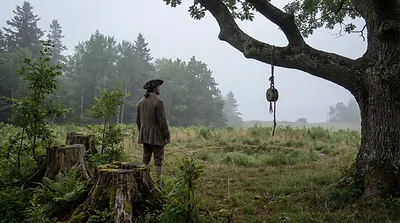
Ross Farm Museum has served as an off-island research hub across multiple seasons, with team members regularly traveling the roughly 20 miles from Oak Island to consult Carmen Legge on newly recovered artifacts. In Season 7 alone, the museum featured in at least five episodes. Alex Lagina and Gary Drayton brought a decking spike recovered from the…
Living history agricultural museum in New Ross, Nova Scotia, roughly 20 miles north of Oak Island. Home to blacksmithing expert Carmen Legge, who has examined hundreds of metallic artifacts recovered from the island across multiple seasons.
About This Site
Ross Farm Museum is a living history site in New Ross, Nova Scotia, operated as a heritage agricultural museum depicting rural life in 19th-century Nova Scotia. The museum preserves traditional trades including blacksmithing, coopering, and woodworking, and maintains heritage breeds of livestock on a working farmstead. Among its staff is blacksmithing expert Carmen Legge, whose deep knowledge of historical metalworking techniques, forge construction, tool marks, and period-specific hardware has made the museum one of the most frequently visited research locations in the Oak Island investigation. Carmen's ability to identify the age, origin, and function of iron, steel, copper, and lead artifacts from visual inspection alone, drawing on decades of hands-on experience with historical metalwork, has provided critical first-pass dating for objects recovered from across the island.
Connection to Oak Island
Ross Farm Museum has served as an off-island research hub across multiple seasons, with team members regularly traveling the roughly 20 miles from Oak Island to consult Carmen Legge on newly recovered artifacts. In Season 7 alone, the museum featured in at least five episodes. Alex Lagina and Gary Drayton brought a decking spike recovered from the beach at Lot 32, which Carmen confirmed was consistent with 1700s ship construction hardware (S07E06). Marty Lagina, Alex, and Gary returned with a swamp iron strap and two digging tools found near the Eye of the Swamp; Carmen identified the strap as a brace from a nine-inch-diameter ship's timber dating to 1710 to 1790, noting clear evidence it had been burned in a fierce fire, and one of the tools as a hand-forged pickax dating to the mid-18th century and suitable for tunneling (S07E14). The team visited again with a hollow metal point recovered from the swamp near a conical boulder, which Carmen identified as an 18th-century pike pole tip, a docking tool used on shipping wharfs to guide sailing vessels (S07E15).
Later in the season, Alex and Craig Tester brought Carmen an iron tool and a pickax recovered from roughly 120 feet deep in the Money Pit shaft RF-1. Carmen identified the iron piece as a possible lantern or pulley anchor consistent with original construction, and dated the pickax to potentially three centuries before 1795, placing it in the 1500s or earlier (S07E22). Carmen's identifications have repeatedly extended the known timeline of activity on Oak Island and have been instrumental in connecting surface finds to the deeper archaeological narrative.
Fieldwork Notes
Visited repeatedly across Seasons 6 through 13. Carmen Legge examines artifacts at his blacksmithing workshop on the museum grounds, assessing construction methods, tool marks, forge characteristics, and period-appropriate metallurgy. Items are typically brought by two or three team members shortly after recovery. Carmen's assessments serve as preliminary expert identifications before artifacts are sent for formal laboratory testing or conservation. His conclusions regarding age, function, and cultural origin frequently shape the direction of further investigation.